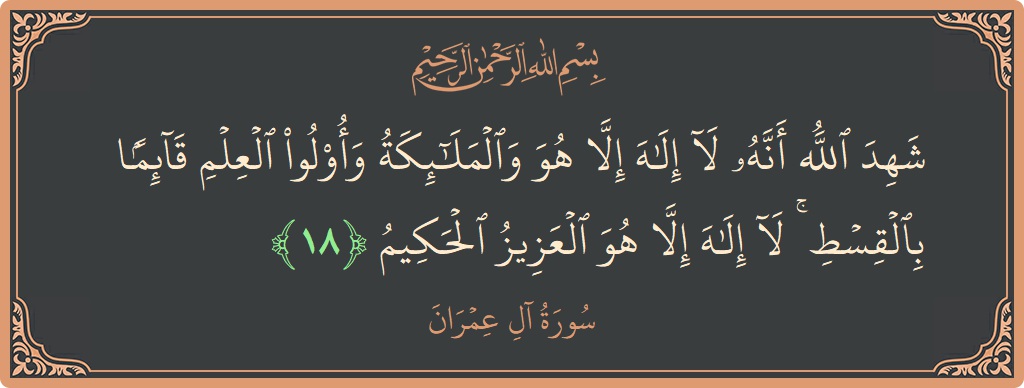
Surah Aal-i-Imraan: Verse 18 - شهد الله أنه لا إله... - English
Tafsir of Verse 18, Surah Aal-i-Imraan
English Translation
Allah witnesses that there is no deity except Him, and [so do] the angels and those of knowledge - [that He is] maintaining [creation] in justice. There is no deity except Him, the Exalted in Might, the Wise.English Transliteration
Shahida Allahu annahu la ilaha illa huwa waalmalaikatu waoloo alAAilmi qaiman bialqisti la ilaha illa huwa alAAazeezu alhakeemuTafsir of Verse 18
The subject of توحید Tauhid (Oneness of Allah) which began with the opening of Surah 'Al-` Imran reappears in the first verse in a very special manner. Out of the three witnesses mentioned here, the evidence of Allah Almighty is in a figurative sense. It means that the being and the attributes of Allah and the manifestations of His power and creativity all over are open signs of His Oneness. Then there are the Messengers and Books sent by Allah, all confirming. that truth. The second testimony mentioned is that of angels who are close to Allah. They carry out His instructions and bear testimony (knowing and seeing) that Allah alone is worthy of worship.
The third witness is that of the men of knowledge. This expression, ulul` ilm, means the blessed prophets and men who have the knowledge of Islam. Imam al-Ghazali and Ibn Kathir رحمۃ اللہ علیہم find this a matter of great honour for ` Ulama for Allah has mentioned their witness along with His, and that of angels. It is also possible that the term, ulul` ilm (the men of knowledge) may, in an absolute sense, be referring to those who, by conducting an inquiry based on sound intellectual principles, or by deliberating into this universe, could acquire the knowl-edge of the unity of Allah Almighty - even if they are not ` alim or 'men of knowledge' in the traditional sense, whose knowledge is acquired under a formal discipline from Islam's own original sources. The next verse (19) clearly settles that the only faith' (دین din) acceptable to Allah is Islam. Thus, totally excluding any other faith or religion as acceptable to Allah, the verse completes the subject of Allah's Oneness, any opposition to which is doomed.
Related considerations
Merits of the verse meaning "Allah bears witness"
The verse beginning with شَهِدَ اللَّـهُ : 'shahidal-lahhu' has a special elegance. Imam al-Baghawi (رح) ، the renowned mufassir reports that two leading Jewish scholars came to Madinah from Syria. With the township of Madinah before them, they started talking to each other about the looks of the place which matched the prophecy in Torah that the last of the prophets would be living here. Later, they came to know that someone very pious lives here and whom people refer to as the prophet. They went to see the Holy Prophet ﷺ sight of him reminded them of all attributes which Torah had predicted he would have. They presented themselves before him and said: "You are Muhammad?" He said: "Yes." Again, they said: "You are Ahmad?" He said: "Yes, I am Muhammad and Ahmad." Then they said: We are going to ask you a question. If you answer it correctly, we shall embrace Islam." He ﷺ said: "Go ahead and ask." They asked: "Which is the greatest witness in the Book of Allah?" This verse of شَهِدَہ 'shahadah' (witness) was revealed as an answer to this question. He recited it for them. Both of them embraced Islam immediately.
According to a hadith in the Musnad of Ahmad, when the Holy Prophet ﷺ recited this verse in ` Arafat, he said right after that:
و انا علیٰ ذلک من الشٰھدین یا رَبِّ
And to that, 0 my Lord, I too am a witness. (Ibn Kathir)
And a narration from Imam al-A'mash (رح) says: Whoever recites this verse and then says: و انا علیٰ ذلک من الشٰھدین یا رَبِّ ; (And to that, 0 my Lord, I too am a witness), Allah Almighty will say to the angels on the Last Day: 'My servant has made a promise while I am the Foremost to keep a promise when I make it, so let my servant be admitted into Paradise.' (Ibn Kathir)
Another hadith from Sayyidna Abu Ayyub al-Ansari ؓ narrates that the Holy Prophet ﷺ said: 'Whoever recites Ayah al-Kursi (2:255) and the Ayah : شَهِدَ اللَّـهُ Shahidal-lahu (3:18) and قُلِ اللَّـهُمَّ مَالِكَ الْمُلْكِ : Qulil-lahumma malik al-mulki upto بِغَيْرِ حِسَابٍ bighairi hisab (3:26, 27), Allah Almighty will forgive all his sins, admit him to Paradise and take care of seventy (i.e. plenty) of his needs, the simplest of these being his forgiveness.' (Ruh a1-Ma` ani with reference to Dailami)
The Testimony of Tawhid
Allah bears witness, and verily, Allah is sufficient as a Witness, and He is the Most Truthful and Just Witness there is; His statement is the absolute truth,
(that La ilaha illa Huwa) meaning, He Alone is the Lord and God of all creation; everyone and everything are His servants, creation and in need of Him. Allah is the Most Rich, Free from needing anyone or anything. Allah said in another Ayah,
(But Allah bears witness to that which He has sent down (the Qur'an) unto you (O Muhammad )) 4:166.
Allah then mentioned the testimony of His angels and those who have knowledge after he mentioned His own testimony,
(Allah bears witness that none has the right to be worshipped but He), and the angels, and those having knowledge (also bear witness to this)). This Ayah emphasizes the great virtue of those who have knowledge.
((He) maintains His creation in justice) in all that He does,
(None has the right to be worshipped but He) thus emphasizing this fact,
(the Almighty, the All-Wise.) the Mighty that does not submit to weakness due to His might and greatness, the Wise in all His statements, actions, legislation and decrees.
The Religion with Allah is Islam
Allah said,
(Truly, the religion with Allah is Islam.) Allah states that there is no religion accepted with Him from any person, except Islam. Islam includes obeying all of the Messengers until Muhammad who finalized their commission, thus closing all paths to Allah except through Muhammad . Therefore, after Allah sent Muhammad , whoever meets Allah following a path other than Muhammad's, it will not be accepted of him. In another Ayah, Allah said,
(And whoever seeks a religion other than Islam, it will never be accepted of him) 3:85.
In this Ayah 3:19, Allah said, asserting that the only religion accepted with Him is Islam,
(Truly, the religion with Allah is Islam.)
Allah then states that those who were given the Scripture beforehand divided in the religion after Allah sent the Messengers and revealed the Books to them providing them the necessary proofs to not do so. Allah said,
(Those who were given the Scripture (Jews and Christians) did not differ except out of rivalry, after knowledge had come to them.) meaning, some of them wronged others. Therefore, they differed over the truth, out of envy, hatred and enmity for each other. This hatred made some of them defy those whom they hated even if they were correct. Allah then said,
(And whoever disbelieves in the Ayat of Allah) meaning, whoever rejects what Allah sent down in His Book,
(then surely, Allah is Swift in reckoning.) Allah will punish him for his rejection, reckon him for his denial, and torment him for defying His Book. Thereafter, Allah said.
(So if they dispute with you (Muhammad )) so if they argue with you about Tawhid,
(Say: "I have submitted myself to Allah (in Islam), and (so have) those who follow me") meaning, Say, `I have made my worship sincere for Allah Alone without partners, rivals, offspring or companion,
(and those who follow me) who followed my religion and embraced my creed.' In another Ayah, Allah said,
(Say (O Muhammad ): "This is my way; I invite unto Allah with sure knowledge, I and whosoever follows me...") 12:108.
Islam is the Religion of Mankind and the Prophet Was Sent to all Mankind
Allah commanded His servant and Messenger, Muhammad , to call the People of the Two Scriptures and the unlettered idolators to his religion, way, Law and all that Allah sent him with. Allah said,
(And say to those who were given the Scripture (Jews and Christians) and to those who are illiterates (Arab pagans): "Do you (also) submit yourselves" If they do, they are rightly guided; but if they turn away, your duty is only to convey the Message.) meaning, their reckoning is with Allah and their return and final destination is to Him. It is He Who guides whom He wills and allows whom He wills to stray, and He has the perfect wisdom and the unequivocal proof for all of this. This is why Allah said,
(And Allah sees the servants.) for He has perfect knowledge of who deserves to be guided and who does not deserve to be guided. Verily,
(He cannot be questioned for what He does, while they will be questioned.) 21:23 because of His perfect wisdom and mercy. This and similar Ayat are clear proofs that the Message of Muhammad is universal to all creation, as it is well established in the religion, according to the various texts of the Book and Sunnah. For instance, Allah said,
(Say (O Muhammad ): "O mankind! Verily, I am sent to you all as the Messenger of Allah.") 7:158, and,
(Blessed be He Who sent down the criterion to His servant that he may be a warner to the `Alamin (mankind and Jinn).) 25:1.
The Two Sahihs and other collections of Hadith recorded that the Prophet sent letters to the kings of the earth during his time and to different peoples, Arabs and non-Arabs, People of the Book and the unlettered, just as Allah had commanded him. `Abdur-Razzaq recorded that Ma`mar said, that Hammam said that Abu Hurayrah said that the Prophet said,
(By He in Whose Hand is my soul! No member of this Ummah, no Jew or Christian, hears of me but dies without believing in what I was sent with, but will be among the people of the Fire.) Muslim recorded this Hadith.
The Prophet said,
(I was sent to the red and black. ) and,
(A Prophet used to be sent to his people, but I was sent to all mankind.)