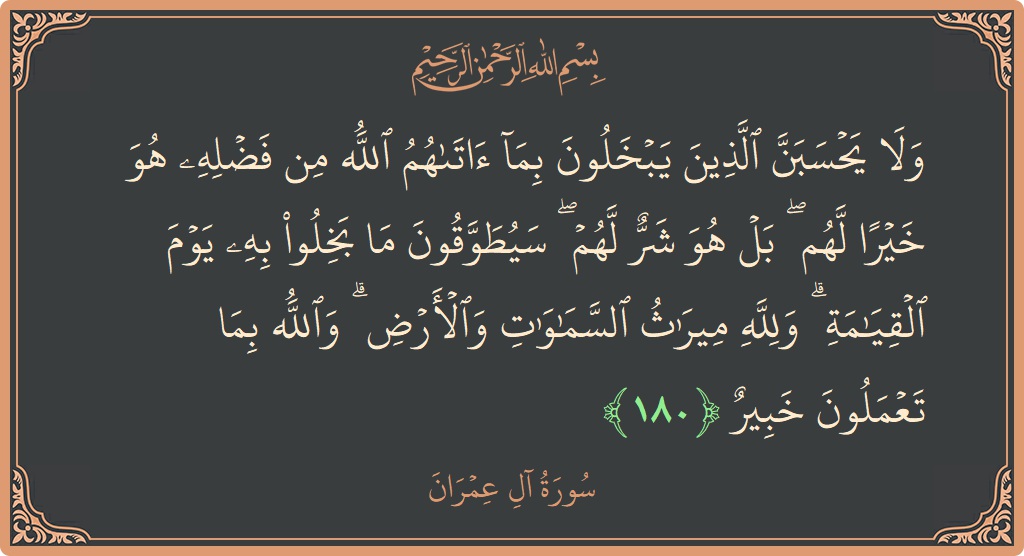
Surah Aal-i-Imraan: Verse 180 - ولا يحسبن الذين يبخلون بما... - English
Tafsir of Verse 180, Surah Aal-i-Imraan
English Translation
And let not those who [greedily] withhold what Allah has given them of His bounty ever think that it is better for them. Rather, it is worse for them. Their necks will be encircled by what they withheld on the Day of Resurrection. And to Allah belongs the heritage of the heavens and the earth. And Allah, with what you do, is [fully] Acquainted.English Transliteration
Wala yahsabanna allatheena yabkhaloona bima atahummu Allahu min fadlihi huwa khayran lahum bal huwa sharrun lahum sayutawwaqoona ma bakhiloo bihi yawma alqiyamati walillahi meerathu alssamawati waalardi waAllahu bima taAAmaloona khabeerunTafsir of Verse 180
Anomalies in the conduct of Jews were mentioned at the beginning of Surah 'Al-` Imran (21-25). The text now reverts back to the same subject. The verses cited above carry related topics. In between, there are words of comfort for the Holy Prophet ﷺ as well as those giving good counsel to Muslims.
Commentary
The first (180) of the seven verses (180-186) appearing here repudiates miserliness and carries a warning for those who practice it.
The Definition of Miserliness and the punishment it brings
In the terminology of the Shari` ah of Islam, miserliness (بُخل Bukhl) refers to the act of not spending that which it is obligatory to spend in the way of Allah. Therefore, miserliness is forbidden (haram). Besides, it carries a stern warning of Hell for its practitioners. As for occasions where spending is not obligatory (wajib) but only recommended (mustahabb), then not spending there is not included under the miserliness which is forbidden. However, this too is called miserliness in its general sense. As said earlier, this kind of miserliness is not forbidden (haram) but against the preferred choice (khilaf aula) it certainly is.
Appearing in Hadith, there is another word - شُّحَّ Shuhh - also used in the sense of بُخل Bukhl or miserliness. By definition, it means not spending what it was obligatory to spend - one may go even farther than that by remaining consumed with greed to increase one's wealth. This then, shall be a crime much more severe than ordinary miserliness. Therefore, the Holy Prophet ﷺ said:
لا یَجتمِعُ شُحُّ و ایمانُ فی قَلبِ رَجُلِ مُسلِم ابَدا
That is, miserliness (Shuhh) and faith (Iman) can never coexist in the heart of a Muslim. (Qurtubi)
The punishment for miserliness بُخُل (Bukhl) mentioned in this verse: 'They shall be forced, on the Doomsday, to put on round their necks the shackles of what they were miserly with' has been explained by the Holy Prophet ﷺ in the following words reported by Sayyidna Abu Hurairah ؓ
'Anyone Allah blessed with some wealth and who did not pay the zakah due on it properly will find his or her wealth turn into a deadly snake shackled round the neck chomping at the person's mouth from one to the other end of the lips and saying: 'I am your wealth. I am your capital gain.' Thereafter, the Holy Prophet ﷺ recited this verse (180). (Al-Nas'i, from Tafsir al-Qurtubi)