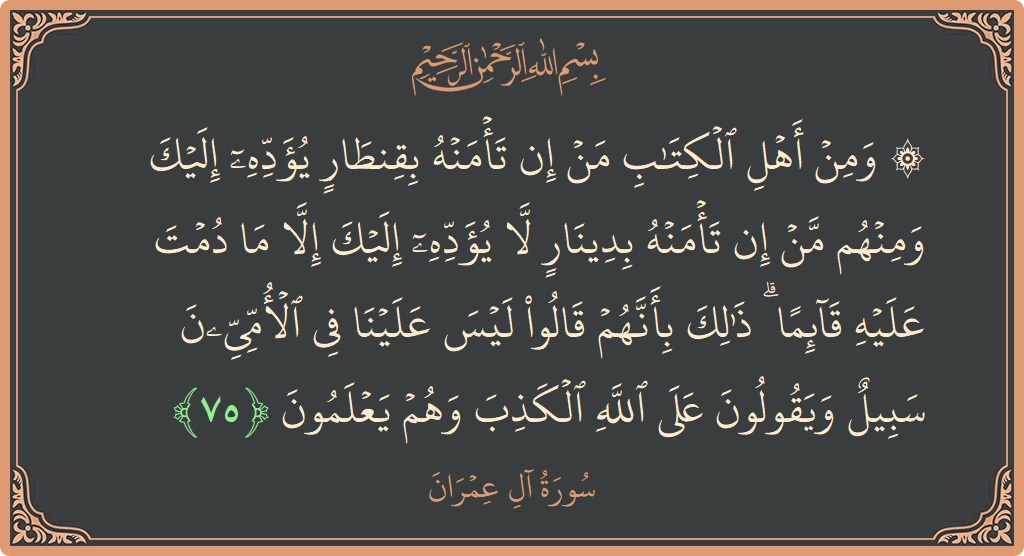
Surah Aal-i-Imraan: Verse 75 - ۞ ومن أهل الكتاب من... - English
Tafsir of Verse 75, Surah Aal-i-Imraan
English Translation
And among the People of the Scripture is he who, if you entrust him with a great amount [of wealth], he will return it to you. And among them is he who, if you entrust him with a [single] silver coin, he will not return it to you unless you are constantly standing over him [demanding it]. That is because they say, "There is no blame upon us concerning the unlearned." And they speak untruth about Allah while they know [it].English Transliteration
Wamin ahli alkitabi man in tamanhu biqintarin yuaddihi ilayka waminhum man in tamanhu bideenarin la yuaddihi ilayka illa ma dumta AAalayhi qaiman thalika biannahum qaloo laysa AAalayna fee alommiyyeena sabeelun wayaqooloona AAala Allahi alkathiba wahum yaAAlamoonaTafsir of Verse 75
Sequence
In the previous verses (70-72), breach of faith committed by the people of the Book was mentioned. This included disbelieving in the verses of Allah, confusing the truth with what is false, concealing the truth and conspiring to mislead Muslim believers.
In the verse cited above (75), their breach of trust in matters of property has been mentioned. Since some of them happened to be trustworthy, both types were identified.
Commentary
Praising good qualities in some non-Muslim is correct
In this verse (75), some people have been praised for their trustworthiness. If this 'some' refers to those among the people of the Book who had embraced Islam, praising them poses no problems. But, in case, it does not refer to Muslims particularly and instead, refers to the people of the Book in the absolute sense including non-Muslims as well, then the situation generates the question: When no act of a kafir (disbeliever) is acceptable why praise them?
The answer is that for an action or deed to become acceptable is a different matter and having a word of praise for it is something else. From praising something it does not follow that it is acceptable with Allah. The purpose is to point out that something good, even if it be that of a kafir (disbeliever), is good enough in a certain degree, the benefit of which he receives in the form of good reputation in the mortal world, and of course, in the Hereafter, in the form of a reduction in punishment for his disbelief.
This statement also makes it, clear that Islam does not resort to prejudice and short-sightedness. On the contrary, it shows open-hearted appreciation of the excellence of even its adversary in respect
of his achievements.
It is from this verse: إِلَّا مَا دُمْتَ عَلَيْهِ قَائِمًا (unless you keep standing over him - 75) that Imam Abu Hanifah (رح) has deduced the ruling that the lender has the right to keep pursuing the borrower until he receives his due. (Qurtubi)
How Trustworthy Are the Jews
Allah states that there are deceitful people among the Jews. He also warns the faithful against being deceived by them, because some of them,
(if entrusted with a Qintar (a great amount)) of money,
(will readily pay it back;) This Ayah indicates that this type would likewise give what is less than a Qintar, as is obvious. However,
(and among them there is he who, if entrusted with a single silver coin, will not repay it unless you constantly stand demanding,) and insisting on acquiring your rightful property. If this is what he would do with one Dinar, then what about what is more than a Dinar We mentioned the meaning of Qintar in the beginning of this Surah, while the value of Dinar is well known. Allah's statement,
(because they say: "There is no blame on us to betray and take the properties of the illiterates (Arabs).") means, what made them reject the truth (or what they owed) is that they said, "There is no harm in our religion if we eat up the property of the unlettered ones, the Arabs, for Allah has allowed it for us." Allah replied,
(But they tell a lie against Allah while they know it.) for they invented this lie and word of misguidance. Rather, Allah would not allow this money for them unless they had a right to it.
`Abdur-Razzaq recorded that Sa`sa`ah bin Yazid said that a man asked Ibn `Abbas, "During battle, we capture some property belonging to Ahl Adh-Dhimmah, such as chickens and sheep." Ibn `Abbas said, "What do you do in this case" The man said, "We say that there is no sin (if we confiscate them) in this case." He said, "That is what the People of the Book said,
(There is no blame on us to betray and take the properties of the illiterates (Arabs).)
Verily, if they pay the Jizyah, then you are not allowed their property, except when they willingly give it up."
Allah then said,
(Yes, whoever fulfills his pledge and fears Allah much,) fulfills his promise and fears Allah among you, O People of the Book, regarding the covenant Allah took from you to believe in Muhammad when he is sent, just as He took the same covenant from all Prophets and their nations. Whoever avoids Allah's prohibitions, obeys Him and adheres to the Shari`ah that He sent with His Final Messenger and the master of all mankind.
(verily, then Allah loves the Muttaqin.)