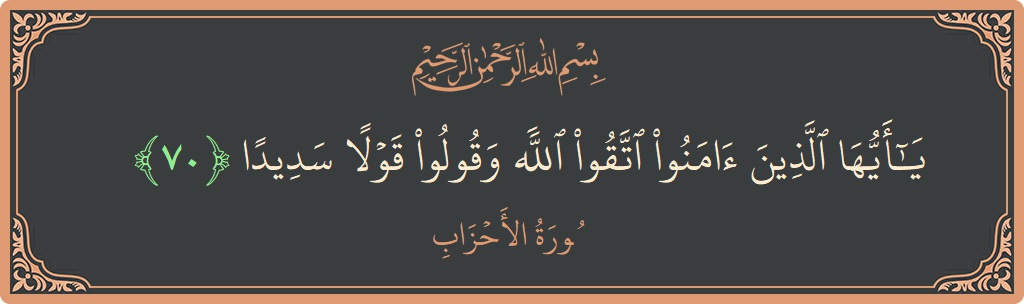
Surah Al-Ahzaab: Verse 70 - يا أيها الذين آمنوا اتقوا... - English
Tafsir of Verse 70, Surah Al-Ahzaab
English Translation
O you who have believed, fear Allah and speak words of appropriate justice.English Transliteration
Ya ayyuha allatheena amanoo ittaqoo Allaha waqooloo qawlan sadeedanTafsir of Verse 70
Customarily, Allah Ta'ala keeps prophets free from physical defects causing aversion
In this event, Allah Ta'ala has demonstrated such unusual concern to have Sayyidna Musa (علیہ السلام) absolved of the blame imputed to him by his people which took no less than a miracle whereby a rock ran away with Sayyidna Musa's clothes and he, compelled by circumstances beyond his control, came out undressed before the people. This extra-ordinary care shown by Allah Ta’ ala to free his prophet from this blame points out to the fact that Allah Ta'ala keeps even the bodies of His prophets generally free and pure from defects that appear repulsive and undignified - as it stands proved from the Hadith of Bukhari that all prophets are lineally high-born. The reason is that it would be hard to agree to listen to, accept and follow someone from the line and family regarded by people as customarily low. Similarly, the history of prophets does not bear out that any prophet was blind, deaf, dumb or handicapped. As for the case of Sayyidna Ayyub (علیہ السلام) it cannot be used to raise any objection, for what happened to him was the dictate of Divine wisdom, a particular trial, a temporary discomfort which was eliminated later on. Allah knows best.
يَا أَيُّهَا الَّذِينَ آمَنُوا اتَّقُوا اللَّـهَ وَقُولُوا قَوْلًا سَدِيدًا ﴿70﴾ يُصْلِحْ لَكُمْ أَعْمَالَكُمْ وَيَغْفِرْ لَكُمْ ذُنُوبَكُمْ
O those who believe, fear Allah, and speak what is straight forward. Allah will correct your deeds for your benefit, and forgive for you your sins. (33:70-71)
The original word used in the text for "what is straight forward" is 'sadid' which has been explained by some exegetes as what is the truth. Others explain it as straight, while still others, as correct. Quoting all of these, Ibn Kathir calls all these true (on the beam hitting the target). The Holy Qur'an has chosen this word, instead of sadiq or mustaqim, because the present word holds all these attributes of ideal speech within itself. It was for this reason that Kashifi said in Ruh-ul-Bayan: Qawl Sadid is the saying of what is true having no trace of falsity; correct having no trace of error, right thing being no joke or fun; spoken softly, not harshly.
The Command to the Believers to have Taqwa and speak the Truth
Here Allah commands His servants to have Taqwa of Him, worshipping Him as if they can see Him, and to
(speak (always) the truth.) meaning, to speak in a straightforward manner, with no crookedness or distortion. He promises them that if they do that, He will reward them by making their deeds righteous, i.e., enabling them to do righteous deeds, and He will forgive them their past sins. With regard to whatever sins they may commit in the future, He will inspire them to repent from them. Then He says:
(And whosoever obeys Allah and His Messenger, he has indeed achieved a great victory.) meaning, he will be saved from the fire of Hell and will enjoy everlasting delights (in Paradise).