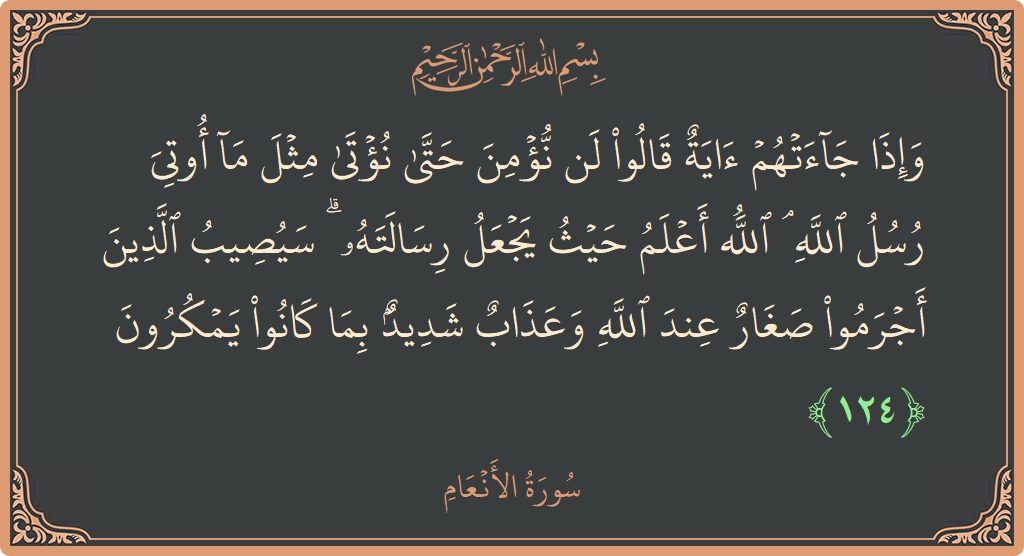
Surah Al-An'aam: Verse 124 - وإذا جاءتهم آية قالوا لن... - English
Tafsir of Verse 124, Surah Al-An'aam
English Translation
And when a sign comes to them, they say, "Never will we believe until we are given like that which was given to the messengers of Allah." Allah is most knowing of where He places His message. There will afflict those who committed crimes debasement before Allah and severe punishment for what they used to conspire.English Transliteration
Waitha jaathum ayatun qaloo lan numina hatta nuta mithla ma ootiya rusulu Allahi Allahu aAAlamu haythu yajAAalu risalatahu sayuseebu allatheena ajramoo sagharun AAinda Allahi waAAathabun shadeedun bima kanoo yamkuroonaTafsir of Verse 124
In the second verse (124), mentioned there is a conversation relating to the same chiefs of the Quraysh. What they said was a combination of verbal belligerence, sarcasm and mockery. It was answered.
Imam al-Baghawi reports from Sayyidna Qatadah that Abu Jahl, the big chief of the tribe of Quraysh once said: We have confronted Banu ` Abd Munaf (that is, the family of the Holy Prophet ﷺ) on every front and we have never been behind them. But, now they say: ` you cannot match us in nobility and spiritual greatness because we have a prophet in our family who receives revelation from Allah Ta` ala.' Then he said: I swear by Allah that we will never follow them unless we too start receiving the kind of revelation he receives. The statement: وَإِذَا جَاءَتْهُمْ آيَةٌ قَالُوا لَن نُّؤْمِنَ حَتَّىٰ نُؤْتَىٰ مِثْلَ مَا أُوتِيَ رُسُلُ اللَّـهِ (And when a sign comes to them, they say, "We shall never come to believe unless we are given the like of what was given to the messengers of Allah) at the end of the verse means exactly this.
Prophets and Messengers are appointed by Allah:
This Office cannot be acquired or appropriated:
After having reported the statement quoted above, the Qur'an answers it by saying: للَّـهُ أَعْلَمُ حَيْثُ يَجْعَلُ رِسَالَتَهُ (Alah knows best where to place his message). It means that the person making this remark thinks in His ignorance that the station of a prophet and messenger can be ac-quired on the basis of family nobility, tribal authority and wealth while prophethood is the office of the Vice Regency (Khilafah) of Allah the acquisition of which is in no one's control. No matter how many excellences and perfections one has acquired for himself, still no one can through his discretion or control or power of achievement - succeed in acquiring the office and station of prophethood and messenger-ship. That is purely a blessing of Allah Jalla Sha'nuhu. He bestows it on whomsoever He wills.
This proves that prophethood and messenger-ship are not controlled by human beings. They are not what can be acquired by intellectual perfection or pragmatic excellence or utmost striving or consuming devotion. Even a waliyy or saint, no matter how high he may soar in his spiritual station, cannot acquire it. That is nothing but Divine grace as it is given only to particular servants of Allah as dictated by Divine knowledge and wisdom. However, it is necessary that whoever is chosen to occupy this station and office, in the ultimate knowledge of Allah Ta` ala, is identified right from the beginning when he is created with appropriate inherent ability and then he is specially groomed in his morals and deeds.
Towards the end of the verse, it was said: سَيُصِيبُ الَّذِينَ أَجْرَمُوا صَغَارٌ عِندَ اللَّـهِ وَعَذَابٌ شَدِيدٌ بِمَا كَانُوا يَمْكُرُونَ ﴿124﴾ (Those who committed sin shall soon suffer from disgrace before Allah and face severe punishment for the mischief they have been making). Here, the word: صَغَار (saghar) is a verbal noun which means disgrace. The sentence means that these antagonists of truth who are known to be the big chiefs of their people will see their pride and prestige rolling in dust. Disgrace is coming; so is punishment - and both are grim. That can be within the life of the present world, and in the 'Akhirah as well - as has been the fate of the oppressors of the prophets in the past who were put to disgrace in the present world as well. The topmost antagonists of our own Prophet ﷺ ، may the blessing of Allah and peace be upon him, who boasted about their prestige, either entered the fold of Islam or, as was the case with those who did not, were destroyed in disgrace. at happened to the legendary chiefs of Quraysh, Abu Jahl and Abu Lahb, became a lesson when the Conquest of Makkah broke their backs.