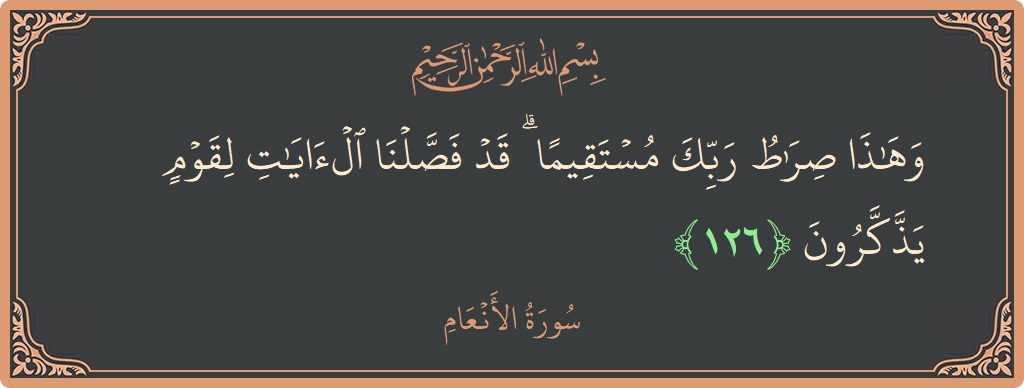
Surah Al-An'aam: Verse 126 - وهذا صراط ربك مستقيما ۗ... - English
Tafsir of Verse 126, Surah Al-An'aam
English Translation
And this is the path of your Lord, [leading] straight. We have detailed the verses for a people who remember.English Transliteration
Wahatha siratu rabbika mustaqeeman qad fassalna alayati liqawmin yaththakkaroonaTafsir of Verse 126
Commentary
In the first (126) of the three verses appearing here, the address is to the Holy Prophet ﷺ and it has been said: وَهَـٰذَا صِرَاطُ رَبِّكَ مُسْتَقِيمًا (And this is the path of your Lord, a straight path). Here, as said by Sayyidna ` Abdullah ibn Masud ؓ عنہما the word: ھذا (hadha: this) refers to the Qur'an, and as said by Sayyidna ` Abdullah ibn ` Abbas ؓ it means Islam (Ruh al-Ma'ni). The sense of the sentence is: This Way is the Way of your Lord, that is, this is a Way which has been proposed by your Lord in His infinite Wisdom, and with Him it finds favour. Here, by attributing the Way to the Lord of all, it has been indicated that the working system of Qur'an and Islam given to him was not for the benefit of Allah Ta` ala, rather, it was for the benefit of those who would act in accordance with it. This is as required by His being the Rabb, the Supreme Nurturer. Through this Way, the purpose is to nurture, train and groom human beings in a manner which would guarantee their eternal well-being.
Then, by bringing in the word: رَبّ (Rabb: Lord) in a state of attribution to the Holy Prophet ﷺ ، that is: (Rabbik: your Lord), the impression of a special kindness towards him has been released - that: ` your' Lord has proposed this Way. The delicacy of this attribution can be readily felt by people of taste. Think of a servant of Allah. If he ever happens to find his person placed in even the minor-most frame of reference to his Rabb and مَعبُود Ma` bud, his Lord and the object of his worship and devotion, that would be, for him, the highest possible achievement. And now, if the Lord of lords, the One worship-worthy entity in this whole universe, were to attribute His pristine Person to him and say, "I am yours," what remains there for him to say anything anymore about his wonderful ` kismet!'
After that, the ` existing identity' of this Qur'anic Way has been explained through the word: مُستَقِیم (mustaqim), that is, this path is the straight path. Here too, rather than have 'mustaqim' (straight) as the adjective of صِرَاط ` sirat' (path), it has been placed as an adverb which indicates that the Way has been proposed by the Lord of the universe, and in this, any probability, other than its being straight, just cannot exist. (Ruh al-Mani and Al-Bahr al-Muhit)
The text then says: قَدْ فَصَّلْنَا الْآيَاتِ لِقَوْمٍ يَذَّكَّرُونَ (We have made the verses elaborate for people who accept the advice).
The word: فَصَّلْنَا (Fassalna: We have made elaborate) is from: تَفصِیل (tafsil) which basically means to describe a subject by analysing it unit by unit. This way comprehending the subject becomes easy. Therefore, the outcome of tafsil is to explain explicitly. So, the sense comes to be: ` We have stated matters of principle explicitly and in details in which there remains no brevity or ambiguity.' After that, by saying: (for people who accept the advice), it was pointed out that, though these statements of the Qur'an are clear, but benefit from them has been derived only by those who ponder over the Qur'an to seek good counsel honestly, that is, doggedness, inherent resistance, opinionatedness, a priori hostility or the barriers of blind adherence to or following of ancestral customs do not come in between as walls.
(And this is the path of your Lord leading straight.) that is, Islam, that We have legislated for you, O Muhammad, by revealing this Qur'an to you, is Allah's straight path.
(We have detailed Our Ayat...) We have explained the Ayat and made them clear and plain,
(for a people who take heed) those who have sound comprehension and understand what Allah and His Messenger convey to them,
(For them will be the abode of peace) Paradise,
(with their Lord.) on the Day of Resurrection. Allah described Paradise as `the abode of peace', because its residents are safe due to their access to the straight path, which conforms to the way of the Prophets. And just as their way was not wicked, they earned the abode of peace which is free from all wickedness.
(And He will be their Wali) Protector, Supporter and Helper,
(because of what they used to do,) As reward for their good deeds, Allah has favored them and been generous with them, and awarded them Paradise.