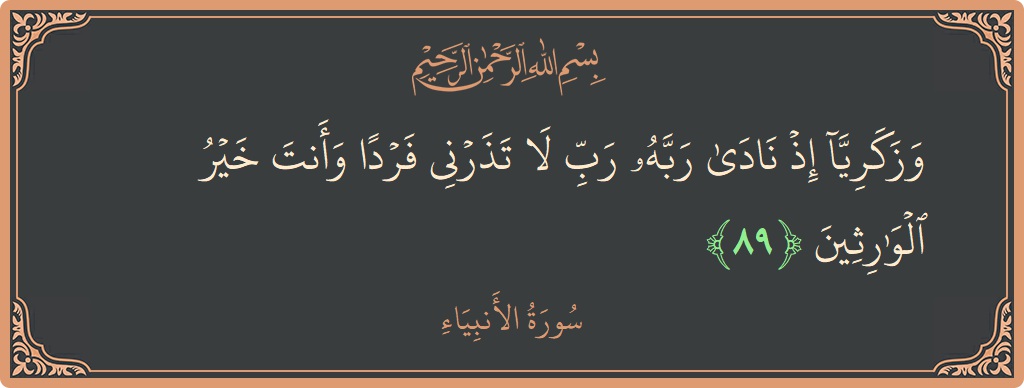
Surah Al-Anbiyaa: Verse 89 - وزكريا إذ نادى ربه رب... - English
Tafsir of Verse 89, Surah Al-Anbiyaa
English Translation
And [mention] Zechariah, when he called to his Lord, "My Lord, do not leave me alone [with no heir], while you are the best of inheritors."English Transliteration
Wazakariyya ith nada rabbahu rabbi la tatharnee fardan waanta khayru alwaritheenaTafsir of Verse 89
Commentary
Sayyidna Zakariyya (علیہ السلام) wished for a son and heir for which he prayed to Allah. But at the same time he made it clear that Allah is the best heir no matter if he had a son or not وَأَنتَ خَيْرُ الْوَارِثِينَ. You are the best of inheritors - 21:89). This was the manifestation of the prophetic respect in that the main concern of the prophets should always be toward Allah Ta’ ala, and even if someone else came into focus, their attention should not deviate from the main objective.
Zakariyya and Yahya
Allah tells us of His servant Zakariyya, who asked Allah to grant him a son who would be a Prophet after him. The story has already been given in detail at the beginning of Surah Maryam and also in Surah `Imran. Here an abbreviated version is given.
(when he cried to his Lord) means, in secret, hiding it from his people.
(O My Lord! Leave me not single,) means, with no child and no heir to stand among the people after me.
(though You are the Best of the inheritors.) This is a supplication and form of praise befitting the topic. Allah says:
(So We answered his call, and We bestowed upon him Yahya, and cured his wife for him.) Ibn `Abbas, Mujahid and Sa`id bin Jubayr said: "She was barren and never had a child, then she gave birth."
(Verily, they used to hasten on to do good deeds,) means, acts of worship and acts of obedience towards Allah.
(and they used to call on Us with hope and fear,) Ath-Thawri said, "Hoping for that (reward) which is with Us and fearing that (punishment) which is with Us."
(and they were Khashi`in before Us.) `Ali bin Abi Talhah reported from Ibn `Abbas that this means, sincerely believing in that which was revealed by Allah. Mujahid said: "Truly believing." Abu Al-`Aliyah said: "Fearing." Abu Sinan said: "Khushu` means the fear which should never leave our hearts." It was also reported from Mujahid that the Khashi`in are those who are humble." Al-Hasan, Qatadah and Ad-Dahhak said, "The Khashi`in are those who humble themselves before Allah." All of these suggestions are close in meaning.