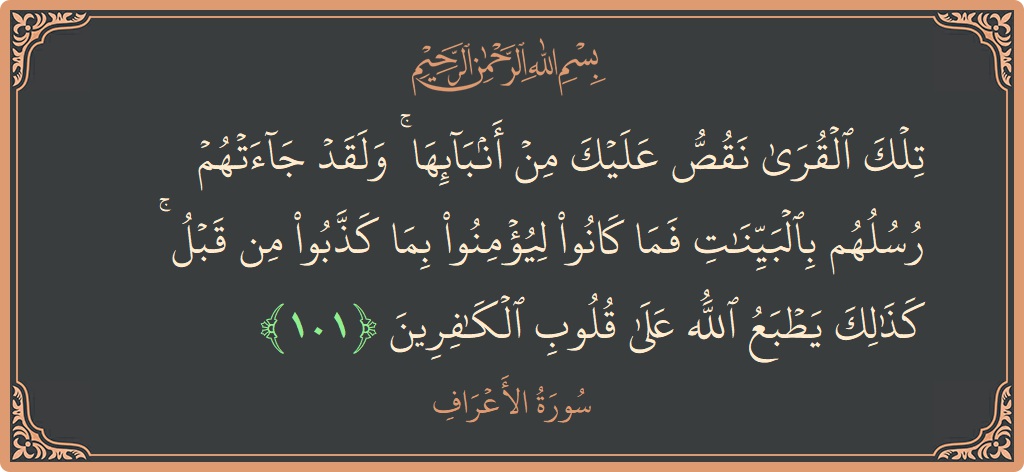
Surah Al-A'raaf: Verse 101 - تلك القرى نقص عليك من... - English
Tafsir of Verse 101, Surah Al-A'raaf
English Translation
Those cities - We relate to you, [O Muhammad], some of their news. And certainly did their messengers come to them with clear proofs, but they were not to believe in that which they had denied before. Thus does Allah seal over the hearts of the disbelievers.English Transliteration
Tilka alqura naqussu AAalayka min anbaiha walaqad jaathum rusuluhum bialbayyinati fama kanoo liyuminoo bima kaththaboo min qablu kathalika yatbaAAu Allahu AAala quloobi alkafireenaTafsir of Verse 101
The verse 101 has contained the phrase تِلْكَ الْقُرَىٰ نَقُصُّ عَلَيْكَ مِنْ أَنبَائِهَا "these are stories of the towns that We narrate to you." The word: نَبَا 'naba' in Arabic is used to denote some great news. With the word: مِن 'min' the verse has indicated that the events described in these verses are only some of a large number of events bearing the same lesson. The verse has further said, "And surely, their messengers came to them with clear signs, but they were not to believe in what they had belied earlier." It brings out their obstinate attitude towards the prophets who came to them with clear signs or miracles which are a definite means to decide between right and wrong but they obstinately rejected the truth, only because they had once belied them.
We know from this verse that miracles were given to all the prophets. The miracles of some prophets have been mentioned while the miracles of most of the prophets have not been referred to in the Holy Qur'an. This does not allow one to infer that the prophets not mentioned in the Qur'an were not given any miracles. As for the statement of the people of the prophet Hud (علیہ السلام) ، appearing in Surah Hud مَا جِئْتَنَا بِبَيِّنَةٍ "you did not bring any clear sign", this verse has clearly indicated that their statement was simply out of their obstinacy or, maybe they thought his miracles were of less significance.
Another point to be noted is that the present verse is speaking of the peculiarity of the disbelieving people who rigidly and obstinately followed the path of ignorance, only to prove that what they had once said was true, with no regard to all the clear signs and proofs of the truth. Most of the Muslims, even some 'Ulama' (the religious scholars) are seen to have the same habit of supporting their wrong statements in the face of clear proofs of the truth. This condition is a usual cause of incurring Allah's wrath. ('Masail al Suluk' )
Thereafter, the verse said كَذَٰلِكَ يَطْبَعُ اللَّـهُ عَلَىٰ قُلُوبِ الْكَافِرِينَ "This is how Allah stamps upon the hearts of the disbelievers" that is, Allah seals the hearts of those who disbelieve and reject the truth, making them unable to accept good as good.
(Those were the towns that We relate to you) O Muhammad,
(their story), and news,
(And there came indeed to them their Messengers with clear proofs,) and evidences of the truth of what they brought them. Allah said in other Ayah,
(And We never punish until We have sent a Messenger (to give warning).) 17:15, and,
(That is some of the news of the towns which We relate unto you; of them, some are standing, and some have been reaped. We wronged them not, but they wronged themselves.) 11:100-101 Allah said
(but they were not such who would believe in what they had rejected before.) meaning they would not have later on believed in what the Messengers brought them, because they denied the truth when it first came to them (although they recognized it), according to the Tafsir of Ibn `Atiyyah. This explanation is sound, and is supported by Allah's statement,
(And what will make you perceive that if it came, they will not believe And We shall turn their hearts and their eyes away (from guidance), as they refused to believe therein for the first time.) 6:109-110 This is why Allah said here,
(Thus Allah does seal up the hearts of the disbelievers. And most of them We found not...) meaning, We did not find most of the previous nations,
(true to their covenant, but most of them We found to indeed be rebellious.) This Ayah means, We found most of them to be rebellious, deviating away from obedience and compliance. The covenant mentioned here is the Fitrah that Allah instilled in them while still in their fathers' loins, and taking their covenant, that He is their Lord, King, and that there is no deity worthy of worship except Him,. They affirmed this covenant and testified against themselves to this fact. However, they defied this covenant, threw it behind their backs and worshipped others besides Allah, having no proof or plea, nor support from rationality or by divine law. Surely, the pure Fitrah defies these actions, while all the honorable Messengers, from beginning to end, forbade them. Muslim collected the Hadith,
(Allah said, "I created My servants Hunafa' (monotheists), but the devils came to them and deviated them from their religion and prohibited them what I allowed them.") It is recorded in the Two Sahihs,
(Every child is born upon the Fitrah, it is only his parents who turn him into a Jew, a Christian or a Zoroastrian.)