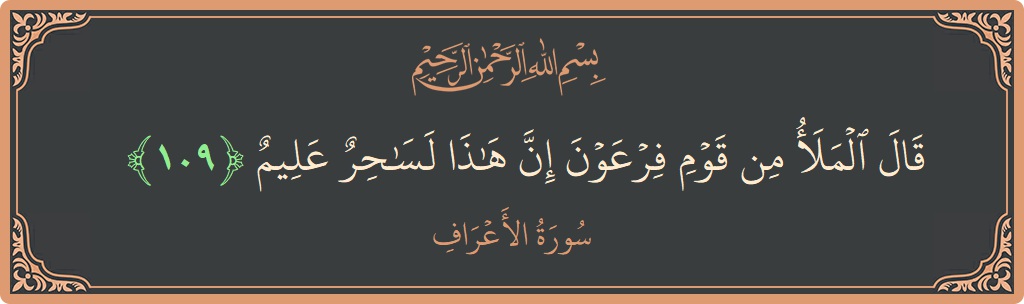
Surah Al-A'raaf: Verse 109 - قال الملأ من قوم فرعون... - English
Tafsir of Verse 109, Surah Al-A'raaf
English Translation
Said the eminent among the people of Pharaoh, "Indeed, this is a learned magicianEnglish Transliteration
Qala almalao min qawmi firAAawna inna hatha lasahirun AAaleemunTafsir of Verse 109
The Arabic word 'Mala" is used for influential chiefs. After seeing these miracles they said to the people he was a great sorcerer. Being ignorant of divine powers of Allah they could say nothing else as they believed Pharaoh to be their god and had seen nothing but the magical charms of the sorcerers in their life. They, however, added the word "alim' signifying the one who knows, showing their impression that the miraculous acts of Musa (علیہ السلام) were of the kind that could not be performed by an ordinary magician. So, they said that he was a sorcerer of great knowledge.
The difference between miracle and sorcery
The miracles and sorcery are so distinct in their nature and effect that they do not require any explanation to any one applying common sense. The sorcerers usually live in impurity and, the more they are unclean and impure the more they are successful in their sorcery. The prophets, on the other hand, are by nature the most clean and pure people. Another obvious distinction is that a sorcerer is never successful when he makes claim to prophethood. Besides, the acts performed under the effect of sorcery do have physical causes as other things have, with the only difference that their causes remain hidden to common people. The people, therefore, take them to be happening without the help of any cause. On the contrary, the miracles are directly a manifestation of Allah's power and have nothing to do with physical causes. This is why the miracles have been ascribed directly to Allah and not to the prophets in the Holy Qur'an. The Qur'an said "but Allah threw the pebbles" (while these pebbles were thrown by the Holy Prophet ﷺ in the battle of Badr) In short, the miracles and sorcery are totally different from each other. The people of knowledge have no confusion about it. In order to eliminate any possible confusion of a common individual, Allah has provided with obvious distinctions between the two.
Even the people of the Pharaoh found the miracles of the prophet Musa (علیہ السلام) somehow different from the normal acts of sorcerers. Therefore, even while accusing him of sorcery they admitted that he was 'of great knowledge' meaning that his act was not comparable with the acts of the normal sorcerers.
Fir`awn's People say that Musa is a Magician!
The chiefs and noblemen of the people of Fir`awn agreed with Fir`awn's statement about Musa. After Fir`awn felt safe and returned to his throne, he said to the chiefs of his people,
(This is indeed a well-versed sorcerer) and they agreed. They held counsel to decide what they should do about Musa. They conspired to extinguish the light that he brought and bring down his word. They plotted to portray Musa as a liar and fake. They feared that he might lure people to his side by his magic, they claimed, and thus prevail over them and drive them away from their land. What they feared occured, just as Allah said,
(And We let Fir`awn and Haman and their hosts receive from them that which they feared.) 28:6 After they conferred about Musa, they agreed on a plot, as Allah said about them,