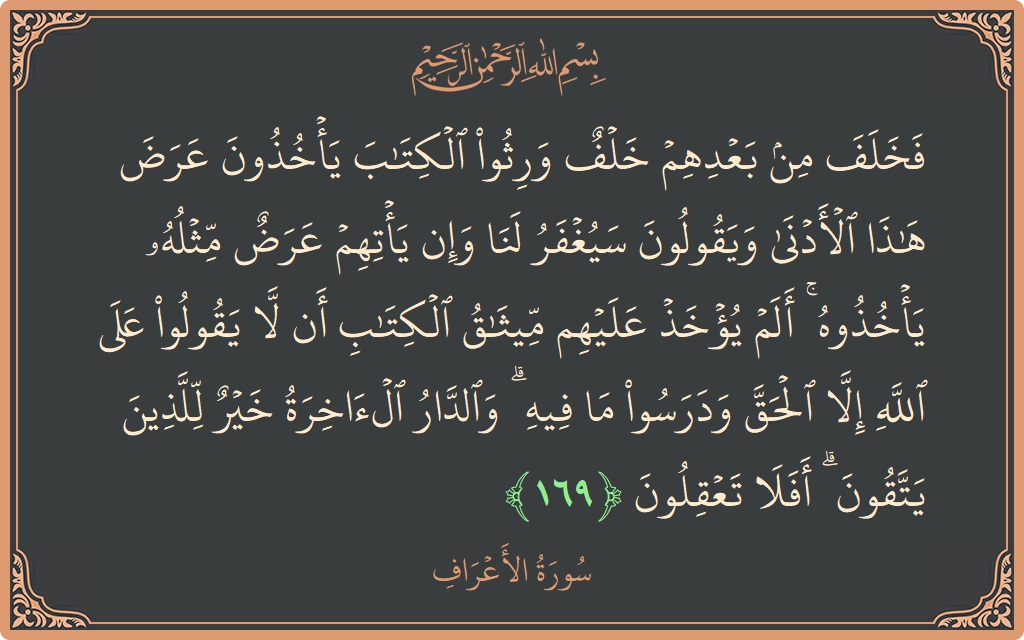
Surah Al-A'raaf: Verse 169 - فخلف من بعدهم خلف ورثوا... - English
Tafsir of Verse 169, Surah Al-A'raaf
English Translation
And there followed them successors who inherited the Scripture [while] taking the commodities of this lower life and saying, "It will be forgiven for us." And if an offer like it comes to them, they will [again] take it. Was not the covenant of the Scripture taken from them that they would not say about Allah except the truth, and they studied what was in it? And the home of the Hereafter is better for those who fear Allah, so will you not use reason?English Transliteration
Fakhalafa min baAAdihim khalfun warithoo alkitaba yakhuthoona AAarada hatha aladna wayaqooloona sayughfaru lana wain yatihim AAaradun mithluhu yakhuthoohu alam yukhath AAalayhim meethaqu alkitabi an la yaqooloo AAala Allahi illa alhaqqa wadarasoo ma feehi waalddaru alakhiratu khayrun lillatheena yattaqoona afala taAAqiloonaTafsir of Verse 169
The verse 169 has said:
فَخَلَفَ مِن بَعْدِهِمْ خَلْفٌ وَرِثُوا الْكِتَابَ يَأْخُذُونَ عَرَضَ هَـٰذَا الْأَدْنَىٰ وَيَقُولُونَ سَيُغْفَرُ لَنَا وَإِن يَأْتِهِمْ عَرَضٌ مِّثْلُهُ يَأْخُذُوهُ
"Then, after them came a generation, who inherited the Book, taking to the mundane stuff of this world and saying: 'We shall be forgiven.' And if there comes to them similar stuff, they would take to it (again).
The Arabic word خَلْفٌ is a past tense of خِلَافَہ signifying a deputy or a person trusted with one's work in one's absence.
The second word used here is خَلْفُ with the merged sound of the second letter ل Lam, generally denoting a deputy who is marked with wickedness, as opposed to the good practices of his elders. The word وَرِثُوا is a derivative of ورَاثَۃ that is, inheritance. The next word is عَرَض meaning something bought with money. Sometimes, it is used just for something possessed. The use of this word for money indicates that anything owned in this world is temporary, because this word, as an antonym of 'Jauhar' (substance), is used for an object which requires something else to show its existence like colour which requires another thing to show itself. The word اَدنی 'has been derived from دُنوُ which denotes nearness or lack of distance. The word دُنیا is a feminine gender of this word. The word اَدنی may also be taken to be a derivative of دَنَاَءۃ which signifies disgrace. In this case the word shall refer to something disgraced.
The verse implies that there were two groups of people among the early Jews, the righteous and the wrong-doers. The people coming in later generations who inherited the Torah, however, acted opposite to their elders and made the Book an object of trading or a means of their earning. They used to manipulate and distort the text of the Torah for some money offered to them for this purpose. Moreover, "they said: وَيَقُولُونَ سَيُغْفَرُ لَنَا "We shall be forgiven". In spite of committing as great a sin as distorting the text of the Book of Allah, they claimed their forgiveness by Allah. They are warned of this error in the very next sentence. saying: وَإِن يَأْتِهِمْ عَرَضٌ مِّثْلُهُ يَأْخُذُوهُ 'If there comes to them similar stuff they would take to it (again)." That is to say, they are in such a state of perversion that in case they are offered money for changing another text, they shall readily accept it. The verse has implied that forgiveness of Allah is always there to those who are mindful of their error and turn to their Lord in repentance showing their remorse over what they have done, and making firm promise of not repeating the same mistake again. Being persistent in their sinful acts and claiming their forgiveness is sheer self deception. The next part of the verse puts a question to them, whether they were not made to enter a covenant with Allah that they shall never say anything but truth about Allah. Yes, they read this pledge in their Book. This is nothing but their impudence and obstinacy that stops them from realizing the truth of the Hereafter which is exclusively the fate of those who fear Allah.