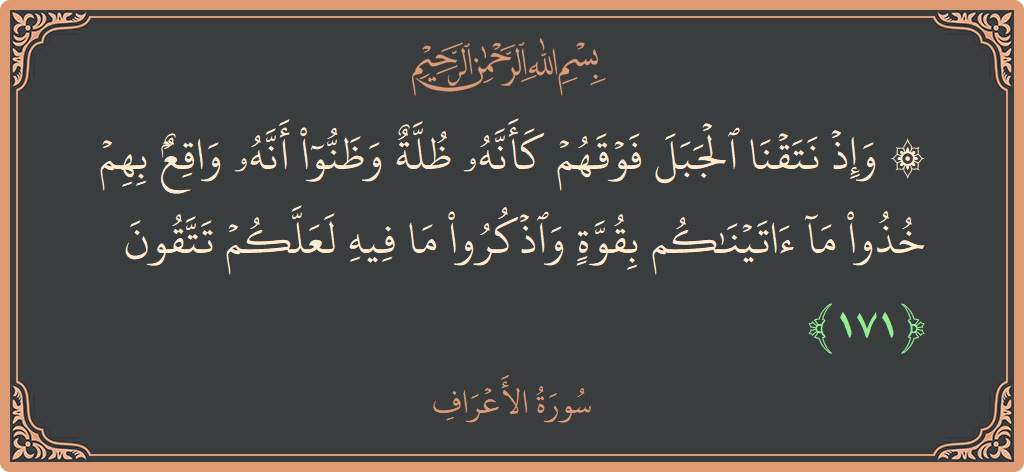
Surah Al-A'raaf: Verse 171 - ۞ وإذ نتقنا الجبل فوقهم... - English
Tafsir of Verse 171, Surah Al-A'raaf
English Translation
And [mention] when We raised the mountain above them as if it was a dark cloud and they were certain that it would fall upon them, [and Allah said], "Take what We have given you with determination and remember what is in it that you might fear Allah."English Transliteration
Waith nataqna aljabala fawqahum kaannahu thullatun wathannoo annahu waqiAAun bihim khuthoo ma ataynakum biquwwatin waothkuroo ma feehi laAAallakum tattaqoonaTafsir of Verse 171
The next verse (171) described another incident of the Israelites when they were forced to promise their obedience to the law of the Torah. It has also been mentioned in the Surah al-Baqarah. The Arabic word نَتَقنَا signifies drawing or lifting up. In the Surah al-Baqarah the word رَفَعنَا has been used which denotes the act of raising up. Sayyidna ` Abdullah ibn ` Abbas ؓ has therefore, taken the word نَتَقنَا to signify raising high. The Arabic word ظُلَّہ 'Zullah' means a sunshade or a canopy.
The verse refers to the time when the Prophet Musa (علیہ السلام) came back from the mount of Sinai with the book of Torah. They found therein many injunctions which they thought were difficult for them, to follow. They started showing their unwillingness for obeying those commandments. Allah commanded the Archangel Jibra'i1 (علیہ السلام) to raise the Mount of Sinai upon their town. The area of this town is reported to have been three square miles. When the mount of Sinai was hanged over their heads they fell down prostrating themselves out of fear and promised their obedience to the Law of Moses (the Torah). The future events, however, witnessed their deviation from the Law every now and again.
No compulsion in Faith
The above incident gives rise to a question. Why the Israelites were forced to make a promise of their obedience while the Holy Qur'an has declared لَا إِكْرَاهَ فِي الدِّينِ "There is no compulsion in Faith?" (2:256) The answer is quite simple. None of the disbelievers has ever been forced to accept faith, nor any one is allowed to use force for this purpose. However, those who have already entered the covenant of faith out of their free will and, later, deviate from the commandments of Allah just for avoiding their commitments, shall essentially be forced to abide by the rules and regulations of the Law. In case of deviation from their duty they must be held liable to punishments prescribed by the Law. This is what exactly happened in this incident. They had already believed in Allah and in His Prophet and had entered the covenant of Faith. What they did was to deny from obeying the Law of the Torah and rightly were forced to fulfill their commitment.
Raising Mount Tur over the Jews, because of Their Rebellion
`Ali bin Abi Talhah reported that Ibn `Abbas commented on the Ayah,
(And (remember) when We Nataqna the mountain over them), "We raised the mountain, as Allah's other statement testifies,
(And for their covenant, We raised over them the mountain) 4:154." Also, Sufyan Ath-Thawri narrated that Al-A`mash said that, Sa`id bin Jubayr said that Ibn `Abbas said, "The angels raised the Mount over their heads, as reiterated by Allah's statement,
(We raised over them the mountain) 4:154." Al-Qasim bin Abi Ayyub narrated that Sa`id bin Jubayr said that Ibn `Abbas said, "Musa later on proceeded with them to the Sacred Land. He took along the Tablets, after his anger subsided, and commanded them to adhere to the orders that Allah ordained to be delivered to them. But these orders became heavy on them and they did not want to implement them until Allah raised the mountain over them,
(as if it had been a canopy), that is, when the angels raised the mountain over their heads." An-Nasa'i collected it.