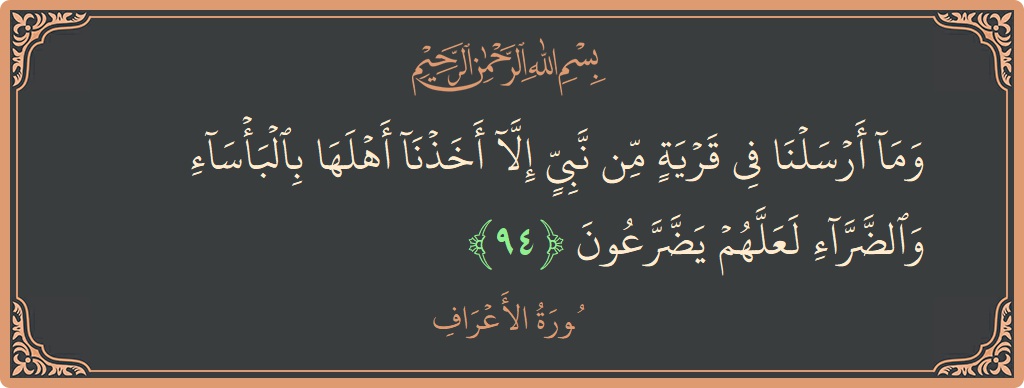
Surah Al-A'raaf: Verse 94 - وما أرسلنا في قرية من... - English
Tafsir of Verse 94, Surah Al-A'raaf
English Translation
And We sent to no city a prophet [who was denied] except that We seized its people with poverty and hardship that they might humble themselves [to Allah].English Transliteration
Wama arsalna fee qaryatin min nabiyyin illa akhathna ahlaha bialbasai waalddarrai laAAallahum yaddarraAAoonaTafsir of Verse 94
The above verses continue to speak of the events of early people and their ominous fate. The events of five early prophets and their people have been so far discussed. The sixth event concerning 'the Prophet Musa (علیہ السلام) and his people is going to be discussed after a few next verses.
We have already noted that usual style of the Holy Qur'an with regard to the historical events is quite different from the books of history. The Holy Qur'an does not care to describe a historical event in its entirety or in chronological order. Rather, it selects certain relevant portion of the event then lays emphasis on the lesson or moral contained therein.
After relating the stories of the early people, the above verses speak of the warnings and lessons for present people in order to save them from the ill-fate met by their forefathers. The verse 94 warns people that the fate of disaster and suffering described in the foregoing verses was not limited to the people of Nuh, ` Ad and Thamud (علیہم السلام) only. It is, rather, a usual practice of Allah that He sends His prophets to people for their guidance and eternal success. Then, those who do not listen to their advice and reject their invitation are subjected to suffering and distress so that they may turn to their Lord in repentance. It is human to turn to The Creator in distress. This suffering is, in fact, a blessing of Allah in disguise as it is meant for their good. The great spiritual leader Maulana Rumi has versified this fact in these words:
خلق را باتو چنسیں بد خوکنند تاترا ناچار روا آنسو کنند
"The people are made to misbehave with you
in order that you turn to your Lord in tears."
The verse 94 has referred to this fact by saying, 'We seized it's people with hardship so that they may turn in humbleness. The Arabic word: بَاسَاء 'Ba'sa' signifies hunger or poverty while the word: ضَرَّاء 'Darra' signifies illness. The Holy Qur'an has used these words to signify the same meanings in other situations. The respected Companion ` Abdullah ibn Masud ؓ has confirmed these meanings of the two words. Some linguists have said that the word: بَاسَاء refers to financial distress while the word: ضَرَّاء 'Darra' signifies loss of health. The verse 95 said: "Thereafter, We substituted good in place of evil until they increased."
Afflictions that struck Earlier Nations
Allah mentions the Ba'sa' and Darra' that struck the earlier nations to whom He sent Prophets. Ba'sa', refers to the physical sicknesses and ailments that they suffered, while Darra', refers to the poverty and humiliation that they experienced,
(so that they might humble themselves) supplicate, humble themselves and invoke Allah, that He might remove the afflictions that they suffered from. This Ayah indicates that Allah sent down severe afflictions to them so that they might invoke Him, but they did not do what He ordered them. Therefore, He changed the affliction into prosperity to test them,
(Then We changed the evil for the good,) Therefore, Allah changed the hardship into prosperity, disease and sickness into health and well-being, and poverty into richness in provision, so that they might be thankful to Allah for this, but they did none of that. Allah's statement,
(until they `Afaw) refers to increase in numbers, wealth and offspring. Allah said next,
(. . and they said: "Our fathers were touched with evil and with good." So We seized them all of a sudden while they were unaware.) He tested them with this (afflictions) and that (ease and abundance) so that they may humble themselves and repent to Him. However, they failed both tests, for neither this nor that compelled them to change their ways. They said, "We suffered Ba'sa' and Darra', but prosperity came afterwards, just as like our forefathers in earlier times." "Therefore," they said, "it is a cycle where we sometimes suffer a hardship and at other times, we enjoy a bounty." However, they did not comprehend Allah's wisdom, nor the fact that He is testing them in both cases. To the contrary, the believers are grateful to Allah in good times and practice patience in hard times. In the Sahih, there is a Hadith that says;
(The matter of the believer is amazing, for nothing that Allah decrees for him, but it is better for him. If a Darra' (harm) strikes him, he is patient, and this is better for him, if he is given Sarra' (prosperity), he thanks (Allah) for it and this is better for him.) The believer, therefore, is aware of the test behind the afflictions whether it may be prosperity or adversity that Allah sends to him, as well as the blessings. Similarly, in another Hadith,
(The believer will continue to be tested by afflictions until he ends up pure from sin. And the parable of the hypocrite is that of a donkey, it does not know why its owners tied it or released it.) Allah said next,
(So We seized them all of a sudden while they were unaware.) meaning, We struck them with punishment all of a sudden, while they were unaware. A Hadith describes sudden death,
(Sudden death is a mercy for the believer, but a sorrowful punishment for the disbeliever.)