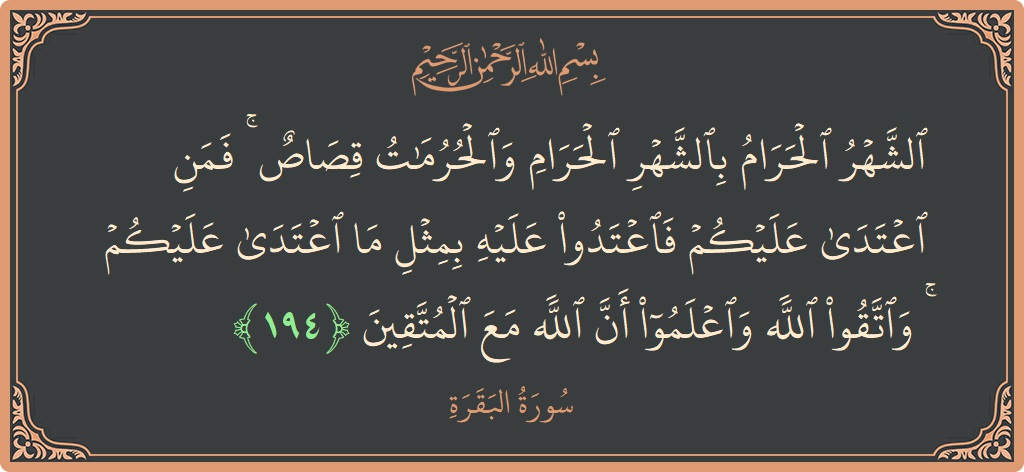
Surah Al-Baqara: Verse 194 - الشهر الحرام بالشهر الحرام والحرمات... - English
Tafsir of Verse 194, Surah Al-Baqara
English Translation
[Fighting in] the sacred month is for [aggression committed in] the sacred month, and for [all] violations is legal retribution. So whoever has assaulted you, then assault him in the same way that he has assaulted you. And fear Allah and know that Allah is with those who fear Him.English Transliteration
Alshshahru alharamu bialshshahri alharami waalhurumatu qisasun famani iAAtada AAalaykum faiAAtadoo AAalayhi bimithli ma iAAtada AAalaykum waittaqoo Allaha waiAAlamoo anna Allaha maAAa almuttaqeenaTafsir of Verse 194
Ruling
There are four 'sacred months': Dhul-Qa'dah, Dhul-Hijjah, Muharram which are consecutive and the fourth is Rajab. Even before Islam, fighting in these months was considered unlawful and the disbelievers of Makkah too used to observe their sanctity. Even in the early days of Islam, right through the year 7 A.H., this law was in force which is why the noble Companions were perplexed. Later, according to the consensus of the Ummah, this unlawfulness of fighting was abrogated and the permission to fight was given, but it is still preferable not to initiate fighting in these four months without the need to defend. Therefore, it can be said that the sanctity of the 'sacred months' has not been abrogated totally, but it holds good like the sanctity of Haram. Both of them have been subjected to an exception for the sake of defence.
Fighting during the Sacred Months is prohibited, except in Self-Defense
Ibn `Abbas, Ad-Dahhak, As-Suddi, Qatadah, Miqsam, Ar-Rabi` bin Anas and `Ata said, "Allah's Messenger went for `Umrah on the sixth year of Hijrah. Then, the idolators prevented him from entering the Sacred House (the Ka`bah in Makkah) along with the Muslims who came with him. This incident occurred during the sacred month of Dhul-Qa`dah. The idolators agreed to allow them to enter the House the next year. Hence, the Prophet entered the House the following year, along with the Muslims who accompanied him, and Allah permitted him to avenge the idolators' treatment of him, when He said:
(The sacred month is for the sacred month, and for the prohibited things, there is the Law of equality (Qisas).)
Imam Ahmad recorded that Jabir bin `Abdullah said, "Allah's Messenger would not engage in warfare during the Sacred Month unless he was first attacked, then he would march forth. He would otherwise remain idle until the end of the Sacred Months." This Hadith has an authentic chain of narrators.
Hence, when the Prophet was told that `Uthman was killed (in Makkah) when he was camped at the area of Al-Hudaybiyyah, after he had sent `Uthman as his emissary to the polytheists, he accepted the pledge from his Companions under the tree to fight the polytheists. They were one thousand and four hundred then. When the Prophet was informed that `Uthman was not killed, he abandoned the fight and reverted to peace.
When the Prophet finished fighting with (the tribes of) Hawazin during the battle of Hunayn and Hawazin took refuge in (the city of) At-Ta'if, he laid siege to that city. Then, the (sacred) month of Dhul-Qa`dah started, while At-Ta'if was still under siege. The siege went on for the rest of the forty days (rather, from the day the battle of Hunayn started until the Prophet went back to Al-Madinah from Al-Ji`ranah, were forty days), as reported in the Two Sahihs and narrated by Anas. When the Companions suffered mounting casualties (during the siege), the Prophet ended the siege before conquering At-Ta'if. He then went back to Makkah, performed `Umrah from Al-Ji`ranah, where he divided the war booty of Hunayn. This `Umrah occurred during Dhul-Qa`dah of the eighth year of Al-Hijrah.
Allah's statement:
(...whoever transgresses against you, you transgress likewise against him.) ordains justice even with the polytheists. Allah also said in another Ayah:
(And if you punish, then punish them with the like of that with which you were afflicted.) (16:126)
Allah's statement:
(And fear Allah, and know that Allah is with Al-Muttaqin (the pious)) (2:194) commands that Allah be obeyed and feared out of Taqwa. The Ayah informs us that Allah is with those who have Taqwa by His aid and support in this life and the Hereafter.