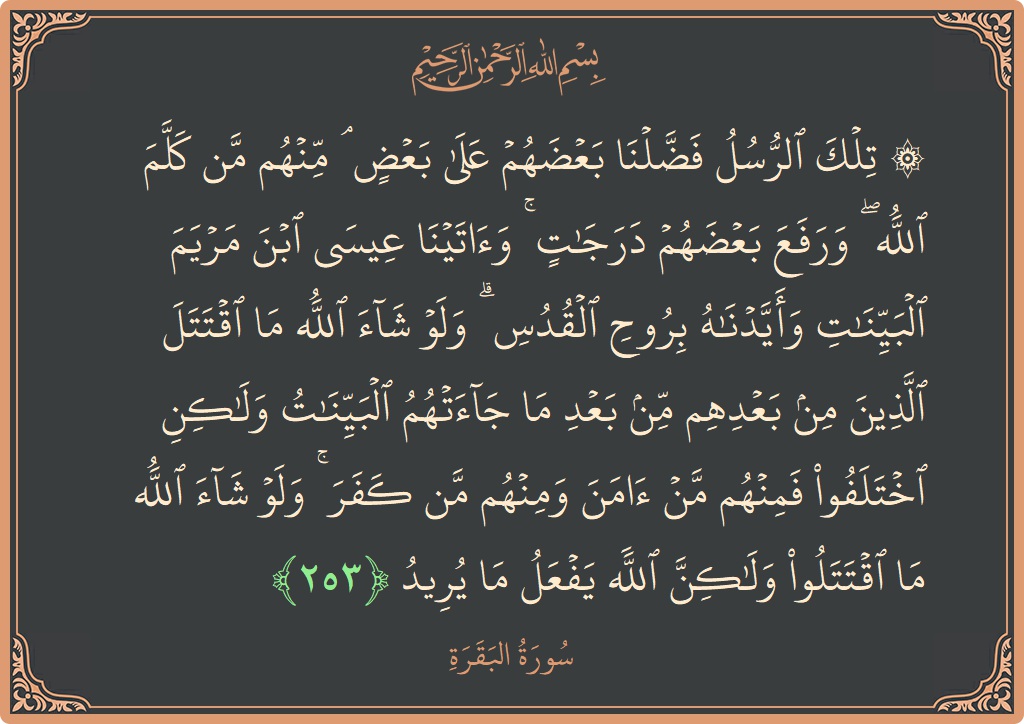
Surah Al-Baqara: Verse 253 - ۞ تلك الرسل فضلنا بعضهم... - English
Tafsir of Verse 253, Surah Al-Baqara
English Translation
Those messengers - some of them We caused to exceed others. Among them were those to whom Allah spoke, and He raised some of them in degree. And We gave Jesus, the Son of Mary, clear proofs, and We supported him with the Pure Spirit. If Allah had willed, those [generations] succeeding them would not have fought each other after the clear proofs had come to them. But they differed, and some of them believed and some of them disbelieved. And if Allah had willed, they would not have fought each other, but Allah does what He intends.English Transliteration
Tilka alrrusulu faddalna baAAdahum AAala baAAdin minhum man kallama Allahu warafaAAa baAAdahum darajatin waatayna AAeesa ibna maryama albayyinati waayyadnahu biroohi alqudusi walaw shaa Allahu ma iqtatala allatheena min baAAdihim min baAAdi ma jaathumu albayyinatu walakini ikhtalafoo faminhum man amana waminhum man kafara walaw shaa Allahu ma iqtataloo walakinna Allaha yafAAalu ma yureeduTafsir of Verse 253
Commentary
1. In Verse 253, beginning with تِلْكَ الرُّسُلُ ('those are the Messenger’), the purpose is to give solace and comfort to the noble Prophet ﷺ since the deniers refused to recognize his prophethood, inspite of the fact that it was conclusively proved, as has been stated in the verse 252: وَإِنَّكَ لَمِنَ الْمُرْسَلِي (And certainly you are among the Messengers.) as well. This situation caused him pain. Therefore, Allah Almighty made him aware of the coming of other prophets too, in varying degrees of station, but universal belief was not witnessed in any of their communities -- some supported while some others opposed. However, this too has its wise considerations which may not necessarily be visible to everyone, but this much is important that one should generally believe that there is definitely a certain wisdom behind this.
2. Since the words تِلْكَ الرُّسُلُ فَضَّلْنَا بَعْضَهُمْ عَلَىٰ بَعْضٍ (Those are the Messengers some of whom We have given excellence over others) in this verse clearly indicate that some prophets are given higher status than others, we have a difficulty on our hands when we compare this with a hadith, where the Holy Prophet ﷺ has said:
لا تفضلوا بین انبیاء اللہ
Do not seek preference among prophets.
لا تخیرونی علی موسٰی
Do not give me precedence over Musa.
لا اقول ان احدا افضل من یونس بن متی
I cannot say if anyone is better than Yunus ibn Matta.
These ahadith so obviously forbid the giving of preference to some prophets over some other prophets.
The reply is: These ahadith mean to tell us not to give preference to some prophets over some others, without any proof, out of our own opinion. This is because a prophet's having higher status means that he has a high station in the sight of Allah. Obviously, this knowledge cannot be acquired through conjectures and surmises but should such a proof come from the Qur'an and Sunnah, establishing the precedence of some prophets over some others, then it will be necessary to believe in it.
Now, as to his saying: لا اقول ان احدا افضل من یونس بن متی (I cannot say if
anyone is better than Yunus ibn Matta) and لا تخیرونی علی موسٰی (Do not give me precedence over Musa), this is related to the time when he was not given the knowledge that he has precedence over all other prophets. This was disclosed to him later on through revelation and he did tell the noble Companions about it. (Mazhari)
3. As regards the statement' مِّنْهُم مَّن كَلَّمَ اللَّـهُ (Among them there is he whom Allah spoke to), it may be noted that the conversation with Musa (علیہ السلام) may be without an angel as intermediary, but it certainly was not without hijab (obstruction of view). So, there remains no conflict of meaning with what has been stated in the verse: وَمَا كَانَ لِبَشَرٍ أَن يُكَلِّمَهُ اللَّـهُ (It belongs not to any mortal that God should speak to him) (42:51), in which conversation without hijab has been negated. However, post-death conversation without hijab is possible, so this verse from Sarah al-Shura relates to the life in this world.
Allah Honored Some Prophets Above Others
Allah states that He has honored some Prophets to others. For instance, Allah said,
(And indeed, We have preferred some of the Prophets above others, and to Dawud We gave the Zabur (Psalms)) 17:55.
In the Ayah above, Allah said,
(Those Messengers! We preferred some of them to others; to some of them Allah spoke (directly)) meaning, Musa and Muhammad , and also Adam according to a Hadith recorded in Sahih Ibn Hibban from Abu Dharr.
(Others He raised to degrees (of honor)) as is evident in the Hadith about the Isra' journey, when the Messenger of Allah saw the Prophets in the various heavens according to their rank with Allah.
If somebody asks about the collective meaning of this Ayah and the Hadith that the Two Sahihs collected from Abu Hurayrah which states, "Once, a Muslim man and a Jew had an argument and the Jew said, `No, by Him Who gave Musa superiority over all human beings!' Hearing him, the Muslim man raised his hand and slapped the Jew on his face and said, `Over Muhammad too, O evil one!' The Jew went to the Prophet and complained to him and the Prophet said,
(Don't give me superiority above the Prophets, for the people will become unconscious on the Day of Resurrection, and I will be the first to be resurrected to see Musa holding on to the pillar of Allah's Throne. I will not know whether the unconsciousness Musa suffered on the Day of the Trumpet sufficed for him, or if he got up before me. So, do not give me superiority above the Prophets.) In another narration, the Prophet said, (Do not give superiority to some Prophets above others.)
The answer to this question is that this Hadith prohibits preferring some Prophets above others in cases of dispute and argument, such as the incident mentioned in the Hadith. The Hadith indicates that it is not up to creation to decide which Prophet is better, for this is Allah's decision. The creation is only required to submit to, obey and believe in Allah's decision.
Allah's statement,
(And We gave `Isa, the son of Maryam, clear signs) refers to the proofs and unequivocal evidences that testify to the truth that `Isa delivered to the Children of Israel, thus testifying that he was Allah's servant and His Messenger to them.
(And supported him with Ruh-il-Qudus) meaning Allah aided `Isa with Jibil, peace be upon him. Allah then said,
(If Allah had willed, succeeding generations would not have fought against each other, after clear Verses of Allah had come to them, but they differed ـ some of them believed and others disbelieved. If Allah had willed, they would not have fought against one another.) meaning all this happened by Allah's decree, and this is why He said next,
(But Allah does what He wills.)