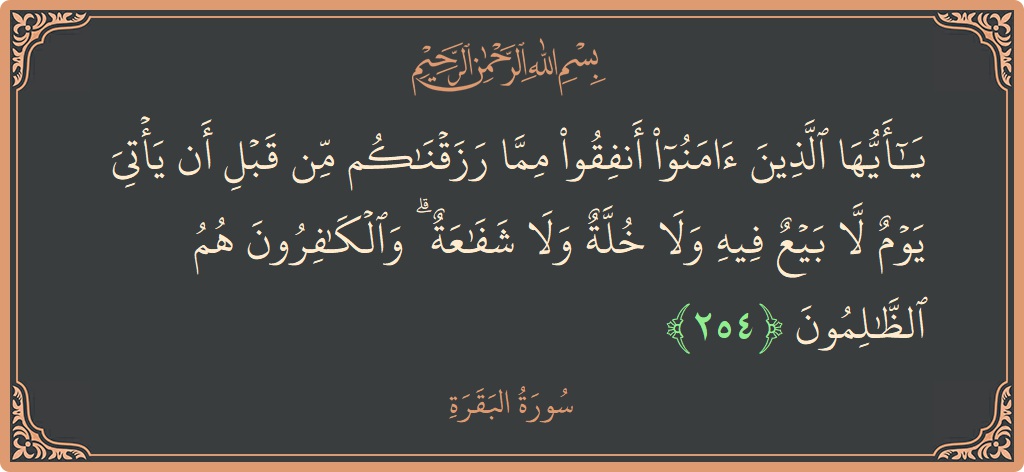
Surah Al-Baqara: Verse 254 - يا أيها الذين آمنوا أنفقوا... - English
Tafsir of Verse 254, Surah Al-Baqara
English Translation
O you who have believed, spend from that which We have provided for you before there comes a Day in which there is no exchange and no friendship and no intercession. And the disbelievers - they are the wrongdoers.English Transliteration
Ya ayyuha allatheena amanoo anfiqoo mimma razaqnakum min qabli an yatiya yawmun la bayAAun feehi wala khullatun wala shafaAAatun waalkafiroona humu alththalimoonaTafsir of Verse 254
Commentary
Many injunctions relating to acts of worship and dealings with human beings have been taken up in this Surah, especially all those a person dislikes to obey finding them burdensome. Then, the most difficult act is to 'spend' one's life and possessions; and when you look at Divine injunctions relating to most situations they either relate to a man's life or his possessions. And when a man falls into the trap of sin, it is either caused by his love of life or expediency of possessions in most cases. As such, the love for these two is the root of sins, and the defence against and the deliverance from it is the object of all acts of obedience. It is for this reason that, following the injunctions relating to worship and social transactions, the subject of 'fighting' and 'spending' in the way of Allah were taken up. The first appeared in وَقَاتِلُوا فِي سَبِيلِ اللَّـهِ (And fight in the way of Allah) (244) and the second in مَّن ذَا الَّذِي يُقْرِضُ اللَّـهَ (Who is the one who would give Allah a good loan?) (245) After that, the former was emphasized by the story of Talut طالوت ، and now, emphasis is being laid on the later by أَنفِقُوا مِمَّا رَزَقْنَاكُم (Spend from what We have given to you) (254). Since a large number of affairs relating to the worship of Allah and dealings with human beings depend on spending out of what Allah has given, this subject has been dealt with in a greater detail. Therefore, the sections that follow have, in most of them, a discussion of the second aspect, which is, the 'spending' out of one's possessions. To sum up, it means: The time to act is still there. In the Hereafter, deeds are not on sale. They cannot be borrowed from a friend either. Once caught by the punishment, one cannot be released on someone's intercession, unless Allah Himself forgives.
Allah commands His servants to spend for His sake, in the path of righteousness, from what He has granted them, so that they acquire and keep the reward of this righteous deed with their Lord and King. Let them rush to perform this deed in this life,
(before a Day comes) meaning, the Day of Resurrection,
(when there will be no bargaining, nor friendship, nor intercession.)
This Ayah indicates that on that Day, no one will be able to bargain on behalf of himself or ransom himself with any amount, even if it was the earth's fill of gold; nor will his friendship or relation to anyone benefit him. Similarly, Allah said,
(Then, when the Trumpet is blown, there will be no kinship among them that Day, nor will they ask of one another) 23:101.
(Nor intercession) meaning, they will not benefit by the intercession of anyone.
Allah's statement,
(and it is the disbelievers who are the wrongdoers) indicates that no injustice is worse than meeting Allah on that Day while a disbeliever. Ibn Abi Hatim recorded that `Ata' bin Dinar said, "All thanks are due to Allah Who said,
(and it is the disbelievers who are the wrongdoers) but did not say, `And it is the wrongdoers who are the disbelievers."'