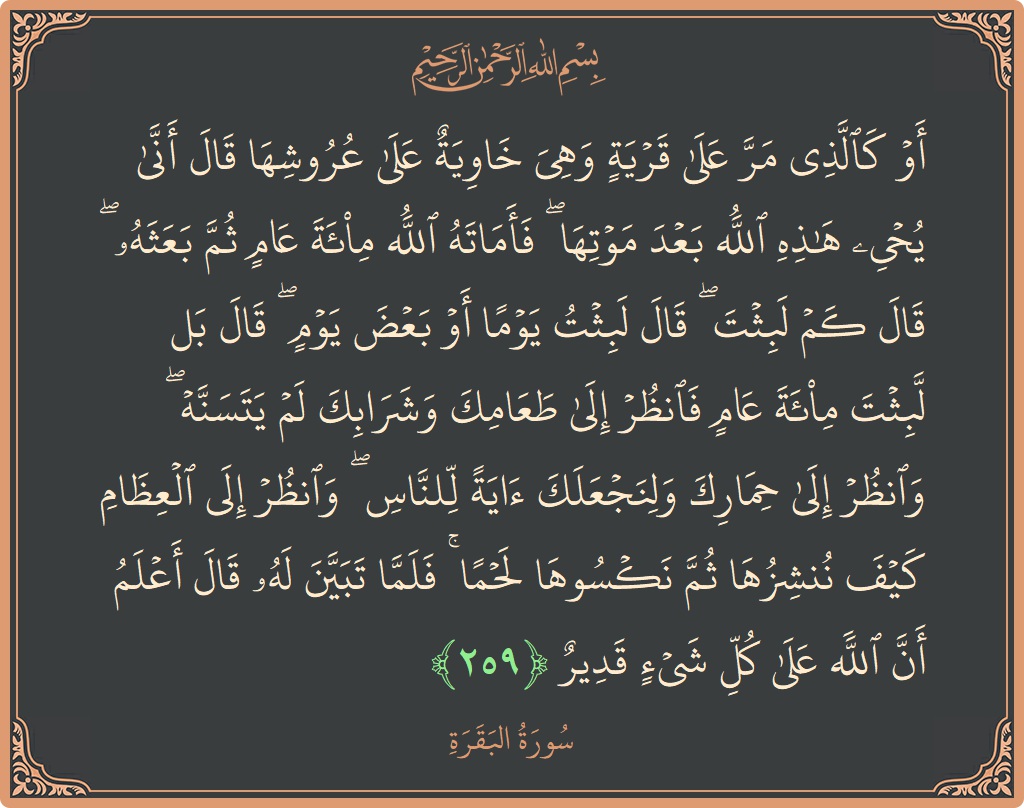
Surah Al-Baqara: Verse 259 - أو كالذي مر على قرية... - English
Tafsir of Verse 259, Surah Al-Baqara
English Translation
Or [consider such an example] as the one who passed by a township which had fallen into ruin. He said, "How will Allah bring this to life after its death?" So Allah caused him to die for a hundred years; then He revived him. He said, "How long have you remained?" The man said, "I have remained a day or part of a day." He said, "Rather, you have remained one hundred years. Look at your food and your drink; it has not changed with time. And look at your donkey; and We will make you a sign for the people. And look at the bones [of this donkey] - how We raise them and then We cover them with flesh." And when it became clear to him, he said, "I know that Allah is over all things competent."English Transliteration
Aw kaallathee marra AAala qaryatin wahiya khawiyatun AAala AAurooshiha qala anna yuhyee hathihi Allahu baAAda mawtiha faamatahu Allahu miata AAamin thumma baAAathahu qala kam labithta qala labithtu yawman aw baAAda yawmin qala bal labithta miata AAamin faonthur ila taAAamika washarabika lam yatasannah waonthur ila himarika walinajAAalaka ayatan lilnnasi waonthur ila alAAithami kayfa nunshizuha thumma naksooha lahman falamma tabayyana lahu qala aAAlamu anna Allaha AAala kulli shayin qadeerunTafsir of Verse 259
The Story of `Uzayr
Allah's statement,
(Have you not looked at him who disputed with Ibrahim about his Lord) means, "Have you seen anyone like the person who disputed with Ibrahim about his Lord" Then, Allah connected the Ayah,
(Or like the one who passed by a town in ruin up to its roofs) to the Ayah above by using `or'.
Ibn Abi Hatim recorded that `Ali bin Abi Talib said that the Ayah 2:259 meant `Uzayr. Ibn Jarir also reported it, and this explanation was also reported by Ibn Jarir and Ibn Abi Hatim from Ibn `Abbas, Al-Hasan, Qatadah, As-Suddi and Sulayman bin Buraydah.
Mujahid bin Jabr said that the Ayah refers to a man from the Children of Israel, and the village was Jerusalem, after Nebuchadnezzar destroyed it and killed its people.
(in ruin) means, it became empty of people. Allah's statement,
(up to its roofs) indicates that the roofs and walls (of the village) fell to the ground. `Uzayr stood contemplating about what had happened to that city, after a great civilization used to inhabit it. He said,
(Oh! How will Allah ever bring it to life after its death) because of the utter destruction he saw and the implausibility of its returning to what it used to be. Allah said,
(So Allah caused him to die for a hundred years, then raised him up (again).)
The city was rebuilt seventy years after the man (`Uzayr) died, and its inhabitants increased and the Children of Israel moved back to it. When Allah resurrected `Uzayr after he died, the first organ that He resurrected were his eyes, so that he could witness what Allah does with him, how He brings life back to his body. When his resurrection was complete, Allah said to him, meaning through the angel,
("How long did you remain (dead)" He (the man) said: "(Perhaps) I remained (dead) a day or part of a day.")
The scholars said that since the man died in the early part of the day and Allah resurrected him in the latter part of the day, when he saw that the sun was still apparent, he thought that it was the sun of that very day. He said,
("Or part of a day. " He said: "Nay, you have remained (dead) for a hundred years, look at your food and your drink, they show no change.")
He had grapes, figs and juice, and he found them as he left them; neither did the juice spoil nor the figs become bitter nor the grapes rot.
(And look at your donkey!), "How Allah brings it back to life while you are watching."
(And thus We have made of you a sign for the people) that Resurrection occurs.
(Look at the bones, how We Nunshizuha) meaning, collect them and put them back together. In his Mustadrak, Al-Hakim, recorded that Kharijah bin Zayd bin Thabit said that his father said that the Messenger of Allah read this Ayah,
(how We Nunshizuha.) Al-Hakim said; "Its chain is Sahih and they (Al-Bukhari and Muslim) did not record it." The Ayah was also read,
(نُنْشِرُهَا)
"Nunshiruha" meaning, bring them back to life, as Mujahid stated.
(And clothe them with flesh. )
As-Suddi said, " `Uzayr observed the bones of his donkey, which were scattered all around him to his right and left, and Allah sent a wind that collected the bones from all over the area. Allah then brought every bone to its place, until they formed a full donkey made of fleshless bones. Allah then covered these bones with flesh, nerves, veins and skin. Allah sent an angel who blew life in the donkeys' nostrils, and the donkey started to bray by Allah's leave." All this occurred while `Uzayr was watching, and this is when he proclaimed,
(He said, "I know (now) that Allah is able to do all things,") meaning, "I know that, and I did witness it with my own eyes. Therefore, I am the most knowledgeable in this matter among the people of my time."