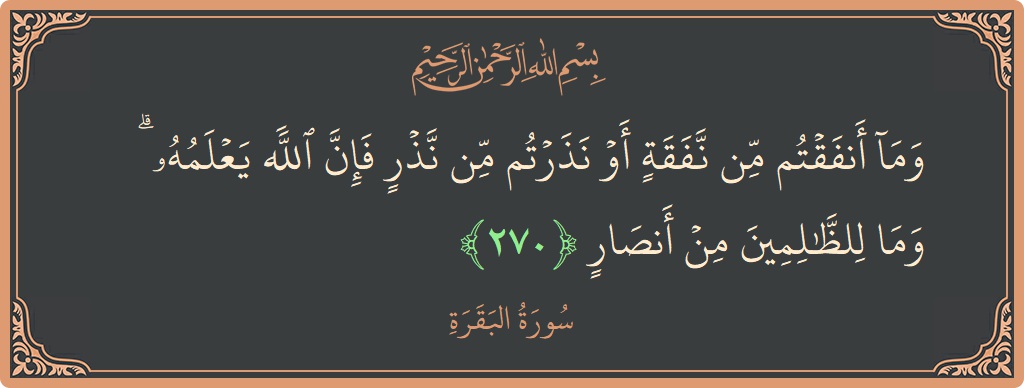
Surah Al-Baqara: Verse 270 - وما أنفقتم من نفقة أو... - English
Tafsir of Verse 270, Surah Al-Baqara
English Translation
And whatever you spend of expenditures or make of vows - indeed, Allah knows of it. And for the wrongdoers there are no helpers.English Transliteration
Wama anfaqtum min nafaqatin aw nathartum min nathrin fainna Allaha yaAAlamuhu wama lilththalimeena min ansarinTafsir of Verse 270
(4) Verse 270: وَمَا أَنفَقْتُم مِّن نَّفَقَةٍ (الی قولہ) وَمَا لِلظَّالِمِينَ مِنْ أَنصَارٍ: "And whatever spending you do ... and for the unjust, there are no supporters."
Here, "and whatever spending you do" covers all spendings - those in which all related conditions are observed and those too, in which all or some conditions are not observed. For instance, it may not be in the way of Allah but be in the ways of sin; or the act of giving may be mixed up with hypocrisy; or may be followed by making a show of the favour before the receiver; or it may not be حلال halal (lawful) and good.
Similarly, all votive offerings (نذور : nudhur) come under the general purview of (nadhr نذر : singular: votive offering), for instance, it includes the nadhr نذر of monetary ` ibadah in accordance with which nadhr نذر has been introduced alongwith infaq (spending) and may also include nadhr نذر of physical ` ibadah. It may be absolute, or dependent on something else; or it may or may not have been fulfilled. The purpose of saying all this is that Allah Almighty knows all these things and He shall recompense for them duly. This was made known so that people are persuaded to observe limits and conditions and be warned of their non-observance. The word (al-zalimin الظَّالِمِينَ ) in the text refers to the unjust, the transgressors, who do not observe the necessary conditions. To them was given clear warning.
Allah states that He has perfect knowledge of the good deeds performed by all of His creation, such as charity and various vows, and He rewards tremendously for these deeds, provided they are performed seeking His Face and His promise. Allah also warns those who do not work in his obedience, but instead disobey His command, reject His revelation and worship others besides Him:
(And for the wrongdoers there are no helpers.) meaning, who will save them from Allah's anger and torment on the Day of Resurrection.
The Virtue of Disclosing or Concealing Charity
Allah said,
(If you disclose your Sadaqat, it is well) meaning, "It is well if you make known the charity that you give away."
Allah's statement,
(But if you conceal them and give them to the poor, that is better for you.) this indicates that concealing charity is better than disclosing it, because it protects one from showing off and boasting. However, if there is an apparent wisdom behind disclosing the charity, such as the people imitating this righteous act, then disclosing it becomes better than concealing it. The Messenger of Allah said,
(He who utters aloud Qur'anic recitation is just like he who discloses charity acts. He who conceals Qur'anic recitation is just like he who conceals charity acts.)
The Ayah indicates that it is better that acts of charity be concealed, as reiterated by the Hadith that the Two Sahihs recorded from Abu Hurayrah that the Messenger of Allah said,
(Allah will give shade to seven on the Day when there will be no shade but His. (They are:) a just ruler, a youth who has been brought up in the worship of Allah, two persons who love each other only for Allah's sake who meet and part in Allah's cause only, a man whose heart is attached to the Masjids from the time he departs the Masjid until he returns to it, a person who remembers Allah in seclusion and his eyes are then flooded with tears, a man who refuses the call of a charming woman of noble birth for illicit intercourse with her and says, `I fear Allah, Lord of the worlds', and a man who gives charitable gifts so secretly that his left hand does not know what his right hand has given.)
Allah's statement,
((Allah) will expiate you some of your sins) means, in return for giving away charity, especially if it was concealed. Therefore, you will gain goodness by your rank being raised, and your sins being forgiven.
Allah's statement,
(And Allah is Well-Acquainted with what you do) means, "No good deed that you perform escapes His knowledge, and He shall reward for it."