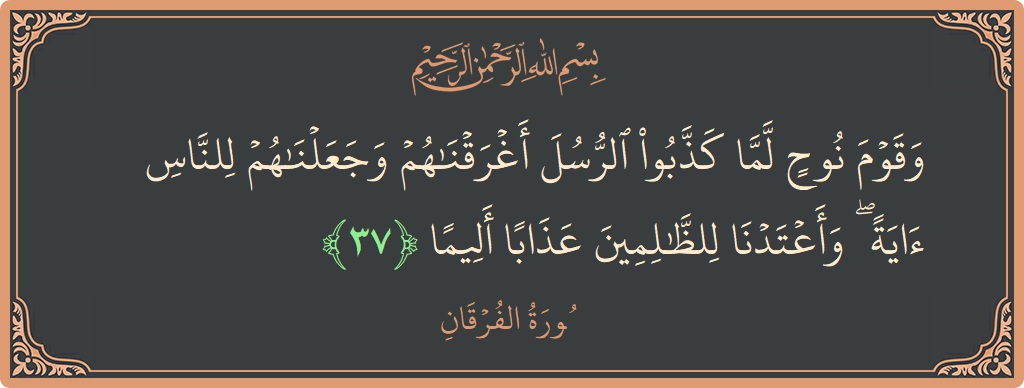
Surah Al-Furqaan: Verse 37 - وقوم نوح لما كذبوا الرسل... - English
Tafsir of Verse 37, Surah Al-Furqaan
English Translation
And the people of Noah - when they denied the messengers, We drowned them, and We made them for mankind a sign. And We have prepared for the wrongdoers a painful punishment.English Transliteration
Waqawma noohin lamma kaththaboo alrrusula aghraqnahum wajaAAalnahum lilnnasi ayatan waaAAtadna lilththalimeena AAathaban aleemanTafsir of Verse 37
Commentary
In the above verses it is mentioned that it had been the common practice of the people through the ages to rebuff the prophets and the message they had brought. In order to give weight to this assertion a few of the well known prophets are mentioned who were rejected by their people and then they were subjected to Allah's wrath and were annihilated completely. By drawing a parallel with the past generations it is elucidated that the pagans of Makkah would not listen to any reason as they were no better than the animals or even worse than that.
It is stated about the people of Sayyidna Nuh (علیہ السلام) that they had rejected the prophets, although they had neither seen the past prophets nor had they rejected them. at is actually meant here is that while denying Sayyidna Nuh (علیہ السلام) they had by implication rejected all the prophets, because the principals of religion expounded by all prophets are essentially the same. Hence rejection of one prophet is tantamount to rejection of all.
أَصْحَابَ الرَّسِّ (People of Rass - 25:38). In Arabic رَس (Rass) means unlined well. Neither Qur'an nor any authentic tradition describes these people in any detail. Whatever information is available about them is through Israelite traditions, which differ from one another. It is more likely that the remaining people of Thamud had settled down near a well. It is not mentioned in the Qur'an or any tradition as to how they were tormented. (Bayan u1-Qur'an)