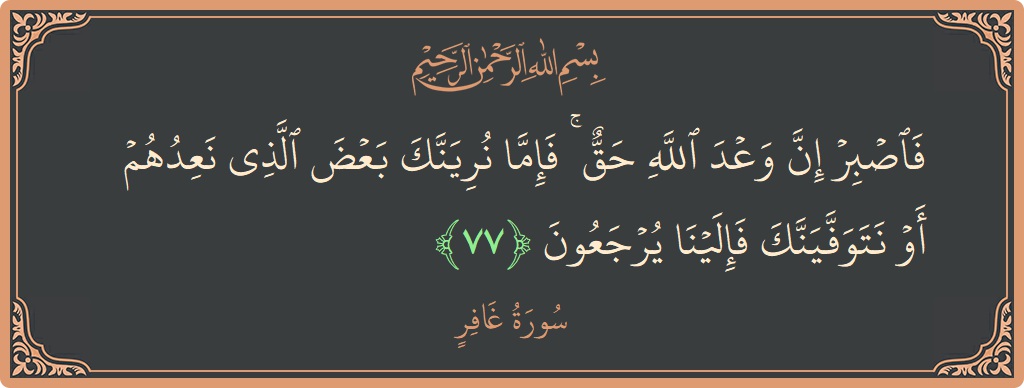
Surah Al-Ghaafir: Verse 77 - فاصبر إن وعد الله حق... - English
Tafsir of Verse 77, Surah Al-Ghaafir
English Translation
So be patient, [O Muhammad]; indeed, the promise of Allah is truth. And whether We show you some of what We have promised them or We take you in death, it is to Us they will be returned.English Transliteration
Faisbir inna waAAda Allahi haqqun faimma nuriyannaka baAAda allathee naAAiduhum aw natawaffayannaka failayna yurjaAAoonaTafsir of Verse 77
In verse 77, it was said: فَاصْبِرْ إِنَّ وَعْدَ اللَّـهِ حَقٌّ فَإِمَّا نُرِيَنَّكَ (Therefore, be patient. Surely, the promise of Allah is true. Then, whether We show you [ in your life ] a part of the promise We are making to them, or make you die [ before they are punished ], in any case they have to be returned to Us). From this verse it appears that the Holy Prophet ﷺ was hopefully waiting for the disbelievers to be punished. Therefore, it was to comfort him that he was asked to be somewhat patient about it. The promise of Allah for them, that they will be punished, will certainly be fulfilled - may be during his lifetime, or after he has departed from the mortal world. Waiting for the disbelievers to be punished apparently seems contrary to the dignity of one who was sent with universal mercy. But, here the matter is different. When the purpose of punishing criminals is to bring comfort to innocent believers who were oppressed, then, the punishment of criminals is not contrary to compassion and mercy. Nobody regards the punishment given to a criminal against the dictate of mercy.
The Command to be Patient and Good News of Victory
Here Allah commands His Messenger to patiently bear the rejection of those who rejected him: `Allah will fulfill His promise to you that you will be victorious and will prevail over your people, and you and those who follow you, will be the successful ones in this world and the Hereafter.'
(and whether We show you some part of what We have promised them,) means, in this world, and this is what happened, for Allah gave them the joy of humiliating the leaders and nobles (of the Quraysh), who were killed on the day of Badr, then Allah granted them victory over Makkah and the entire Arabian Peninsula during the lifetime of the Prophet .
(or We cause you to die, then still it is to Us they all shall be returned.) means, `and We shall inflict a severe punishment upon them in the Hereafter.' Then Allah says, consoling His Prophet :
(And, indeed We have sent Messengers before you, of some of them We have related to you their story.) as Allah also says in Surat An-Nisa', meaning, `We have revealed the stories of some of them and how their people disbelieved in them, but the Messengers ultimately prevailed.'
(And of some We have not related to you their story, ) and they are many, many more than those whose stories have been told, as has been stated in Surat An-Nisa'. Praise and blessings be to Allah.
(and it was not given to any Messenger that he should bring a sign except by the leave of Allah.) means, none of the Prophets was able to bring miracles to his people except when Allah granted him permission to do that as a sign of the truth of the message he brought to them.
(But, when comes the commandment of Allah,) means, His punishment and vengeance which will encompass the disbelievers,
(the matter will be decided with truth,) so the believers will be saved and the disbelievers will be destroyed. Allah says:
(and the followers of falsehood will then be lost.)