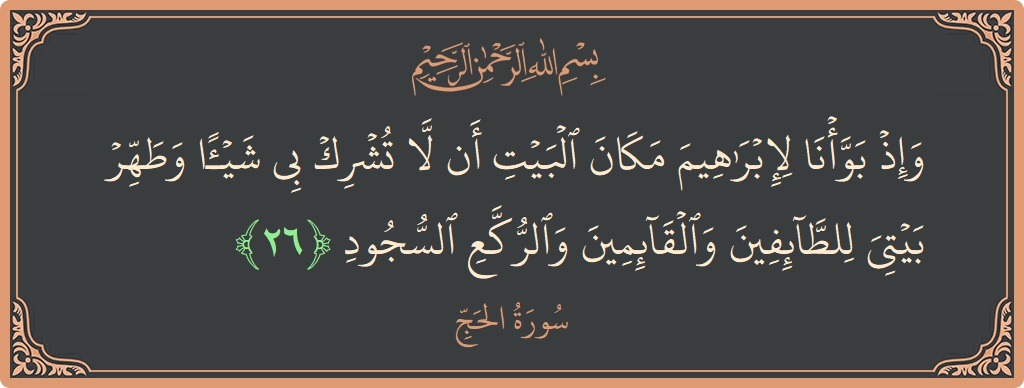
Surah Al-Hajj: Verse 26 - وإذ بوأنا لإبراهيم مكان البيت... - English
Tafsir of Verse 26, Surah Al-Hajj
English Translation
And [mention, O Muhammad], when We designated for Abraham the site of the House, [saying], "Do not associate anything with Me and purify My House for those who perform Tawaf and those who stand [in prayer] and those who bow and prostrate.English Transliteration
Waith bawwana liibraheema makana albayti an la tushrik bee shayan watahhir baytiya lilttaifeena waalqaimeena waalrrukkaAAi alssujoodiTafsir of Verse 26
Commentary
The previous verse contains a warning of severe punishment to the infidels who prevented the Muslims from entering the Sacred Mosque and the precincts of Haram. This verse describes the eminence and the superior status of the Baitullah which magnifies manifold the evil of their deeds.
The start of founding the structure of the House of Allah (the Holy Ka'bah)
وَإِذْ بَوَّأْنَا لِإِبْرَاهِيمَ مَكَانَ الْبَيْتِ (And [ remember ] when We pointed out for Ibrahim the place of the House - 22:26.) The word بَوَّء literally means ` to assign to someone a place for his residence.' The verse calls to attention the fact that Allah assigned to Sayyidna Ibrahim علیہ السلام a place where Baitullah was located. There is a hint here that he was not settled there already, since he migrated here from Syria. And a reference to مَکَانَ البَیت (the place of the House) suggests that the House of Allah pre-existed the arrival of Sayyidna Ibrahim (علیہ السلام) ، because according to reliable traditions its first foundations were laid about the time when Sayyidna 'Adam (علیہ السلام) was sent upon the earth and he, and the prophets who came after him, used to make tawaf (circumambulation) around it. At the time of Deluge in the days of Sayyidna Nuh (علیہ السلام) its upper-structure was removed but the foundations remained intact. Sayyidna Ibrahim (علیہ السلام) was brought to this place and commanded by Allah Ta’ ala أَن لَّا تُشْرِكْ بِي شَيْئًا (Do not associate with Me any one - 22:26). It is quite evident that Sayyidna Ibrahim (علیہ السلام) could not commit shirk, because he had himself suffered considerable torment at the hands of polytheists after they accused him of having destroyed their idols. The intention here is to warn the people at large against the great sin of polytheism. The second command was وَطَهِّرْ بَيْتِيَ (purify My House - 22:26), even though the House of Allah did not exist at that time. But the fact of the matter is that Baitullah is not just a structure of bricks and mortar, rather the term encompasses that entire piece of sacred land where Baitullah once stood and whose structure Sayyidna Ibrahim (علیہ السلام) was now commanded to raise once again on the original foundations. As for the command to purify the place, Qurtubi says that in those days the tribes of Jurhum (جُرھَم) and Amalakites (عمالقہ) had placed idols there, which they worshipped. (Qurtubi) Another view is that this command is for the future generations not only to keep the place free from infidelity and polytheism but also to pay special attention to its external cleanliness and purity.
Building of the Ka`bah and the Proclamation of the Hajj
This is a rebuke to those among Quraysh who worshipped others than Allah and joined partners with Him in the place which from the outset had been established on the basis of Tawhid and the worship of Allah Alone, with no partner or associate. Allah tells us that He showed Ibrahim the site of the `Atiq House, i.e., He guided him to it, entrusted it to him and granted him permission to build it. Many scholars take this as evidence to support their view that Ibrahim was the first one to build the House and that it was not built before his time. It was recorded in the Two Sahihs that Abu Dharr said, "I said, `O Messenger of Allah, which Masjid was the first to be built' He said,
(Al-Masjid Al-Haram.) I said, `Then which' He said,
(Bayt Al-Maqdis.) I said, `How long between them' He said,
(Forty years.)" And Allah says:
(Verily, the first House (of worship) appointed for mankind was that at Bakkah (Makkah), full of blessing) 3:96 until the end of following two Ayat. Allah says:
(and We commanded Ibrahim and Isma`il that they should purify My House for those who are circumambulating it, or staying (I`tikaf), or bowing or prostrating themselves.) 2:125 And Allah says here:
(Associate not anything with Me,) meaning, `Build it in My Name Alone.'
(and sanctify My House) Qatadah and Mujahid said, "And purify it from Shirk.
(for those who circumambulate it, and those who stand up, and those who bow, and make prostration (in prayer)) means, `and make it purely for those who worship Allah Alone, with no partner or associate.' What is meant by "those who circumambulate it" is obvious, since this is an act of worship that is done only at the Ka`bah and not at any other spot on earth.
(and those who stand up) means, in prayer. Allah says:
(and those who bow, and make prostration.) Tawaf and prayer are mentioned together because they are not prescribed together anywhere except in relation to the House. Tawaf is done around the Ka`bah and prayer is offered facing its direction in the majority of cases, with a few exceptions, such as when one is uncertain of the direction of the Qiblah, during battle and when praying optional prayers while traveling. And Allah knows best.
(And proclaim to mankind the Hajj) meaning, `announce the pilgrimage to mankind and call them to perform pilgrimage to this House which We have commanded you to build.' It was said that Ibrahim said: "O Lord, how can I convey this to people when my voice will not reach them" It was said: "Call them and We will convey it." So Ibrahim stood up and said, "O mankind! Your Lord has established a House so come on pilgrimage to it." It is said that the mountains lowered themselves so that his voice would reach all the regions of the earth, and those who were still in their mothers' wombs and their fathers' loins would hear the call. The response came from everyone in the cities, deserts and countryside, and those whom Allah has decreed will make the pilgrimage, until the Day of Resurrection: "At Your service, O Allah, at Your service." This is a summary of the narrations from Ibn `Abbas, Mujahid, `Ikrimah, Sa`id bin Jubayr and others among the Salaf. And Allah knows best. This was recorded by Ibn Jarir and by Ibn Abi Hatim at length.
(They will come to you on foot and on every lean camel,) This Ayah was used as evidence by those scholars whose view is that Hajj performed on foot by those who are able, is better than Hajj performed riding, because the phrase "on foot" is mentioned first, and because it is an indication of their keenness and resolve. Waki` narrated from Abu Al-`Umays from Abu Halhalah from Muhammad bin Ka`b that Ibn `Abbas said, "I do not regret anything except for the fact that I wish I had performed Hajj on foot, because Allah says,
(They will come to you on foot)." But the majority are of the view that performing Hajj while riding is better, following the example of the Messenger of Allah , because he performed Hajj riding, although his physical ability was sound.
(they will come from every Fajj) means every route, as Allah says:
(and We placed therein Fijaj for them to pass) 21:31.
(`Amiq) means dis- tant. This was the view of Mujahid, `Ata', As-Suddi, Qatadah, Muqatil bin Hayan, Ath-Thawri and others. This Ayah is like the Ayah in which Allah tells us how Ibrahim prayed for his family,
(So fill some hearts among men with love towards them) 14:37. There is no one among the Muslims who does not long to see the Ka`bah and perform Tawaf, people come to this spot from every corner of the world.