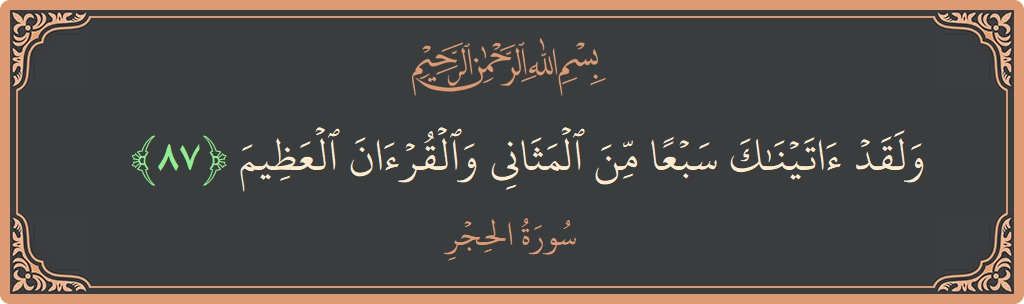
Surah Al-Hijr: Verse 87 - ولقد آتيناك سبعا من المثاني... - English
Tafsir of Verse 87, Surah Al-Hijr
English Translation
And We have certainly given you, [O Muhammad], seven of the often repeated [verses] and the great Qur\'an.English Transliteration
Walaqad ataynaka sabAAan mina almathanee waalqurana alAAatheemaTafsir of Verse 87
Commentary
Surah Al-Fatihah is the Text and Summary of the Whole Qur'an
That Surah Al-Fatihah (The Opening) has been called the Glorious Qur’ an in this verse (87) indicates that Surah Al-Fatihah is, in a way, the whole Qur’ an - because the basic principles of Islam have been merged in it.l
1. In order to understand this, one must keep in mind that the words: اَلسَبعَ المثانِی واَلقُرآن (the seven oft repeated verses and the glorious Qur'an) in verse (87) are interpreted by the commentators in different ways. Most of them are of the view that 'seven oft-repeated verses' refer to Surah al-Fatihah which consists of seven verses. Since these seven verses are repeated in every Salah, they have been referred to in the verse 87 as 'oft-repeated verses'. Then, the words 'and the glorious Qur'an' occurring after it are of explanatory nature which refer to the same 'seven oft repeated verses'. Therefore, the name of the 'glorious Qur'an' has been given here to the Surah al-Fatihah itself. The comment of the author is based on this interpretation.
On Being Questioned in Al-Mal} shar : About what will it be?
In verse 92, swearing by His Own sacred Being, Allah Ta’ ala has declared that all such people who came earlier or later shall definitely be questioned.
The Sahabah ؓ asked the Holy Prophet ﷺ as to what it will be about. He said that it will be about saying: لا إله إلا اللہ (la ilaha illallah: there is no god worthy of worship but Allah). Al-Qurtubi, after reporting this narration in his Tafsir, has said: It means the fulfilling of this pledge practically as signified by the Kalimah Tayyibah: La ilaha illallah. A simple verbal statement is not what is desired here because, as for verbal attestation, that was done by the hypocrites (munafiqin) too. Hazrat al-Hasan al-Basri (رح) said: 'Iman (faith) does not become a living reality by taking on a particular style and form, and Din (religion) does not prosper by simply having the best of wishes for it. 'Iman is the name of that certitude which has been poured into the heart and which has been proved true by deeds. This is well illustrated by a Hadith from Sayyidna Zayd ibn Arqam in which the Holy Prophet ﷺ has been reported to have said: A person who says: لا إله إلا اللہ (la ilaha illallah : there is no god worthy of worship but Allah) with ikhlas (totally unalloyed sincerity) will definitely go to Jannah. People asked: Ya Rasul Allah, how is 'ikhlas' related to this Kalimah? He said: When this Kalimah stops a person from what has been prohibited by Allah as unlawful and impermissible, then, it is with 'ikhlas' (with sincerity in the absolute sense). (Qurtubi)
A Reminder of the Blessing of the Qur'an and the Command to focus on its Message
Allah is saying to His Prophet : Since We have given you the Grand Qur'an, then do not look at this world and its attractions, or the transient delights that we have given to its people in order to test them. Do not envy what they have in this world, and do not upset yourself with regret for their rejection of you and their opposition to your religion.
(And lower your wings to the believers who follow you) (26:215) meaning - be gentle with them, like the Ayah,
(Verily, there has come unto you a Messenger from among yourselves. It grieves him that you should receive any injury or difficulty. He is anxious for you, for the believers - he is full of pity, kind and merciful)(9:128). There were some differences among the scholars over the meaning of "seven of the Mathani". Ibn Mas`ud, Ibn `Umar, Ibn `Abbas, Mujahid, Sa`id bin Jubayr, Ad-Dahhak and others said that they are the seven long (Surahs), meaning Al-Baqarah, Al- `Imran, An-Nisa', Al-Ma'idah, Al-An`am, Al-A`raf and Yunus. There are texts to this effect reported from Ibn `Abbas and Sa`id bin Jubayr. Sa`id said: "In them, Allah explains the obligations, the Hudud (legal limits), stories and rulings." Ibn `Abbas said, "He explains the parables, stories and lessons." The second opinion is that they (the seven of the Mathani) are Al-Fatihah, which is composed of seven Ayat. This was reported from `Ali, `Umar, Ibn Mas`ud and Ibn `Abbas. Ibn `Abbas said: "The Bismillah, is completing seven Ayah, which Allah has given exclusively to you (Muslims)." This is also the opinion of Ibrahim An-Nakha`i, `Abdullah bin `Umayr, Ibn Abi Mulaykah, Shahr bin Hawshab, Al-Hasan Al-Basri and Mujahid. Al-Bukhari, may Allah have mercy on him, recorded two Hadiths on this topic. (The first) was recorded from Abu Sa`id bin Al-Mu`alla, who said: "The Prophet passed by me while I was praying. He called out for me but I did not come until I finished my prayer. Then I came to him, and He asked,
(What stopped you from coming to me) I said, `I was praying'. He said,
(O you who believe! Answer Allah (by obeying Him) and (His) Messenger when he calls you...) 8:24
(Shall I not teach you the most magnificent Surah before I leave the Masjid) Then the Prophet went to leave the Masjid, and I reminded him, so he said,
("Al-Hamdu Lillahi Rabbil-'Alamin All praises and thanks be to Allah, the Lord of all that exists)(1:2).
(This is the seven of the Mathani and the Qur'an which I have been given.)" (The second Hadith) was reported from Abu Hurayrah who said that the Messenger of Allah said:
(Umm Al-Qur'an (the Mother or the Essence of the Qur'an,) is the seven Mathani, and the Grand Qur'an.) This means that Al-Fatihah is the seven Mathani and the Grand Qur'an, but this does not contradict the statement that the seven Mathani are the seven long Surahs, because they also share these attributes, as does the whole Qur'an. As Allah says,
(Allah has sent down the best statement, a Book (this Qur'an), its parts resembling each other in goodness and truth, oft-recited) (39:23). So it is oft-recited in one way, and its parts resemble one another in another way, and this is also the Grand Qur'an.
(Look not with your eyes ambitiously at what We have given to certain classes of them) 20: 131 meaning, be content with the Grand Qur'an that Allah has given to you, and do not long for the luxuries and transient delights that they have.
(Look not with your eyes ambitiously) Al-`Awfi reported that Ibn `Abbas said: "He in this Ayah forbade a man to wish for what his companion has."
(at what We have given to certain classes of them,) Mujahid said: "This refers to the rich."