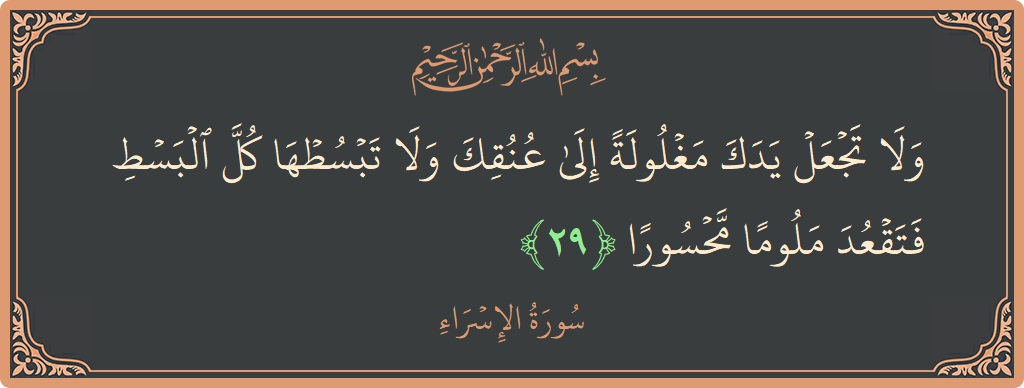
Surah Al-Israa: Verse 29 - ولا تجعل يدك مغلولة إلى... - English
Tafsir of Verse 29, Surah Al-Israa
English Translation
And do not make your hand [as] chained to your neck or extend it completely and [thereby] become blamed and insolvent.English Transliteration
Wala tajAAal yadaka maghloolatan ila AAunuqika wala tabsutha kulla albasti fataqAAuda malooman mahsooranTafsir of Verse 29
Commentary
The instruction for moderation in spending
In this verse, the Holy Prophet ﷺ is the direct addressee while the entire Muslim ummah is being addressed through him. The purpose is to teach a just and moderate course in spending which does not prevent one from helping others nor does it end up in a lot of trouble for him. There is an event in the background of the revelation of this verse. Ibn Marduwayh has reported it on the authority of Sayyidna ` Abdullah ibn Mas’ ud ؓ and al-Baghawi, on the authority of Sayyidna Jabir. According to this report, a boy came to the Holy Prophet ﷺ and said, "My mother asks of you a shirt." At that time, the Holy Prophet ﷺ had no shirt except the one that was on his blessed body. He told the boy, "Come some other time when we have enough means to respond to what your mother is asking for." The boy went back home, and returned and said, "My mother says that you kindly give her the very shirt you have on your blessed body." Hearing this, the Holy Prophet ﷺ took the shirt off and let him have it. His body was left bare. Came the time for Salah. Sayyidna Bilal ؓ called the Adhan. But, when he did not come out as usual, people were worried. When some of them went in, they saw that he was sitting bare-bodied without the shirt. Thereupon, this verse was revealed.
Moderation in Spending
Allah enjoins moderation in living. He condemns miserliness and forbids extravagance.
(And let not your hand be tied (like a miser) to your neck,) this means, do not be miserly and stingy, never giving anything to anyone, as the Jews - may the curses of Allah be upon them - said, "Allah's Hand is tied up (i.e., He does not give and spend of His bounty)". They attributed miserliness to Him, Exalted and Sanctified be the Most Generous Bestower!
(nor overextend it (like a spendthrift)) means, nor be extravagant in spending and giving more than you can afford, or paying more than you earn, lest you become blameworthy and find yourself in severe poverty. If you are a miser, people will blame you and condemn you, and no longer rely on you. When you spend more than you can afford, you will find yourself without anything to spend, so you will be worn out, like an animal that cannot walk, so it becomes weak and incapable. It is described as worn out, which is similar in meaning to exhausted. As Allah says:
(Then look again: "Can you see any rifts" Then look again and yet again, your sight will return to you in a state of humiliation and worn out. ) (67:3-4) meaning, unable to see any faults. Similarly, Ibn `Abbas, Al-Hasan, Qatadah, Ibn Jurayj, Ibn Zayd and others understood this Ayah as miserliness and extravagance. It was reported in the Two Sahihs from the Hadith of Abu Az-Zinad from Al-A`raj that Abu Hurayrah heard the Messenger of Allah say:
(The parable of the miser and the almsgiver is that of two persons wearing iron cloaks from their chests to their collar-bones. When the almsgiver gives in charity, the cloak becomes spacious until it covers his whole body to such an extent that it hides his fingertips and covers his tracks (obliterates his tracks - or, his sins will be forgiven). And when the miser wants to spend, it (the iron cloak) sticks and (its) every ring gets stuck to its place, and he tries to widen it, but it does not become wide.) This version was recorded by Al-Bukhari in the Book of Zakah. In the Two Sahihs it is recorded that Mu`awiyah bin Abi Muzarrid narrated from Sa`id bin Yasar that Abu Hurayrah said: "The Messenger of Allah said:
(There is no day when a person wakes up but two angels come down from heaven. One of them says, `O Allah, compensate the one who gives (in charity),' and the other one says, `O Allah, destroy the one who withholds.')" Muslim recorded from Abu Hurayrah that the Prophet said:
(Wealth never decreases because of Sadaqah (charity). Allah never increases a servant who gives in charity except in honor, and whoever is humble for the sake of Allah, Allah will raise him in status.) According to a Hadith narrated by Abu Kathir from `Abdullah bin `Amr, who attributed it to the Prophet :
(Beware of stinginess for it destroyed the people who came before you. It commanded them to be miserly, so they were miserly; and it commanded them to cut the ties of kinship, so they cut them; and it commanded them to commit immoral actions, so they did so.)
(Truly, your Lord expands the provision for whom He wills and straitens (for whom He wills).) This Ayah is telling us that Allah is the One Who provides or withholds, the Bestower Who is running the affairs of His creation as He wills. He makes rich whomever He wills, and He makes poor whomever He wills, by the wisdom that is His. He said: /
(Verily, He is Ever All-Knower, All-Seer of His servants.) meaning, He knows and sees who deserves to be rich and who deserves to be poor. In some cases, richness may be decreed so that a person gets carried away, leading to his own doom. In other cases, poverty may be a punishment. We seek refuge with Allah from both.