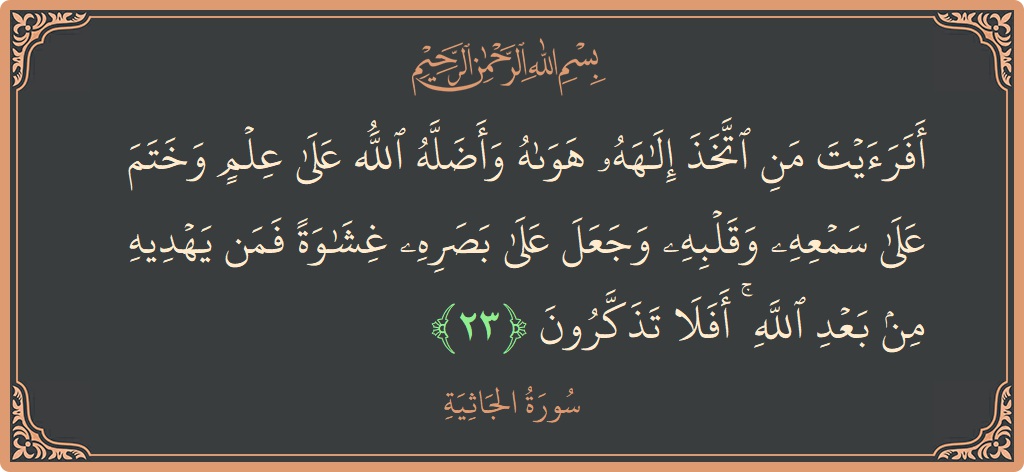
Surah Al-Jaathiya: Verse 23 - أفرأيت من اتخذ إلهه هواه... - English
Tafsir of Verse 23, Surah Al-Jaathiya
English Translation
Have you seen he who has taken as his god his [own] desire, and Allah has sent him astray due to knowledge and has set a seal upon his hearing and his heart and put over his vision a veil? So who will guide him after Allah? Then will you not be reminded?English Transliteration
Afaraayta mani ittakhatha ilahahu hawahu waadallahu Allahu AAala AAilmin wakhatama AAala samAAihi waqalbihi wajaAAala AAala basarihi ghishawatan faman yahdeehi min baAAdi Allahi afala tathakkaroonaTafsir of Verse 23
Commentary
مَنِ اتَّخَذَ إِلَـٰهَهُ هَوَاهُ ("Have you seen him who has taken his desires as his god...45:23) In other words, he who has made his selfish desires his object of worship. Obviously, no unbeliever claims that his desires are his object of worship. Keeping this in view, this verse of the Qur'an indicates that ` worship' actually means ` obedience'. Thus anyone who undertakes to obey someone against the obedience of Allah makes him the object of his worship instead of Allah. There are people who ignore what Allah has declared lawful and unlawful or what He has permitted and what has forbidden. People who do not care what Allah has forbidden and follow their whims and fancies, their desires are their god, in this sense, although they may not have uttered it by word of mouth. The same theme has been versified by an ` Arif:
سودہ گشت از سجدہ راہ بُتَاں پیشانیم چند برخود تھمت دین مسلمانی نھم
"My forehead has swollen by prostrating before the statues of beauty, although I claim to profess the religion of Islam."
In this couplet, the poet has portrayed selfish desires as statues. He who takes his desires as his leader and follows them is as good as their worshipper, that is why they have been described as their deities. Sayyidna Abu ` Umamah narrates that the Messenger of Allah ﷺ said: "Of all the deities worshipped under the firmament of the earth, the most detestable one in the sight of Allah is hawa, that is, selfish desires. Sayyidna Shaddad Ibn ` Aws ؓ narrates that the Messenger of Allah ﷺٍ said: "A wise person is he who keeps his desires under control and works for life after death; and sinful is he who runs after his desires and yet expects the best in the Hereafter." Sayyidna Sahl Ibn ` Abdullah Tustari ؓ said: "Your ailment is your selfish desires. And if you oppose them, it will turn into your cure." (All these narratives have been adapted from Qurtubi).