Surah Al-Jumu'a: Verse 11 - وإذا رأوا تجارة أو لهوا... - English
Tafsir of Verse 11, Surah Al-Jumu'a
English Translation
But when they saw a transaction or a diversion, [O Muhammad], they rushed to it and left you standing. Say, "What is with Allah is better than diversion and than a transaction, and Allah is the best of providers."English Transliteration
Waitha raaw tijaratan aw lahwan infaddoo ilayha watarakooka qaiman qul ma AAinda Allahi khayrun mina allahwi wamina alttijarati waAllahu khayru alrraziqeenaTafsir of Verse 11
Admonishing those who abandon the Imam while he is delivering the Jumu’ ah Khutbah [ Sermon ]
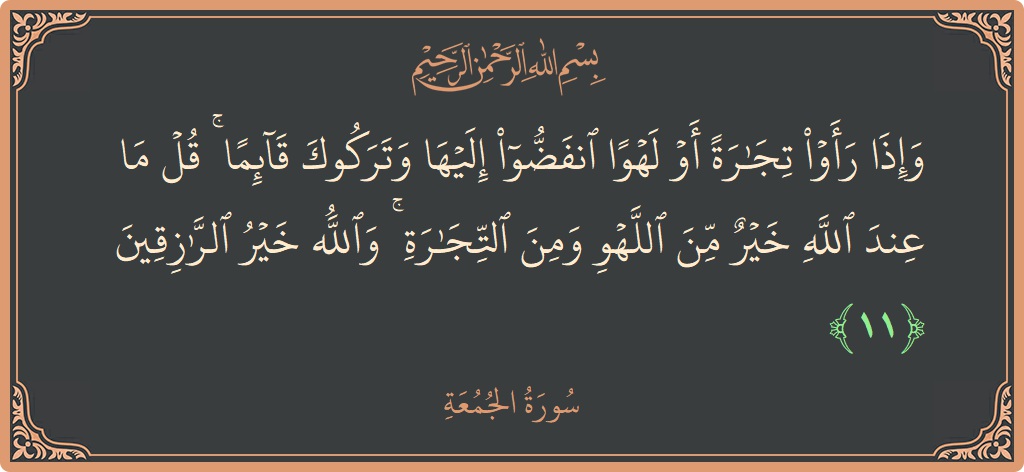
وَإِذَا رَأَوْا تِجَارَةً أَوْ لَهْوًا انفَضُّوا إِلَيْهَا وَتَرَكُوكَ قَائِمًا ۚ قُلْ مَا عِندَ اللَّـهِ خَيْرٌ مِّنَ اللَّـهْوِ وَمِنَ التِّجَارَةِ ۚ وَاللَّـهُ خَيْرُ الرَّازِقِينَ
And when they see some merchandise or amusement, they break away to it, and leave you standing. Say, “ What is with Allah is much better than the amusement and the merchandise, and Allah is the best giver of sustenance.” (62:11)
The verse admonishes those who once abandoned the Friday sermon and attended some trade activity. Imam Ibn Kathir says that this incident took place when the Holy Prophet ﷺ used to deliver the Friday sermon after the Jumu’ ah prayer, as it happens on ‘Idain عِیدَین even in our days. It once happened that the Friday prayer had finished and the Holy Prophet ﷺ was delivering his sermon. Suddenly a trading caravan arrived in the market-place of Madinah. Drums were beaten to announce the arrival of the caravan. The Friday prayer had finished and the sermon was in progress. Many of the noble Companions went away to the market-place. Only a few of them had remained behind with the Holy Prophet ﷺ who were about twelve in number [ according to a narration in Marasil of Abu Dawud ]. According to some narratives, the Messenger of Allah ﷺ said: “ If all had gone, the entire valley of Madinah would have been filled with the fire of punishment”. [ Transmitted by Abu Ya’ la, as quoted by Ibn Kathir ].
Muqatil, the leading scholar of Qur’ anic commentary, says that this was the trading caravan of Dihyah Ibn Khalaf Kalbi, which had come from Syria. This caravan normally came to Madinah with all the essentials, especially essential foodstuff. Whenever it arrived in Madinah, and the people came to know about it, men and women all rushed towards it. Dihyah Ibn Khalaf was not a Muslim until then. He became a Muslim later on.
Hasan al-Basri (رح) and Abu Malik said that that was a time when there was scarcity and dearth of things. [ Mazhari ] There were several factors on account of which a large group of the blessed Companions left the mosque when they heard the sound of the caravan. First, the fard prayer had already finished, and they did not know until then the status of the Friday sermon whether it was part of the fard prayer. Second, there was scarcity and dearth of essential goods and items. Third, buyers would rush to the caravan and they feared that if they did not make it in time, they would not be able to obtain their essentials. As a result, the noble Companions committed the mistake and the above Tradition sounded a warning, that is, if all of them had gone the Divine punishment would have overtaken them. The current verse إِذَا رَأَوْا تِجَارَةً was revealed to admonish them and put them to shame. For this reason, the Holy Prophet ﷺ ، since that day, changed the order of Friday sermon and prayer, delivering the sermons before the prayer. This is now the approved way [ Sunnah ]. [ Ibn Kathir ]
The verse under comment instructs the Holy Prophet ﷺ to tell the people that what is with Allah is better than the merchandise and amusement of this world, that is, the reward of the Hereafter. It is not far-fetched to conceive that people who forsake business and earning of livelihood for the sake or prayer and sermon will attract ample blessings in their provision from Allah, even in this world, as was cited earlier from the righteous elders on the authority of Ibn Kathir.
Al-Hamdulillah
The Commentary on
Surah Al-Jumu’ ah
Ends here.
The Prohibition of leaving the Masjid while the Imam is delivering the Friday Sermon
Allah criticizes what happened during one Friday sermon, when a caravan arrived at Al-Madinah and the people rushed out to the merchandise. Allah said,
(And when they see some merchandise or some amusement, they disperse headlong to it, and leave you standing.) meaning, on the Minbar, delivering the Khutbah. Several of the Tabi`in said this, such as Abu Al-`Aliyah, Al-Hasan, Zayd bin Aslam and Qatadah. Muqatil bin Hayyan said that the caravan belonged to Dihyah bin Khalifah before he became a Muslim, and there were drums accompanying it.So they rushed to the caravan and left Allah's Messenger standing on the Minbar. Only a few remained, according to the authentic Hadith that Imam Ahmad recorded that Jabir said, "Once, a caravan arrived at Al-Madinah while Allah's Messenger was giving a Khutbah. So, the people left, and only twelve men remained with the Messenger . Then Allah sent down this Ayah,
(And when they see some merchandise or some amusement, they disperse headlong to it,)" The Two Sahihs also recorded this Hadith. Allah's statement,
(And leave you standing.) proves that the Imam should deliver the speech on Friday while standing. In his Sahih, Imam Muslim recorded that Jabir bin Samurah said, "(During Jumu`ah,) the Prophet gave two speeches, and he used to sit between them. The Prophet would recite the Qur'an and remind the people (of Allah)." Allah's statement,
(Say: "That which Allah has...") means the reward that is with Allah in the Hereafter,
(is better than any amusement or merchandise! And Allah is the best of providers.) means, for those who trust in Him and seek His provisions when they are allowed to do so. This is the end of the Tafsir of Surat Al-Jumu`ah. All praise and thanks are due to Allah and from Him comes the success and immunity from error.