Surah Al-Kahf: Verse 22 - سيقولون ثلاثة رابعهم كلبهم ويقولون... - English
Tafsir of Verse 22, Surah Al-Kahf
English Translation
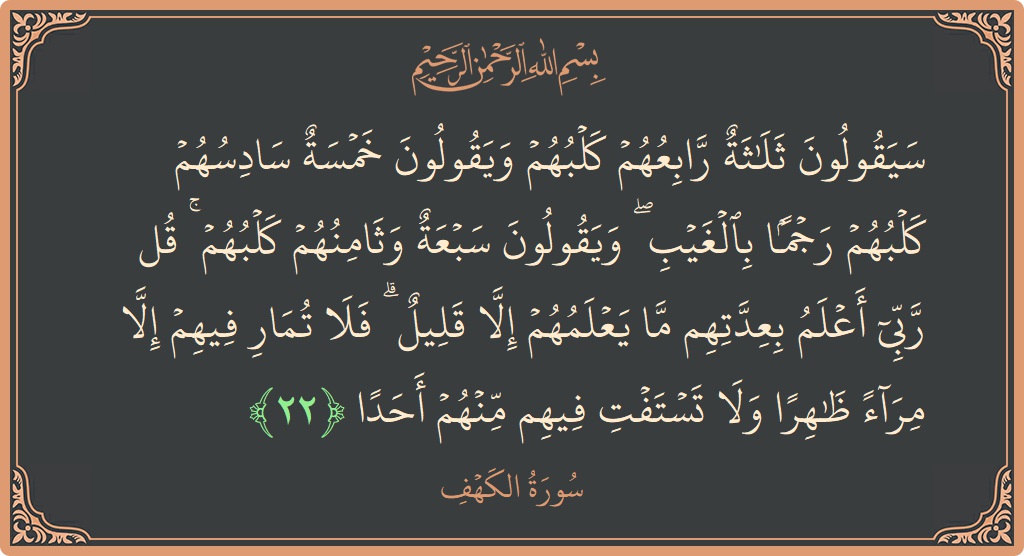
They will say there were three, the fourth of them being their dog; and they will say there were five, the sixth of them being their dog - guessing at the unseen; and they will say there were seven, and the eighth of them was their dog. Say, [O Muhammad], "My Lord is most knowing of their number. None knows them except a few. So do not argue about them except with an obvious argument and do not inquire about them among [the speculators] from anyone."English Transliteration
Sayaqooloona thalathatun rabiAAuhum kalbuhum wayaqooloona khamsatun sadisuhum kalbuhum rajman bialghaybi wayaqooloona sabAAatun wathaminuhum kalbuhum qul rabbee aAAlamu biAAiddatihim ma yaAAlamuhum illa qaleelun fala tumari feehim illa miraan thahiran wala tastafti feehim minhum ahadanTafsir of Verse 22
Commentary
The verse opens with the word: سَيَقُولُونَ (sayaqulun: Some will say).Who are these people who will say? There are two probabilities therein. (1) They could be the people who had differed among themselves during the time of the People of Kahf about their name and lineage, already mentioned in the previous verse. Out of these very people, some had made the first statement, some others, the second and still others, the third. (Mentioned in al-Bahr al-Muhit from al-Mawardi)
(2) The second probability is that the pronoun in 'sayaqulun' could be reverting back to the Christians of Najran who had argued with the Holy Prophet ﷺ about the number of the People of Kahf. They had three sects among them. One sect was called Malkaniyah. They made the first statement about the number, that is, gave the number as three. The second sect was Ya` qubiyah. They went by the second statement, that is, they were five. The third sect was Nasturiyah. They made the third statement, saying that they were seven. However, some said that this third statement was that of Muslims. What finally happened was that the third statement turned out to be true as it appears from the hint given by the Qur'an, and the word of the Holy Prophet ﷺ . (Al-Bahr al-Muhit)
. The hint is that the former two views about their number have been termed by the Qur'an as 'conjectures' while the third view has appeared without such a comment. (Mul} ammad Taqi Usmani)
The use of the conjunction waw:(and) in: وَثَامِنُهُمْ (wa thaminuhum: and the eighth of them) is worth noticing here. At this place, three statements have been reported about the number of the People of Kahf - three, five and seven - and after each, their dog has been counted. But, no conjunction 'waw' has been introduced in between their number and the count of the dog in the first two statements. The sentence: ثَلَاثَةٌ رَّابِعُهُمْ كَلْبُهُمْ (Three, the fourth of them being their dog) and the sentence: خَمْسَةٌ سَادِسُهُمْ كَلْبُهُمْ. (Five, the sixth of them being their dog) appear without that conjunction 'waw.' But, the arrangement is different in the third statement. Here, the word: سَبْعَةٌ (Seven) is followed by a connective 'waw' attached to the text of: وَثَامِنُهُمْ كَلْبُهُمْ (and the eighth of them is their dog).
Giving its reason, commentators say that early Arabs used to count up to seven digits, after which the number that followed was counted as separate, similar to its present counterpart, the number 9 where units end and the tens begin. Therefore, while counting from three to seven, they would not use the connective To give a number after seven, they would state it separately with the help of a connective 'waw' - and for this reason, this 'waw' (and) was called the 'waw° (and) of 'thaman' (eight). (Mazhari and others)
The names of the People of Kahf
The fact of the matter is that the names of the People of Kahf do not stand proved authentically from any Sahih Hadith. Names given in exegetical and historical reports differ. The closest out of these is the report given on the authority of Sayyidna ` Abdullah ibn ` Abbas ؓ by al-Tabarani in al-Mu'jim al-Ausat with sound chains of narrators. The names given there are:
Muksalmina مُکسلمِینا
Tamlikha تَملِیخَا
Martunis مَرطُونس
Sanunis سنونس
Sarinunisy سَارینونس
Dhu Niwas ذونواس
Ka'astitiunis کِعسططیونس
Basic rule in debatable matters: Avoid long-drawn argumentation
Referring to the animated efforts to determine the number of the People of Kahf, and other matters, the text says: فَلَا تُمَارِ فِيهِمْ إِلَّا مِرَاءً ظَاهِرًا وَلَا تَسْتَفْتِ فِيهِم مِّنْهُمْ أَحَدًا (So do not argue about them except [ with ] an apparent argumentation. And do not ask anyone of these about them). The rule of conduct, a golden legacy of the Qur'an, taught in these two sentences to the Holy Prophet ﷺ are, in fact, significant guiding principles for the learned among the Muslim community. The thing to do when difference arises on any issue is to state what is necessary clearly. If people, even after that, elect to pursue a course of unnecessary debate, one should offer cursory comments in the light of the earlier presentation and conclude the debate. Any effort to dig deeper to affirm one's claim or to make the extra effort to refute the assertion of debaters should be avoided - for nothing good would really come out of it. Moreover, any further prolongation of the debate and altercation would result in uncalled for waste of time as well as pose the danger of mutual bickering.
The second line of guidance given in the other sentence is that the optimum information given to him through Divine revelation about the People of Kahf should be taken as perfectly sufficient and satisfactory for all practical purposes. Let him not worry about finding more and asking oth-ers. As for asking others, it could have another aspect too. May be, the question asked is to expose their ignorance or to disgrace them. This too would be contrary to the high morals prophets have. Therefore, restraint was placed on asking both kinds of questions, either for additional investigation, or to prove the addressee ignorant and disgrace him.
Their Number
Allah tells us that people disputed over the number of the people of the Cave. The Ayah mentions three views, proving that there was no fourth suggestion. Allah indicates that the first two opinions are invalid, by saying,
(guessing at the unseen), meaning that they spoke without knowledge, like a person who aims at an unknown target -- he is hardly likely to hit it, and if he does, it was not on purpose. Then Allah mentions the third opinion, and does not comment on it, or He affirms it by saying,
(and the dog being the eighth.) indicating that this is correct and this is what happened.
(Say: "My Lord knows best their number...") indicating that the best thing to do in matters like this is to refer knowledge to Allah, because there is no need to indulge in discussing such matters without knowledge. If we are given knowledge of a matter, then we may talk about it, otherwise we should refrain.
(none knows them but a few.) of mankind. Qatadah said that Ibn `Abbas said: "I am one of the few mentioned in this Ayah; they were seven. " Ibn Jurayj also narrated that `Ata' Al-Khurasani narrated from him, "I am one of those referred to in this Ayah," and he would say: "Their number was seven." Ibn Jarir recorded that Ibn `Abbas said:
(none knows them but a few.) "I am one of the few, and they were seven." The chains of these reports narrated from Ibn `Abbas, which say that they were seven, are Sahih, and this is in accordance with what we have stated above.
(So debate not except with the clear proof.) meaning, gently and politely, for there is not a great deal to be gained from knowing about that.
(And consult not any of them (about the people of the Cave).) meaning, `They do not have any knowledge about it except what they make up, guessing at the unseen; they have no evidence from an infallible source. But Allah has sent you, O Muhammad, with the truth in which there is no doubt or confusion, which is to be given priority over all previous books and sayings.'