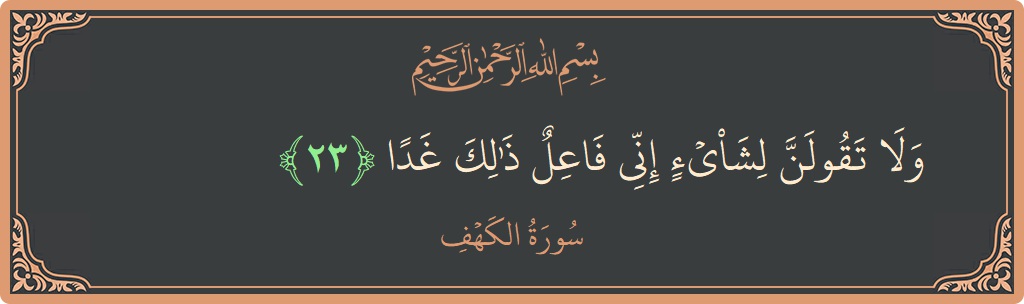
Surah Al-Kahf: Verse 23 - ولا تقولن لشيء إني فاعل... - English
Tafsir of Verse 23, Surah Al-Kahf
English Translation
And never say of anything, "Indeed, I will do that tomorrow,"English Transliteration
Wala taqoolanna lishayin innee faAAilun thalika ghadanTafsir of Verse 23
Commentary
The story of Ashab al-Kahf is due to end on the four verses cited above. In the first two of these, the Holy Prophet ﷺ and his Ummah has been taught to say ` Insha'Allah Ta’ ala along with the promise or affirmation of doing something in the future. Because, who knows if one does or does not live, and even if one does, will one be able to do or not to do that? Therefore, a believer should be confident about it in his or her heart, and confess to it verbally as well that in the event of making a commitment to do something next day, what will be said will be: If Allah Ta` ala wills, I shall do this thing tomorrow.' This is what the saying of Insha'Allah means.
In the third verse (25), a decision has been given on a controversy. This was a debate in which people had held different opinions during the time of the People of Kahf, and equally different were the sayings of the Jews and Christians of the contemporary period about it, that is, the period of time they kept sleeping in the Cave. It was stated in the verse that those were three hundred and nine years. This is, so to say, a clarification of the statement made briefly at the beginning of the story: فَضَرَبْنَا عَلَىٰ آذَانِهِمْ فِي الْكَهْفِ سِنِينَ عَدَدًا (So We veiled their hearing [ putting them to sleep ] in the Cave for a number of years - 11).
After that, those who still differ with it have been warned once again that they are not the ones who know the reality of things as they are. The One who knows it all is none else but Allah with whom rests the knowledge of all that is unseen in the heavens and the earth. He is All Hearing. He is All Seeing. The time duration of three hundred nine years given by Him should be enough for their satisfaction.
Saying "If Allah wills" when determining to do Something in the Future
Here Allah, may He be glorified, shows His Messenger the correct etiquette when determining to do something in the future; this should always be referred to the will of Allah, the Knower of the Unseen, Who knows what was and what is yet to be and what is not to be, and how it will be if it is to be. It was recorded in the Two Sahihs that Abu Hurayrah said that the Messenger of Allah said:
(Sulayman bin Dawud (peace be upon them both) said: "Tonight I will go around to seventy women according to some reports, it was ninety or one hundred women so that each one of them will give birth to a son who will fight for the sake of Allah." It was said to him, according to one report, the angel said to him "Say: `If Allah wills'", but he did not say it. He went around to the women but none of them gave birth except for one who gave birth to a half-formed child.) The Messenger of Allah said, (By the One in Whose hand is my soul, had he said, "If Allah wills," he would not have broken his oath, and that would have helped him to attain what he wanted. ) According to another report, (They would all have fought as horsemen in the cause of Allah.) At the beginning of this Surah we discussed the reason why this Ayah was revealed: when the Prophet was asked about the story of the people of the Cave, he said, "I will tell you tomorrow." Then the revelation was delayed for fifteen days. Since we discussed this at length at the beginning of the Surah, there is no need to repeat it here.
(And remember your Lord when you forget) It was said that this means, if you forget to say "If Allah wills", then say it when you remember. This was the view of Abu Al-`Aliyah and Al-Hasan Al-Basri. Hushaym reported from Al-A`mash from Mujahid that concerning a man who swears an oath, Ibn `Abbas said "He may say `If Allah wills' even if it is a year later." Ibn `Abbas used to interpret this Ayah:
(And remember your Lord when you forget) in this way. Al-A`mash was asked, "Did you hear this from Mujahid" He said, "Layth bin Abi Salim told it to me." The meaning of Ibn `Abbas' view, that a person may say "If Allah wills", even if it is a year later, is that if he forgets to say it when he makes the oath or when he speaks, and he remembers it later, even a year later, the Sunnah is that he should say it, so that he will still be following the Sunnah of saying "If Allah wills", even if that is after breaking his oath. This was also the view of Ibn Jarir, but he stated that this does not make up for breaking the oath or mean that one is no longer obliged to offer expiation. What Ibn Jarir said is correct, and it is more appropriate to understand the words of Ibn Abbas in this way. And Allah knows best.
(And never say of anything, "I shall do such and such thing tomorrow." Except (with the saying), "If Allah wills!" And remember your Lord when you forget) At-Tabarani recorded that Ibn `Abbas said that this meant saying, "If Allah wills."
(and say: "It may be that my Lord guides me to a nearer way of truth than this.") meaning, `if you (O Prophet) are asked about something you know nothing about, ask Allah about it, and turn to Him so that He may guide you to what is right.' And Allah knows best.