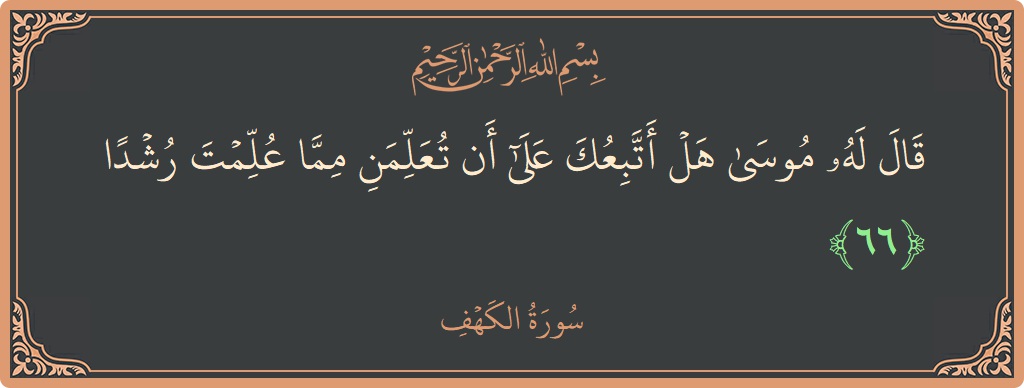
Surah Al-Kahf: Verse 66 - قال له موسى هل أتبعك... - English
Tafsir of Verse 66, Surah Al-Kahf
English Translation
Moses said to him, "May I follow you on [the condition] that you teach me from what you have been taught of sound judgement?"English Transliteration
Qala lahu moosa hal attabiAAuka AAala an tuAAallimani mimma AAullimta rushdanTafsir of Verse 66
Following the teacher is incumbent on the student
In verse 66: هَلْ أَتَّبِعُكَ عَلَىٰ أَن تُعَلِّمَنِ مِمَّا عُلِّمْتَ رُشْدًا ، Sayyidna Musa (علیہ السلام) despite being a prophet and messenger of great resolve, has most reverentially requested al-Khadir (علیہ السلام) if he could follow him to learn his knowledge from him. This tells us that the etiquette of acquiring knowledge is nothing but that the student should show respect for the teacher and follow him (as an individual who is eager to learn) - even if the student happens to be superior to his teacher. (Qurtubi, Mazhari)
Musa meeting with Al-Khidr and accompanying Him
Allah tells us what Musa said to that learned man, who was Al-Khidr. He was one to whom Allah had given knowledge that He had not given to Musa, just as He had given Musa knowledge that He had not given to Al-Khidr.
(Musa said to him: "May I follow you...") This is a question phrased in gentle terms, with no sense of force or coercion. This is the manner in which the seeker of knowledge should address the scholar.
(I follow you) means, I accompany you and spend time with you.
(so that you teach me something of that knowledge which you have been taught) meaning, teach me something from that which Allah has taught you so that I may be guided by it and learn something beneficial and do righteous deeds. At this point,
(He said) meaning, Al-Khidr said to Musa,
(Verily, you will not be able to have patience with me!) meaning, `You will not be able to accompany with me when you see me doing things that go against your law, because I have knowledge from Allah that He has not taught you, and you have knowledge from Allah that He has not taught me. Each of us has responsibilities before Allah that the other does not share, and you will not be able to stay with me,'
(And how can you have patience about a thing which you know not) `For I know that you will denounce me justifiably, but I have knowledge of Allah's wisdom and the hidden interests which I can see but you cannot.'
(He said) meaning, Musa said:
(If Allah wills, you will find me patient,) with whatever I see of your affairs,
(and I will not disobey you in aught.) means, `I will not go against you in anything.' At that point, Al-Khidr, upon him be peace, set a condition:
(Then, if you follow me, ask me not about anything) do not initiate any discussion of the matter,
(till I myself mention of it to you. ) meaning, `until I initiate the discussion, before you ask me about it.'