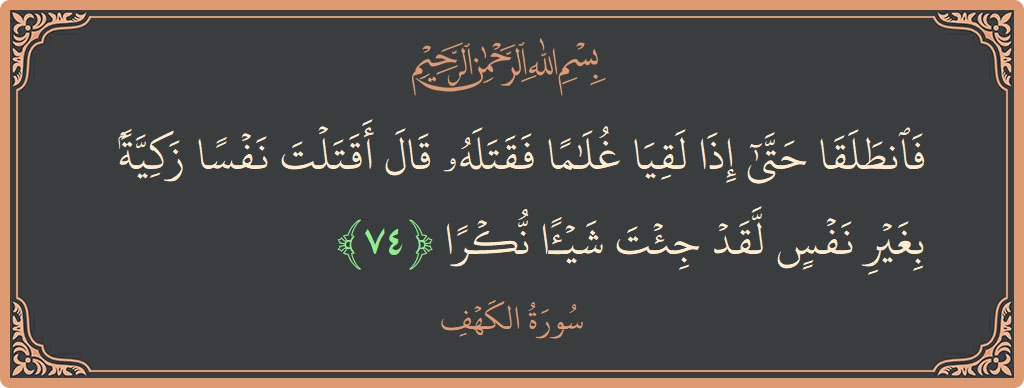
Surah Al-Kahf: Verse 74 - فانطلقا حتى إذا لقيا غلاما... - English
Tafsir of Verse 74, Surah Al-Kahf
English Translation
So they set out, until when they met a boy, al-Khidh r killed him. [Moses] said, "Have you killed a pure soul for other than [having killed] a soul? You have certainly done a deplorable thing."English Transliteration
Faintalaqa hatta itha laqiya ghulaman faqatalahu qala aqatalta nafsan zakiyyatan bighayri nafsin laqad jita shayan nukranTafsir of Verse 74
We now move to the sentence: حَتَّىٰ إِذَا لَقِيَا غُلَامًا (until when they met a boy -74). The word: غُلَام (ghulam) in the text is used for a minor boy in the Arabic usage. This boy killed by al-Khadir (علیہ السلام) was a minor - as corroborated by Sayyidna Ibn ` Abbas ؓ and most commentators. Further on, when the words: نَفْسًا زَكِيَّةً (innocent person) were used for him, that too supports the view that he was a minor. The reason is that زَكِيَّةً (zakiyyah) means 'free of sin' and it can be either the attribute of a prophet or a minor child who faces no accounting for what is done by him and no sin is written in his Book of Deeds.
The Story of killing the Boy
(Then they both proceeded,) means, after the first incident,
(till they met a boy, and he (Khidr) killed him.) It has been stated previously that this boy was playing with other boys in one of the towns, and that Al-Khidr deliberately singled him out. He was the finest and most handsome of them all, and Al-Khidr killed him. When Musa, peace be upon him, saw that he denounced him even more fervently than in the first case, and said hastily:
(Have you killed an innocent person) meaning, a young person who had not yet committed any sin or done anything wrong, yet you killed him
(without Nafs) with no reason for killing him.
(Verily, you have committed a thing Nukr!) meaning, something that is clearly evil.
(He said: "Did I not tell you that you can have no patience with me") Once again, Al-Khidr reiterates the condition set in the first place, so Musa says to him:
(If I ask you anything after this,) meaning, `if I object to anything else you do after this,'
(keep me not in your company, you have received an excuse from me.) `you have accepted my apology twice.' Ibn Jarir narrated from Ibn `Abbas that Ubayy bin Ka`b said: "Whenever the Prophet mentioned anyone, he would pray for himself first. One day he said:
(May the mercy of Allah be upon us and upon Musa. If he had stayed with his companion he would have seen wonders, but he said, (`If I ask you anything after this, keep me not in your company, you have received an excuse from me.'))"