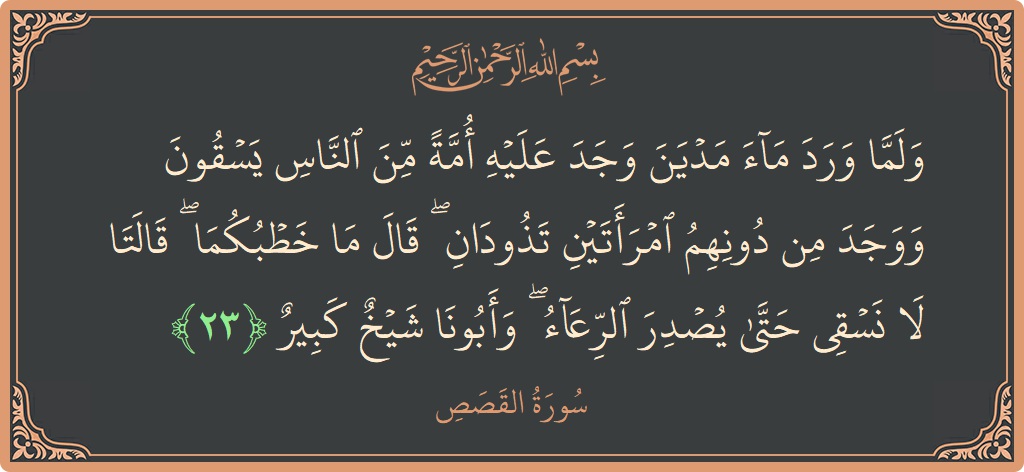
Surah Al-Qasas: Verse 23 - ولما ورد ماء مدين وجد... - English
Tafsir of Verse 23, Surah Al-Qasas
English Translation
And when he came to the well of Madyan, he found there a crowd of people watering [their flocks], and he found aside from them two women driving back [their flocks]. He said, "What is your circumstance?" They said, "We do not water until the shepherds dispatch [their flocks]; and our father is an old man."English Transliteration
Walamma warada maa madyana wajada AAalayhi ommatan mina alnnasi yasqoona wawajada min doonihimu imraatayni tathoodani qala ma khatbukuma qalata la nasqee hatta yusdira alrriAAao waaboona shaykhun kabeerunTafsir of Verse 23
(And when he arrived at the waters of Madyan, he found a large number of people watering (their animals) - 28:23) مَاءَ مَدْيَنَ (waters of Madyan) refers to the well from where people of that place used to make their animals drink water. وَوَجَدَ مِن دُونِهِمُ امْرَأَتَيْنِ تَذُودَانِ (found, aloof from them, two women keeping back (their animals) - 23). That is he saw two girls stopping their goats from going to the water, so that they did not get mixed up with other goats.
قَالَ مَا خَطْبُكُمَا ۖ قَالَتَا لَا نَسْقِي حَتَّىٰ يُصْدِرَ الرِّعَاءُ ۖ وَأَبُونَا شَيْخٌ كَبِيرٌ (He said, "What is the matter with you?" They said, "We cannot water (our animals) unless the shepherds bring (their animals) back and our father is very old man." -28:23). The word خَطب Khatb means "matter". The sense is that Sayyidna Musa (علیہ السلام) asked the two girls ` What was it that you are stopping your goats from coming to the well for drinking water like other goats? The two girls answered that, in order to avoid mixing with men-folk, they used to make their goats wait until men had left the place after watering their animals. The question arose here whether they did not have any male member in the family to do this job . The girls answered this question on their own by saying that their father was very old and could not perform this job. This is why they were doing the job.
Some very important points are learnt by this incident. One, that it was the practice of the prophets to help the weak. Sayyidna Musa (علیہ السلام) saw that two girls had brought their goats for drinking water, but they were unable to find room because of the rush of people. Therefore, he asked them about their problem. Two, that there is no harm to talk to stranger women, if no mischief is involved. Three, that although this incident had happened when hijab was not enjoined, a situation that continued even in the early days of Islam (hijab was enjoined in Madinah after the Hijrah), but the underlying spirit of hijab, i.e the natural instinct of modesty and bashfulness, was there even in those days. Because of this natural instinct the two girls preferred hardship rather than getting mixed with men-folk. Four, that it was not considered desirable for women even in those days to go out and perform such type of duties. It was for this reason that they put forward the justification that their father was very old and weak.