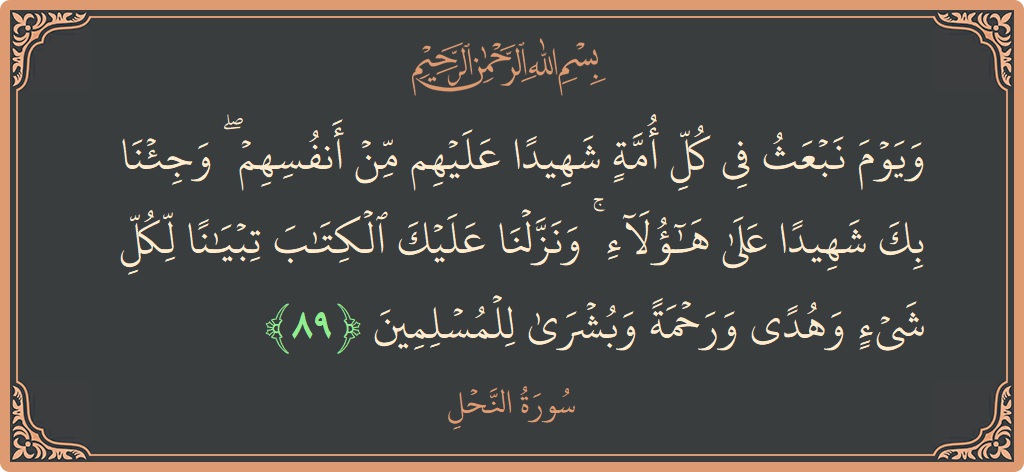
Surah An-Nahl: Verse 89 - ويوم نبعث في كل أمة... - English
Tafsir of Verse 89, Surah An-Nahl
English Translation
And [mention] the Day when We will resurrect among every nation a witness over them from themselves. And We will bring you, [O Muhammad], as a witness over your nation. And We have sent down to you the Book as clarification for all things and as guidance and mercy and good tidings for the Muslims.English Transliteration
Wayawma nabAAathu fee kulli ommatin shaheedan AAalayhim min anfusihim wajina bika shaheedan AAala haolai wanazzalna AAalayka alkitaba tibyanan likulli shayin wahudan warahmatan wabushra lilmuslimeenaTafsir of Verse 89
Commentary
In verse 89, by saying: وَنَزَّلْنَا عَلَيْكَ الْكِتَابَ تِبْيَانًا لِّكُلِّ شَيْءٍ the Qur'an has been credited as the exposition of everything. It means everything about the religion because the objective of Divine revelation and Prophetic mission concerns with these very things. Therefore, the very effort to cull out answers to problems pertaining to economic sciences from the Qur’ an is an exercise in error. However, the appearance of some implied hint some-where there shall not be deemed contrary to this. Now remains the question that the Qur’ an does not carry answers to all problems of the religion itself, how then, would it be correct to say that it is an exposition of everything'?
The answer is that the Qur’ an, does carry the basic principles concerning all problems, and it is in their light that the Ahadith of the Rasul of Allah clarify these problems. Then, there are some details which are delegated to the principles of Ijma` (consensus) and Al-Qiyas (analogical deduction following the norms set by the Shari` ah of Islam). This tells us that the religious rulings deduced from the Ahadith of the Holy Prophet ﷺ ، and from Ijma` and Qiyas are also, in a way, as stated by the Qur’ an itself.
Every Prophet will bear Witness against his Nation on the Day of Resurrection
Allah addressed His servant and Messenger Muhammad , saying:
(And on the Day when We resurrect a witness from each nation from among themselves, and We bring you (O Muhammad) as a witness against these.), meaning, your Ummah. The Ayah means: remember that Day and its terrors, and the great honor and high position that Allah has bestowed upon you. This Ayah is like the Ayah with which `Abdullah bin Mas`ud ended when he recited to the Messenger of Allah from the beginning of Surat An-Nisa'. When he reached the Ayah:
(How (will it be) then, when We bring from each nation a witness and We bring you (O Muhammad) as a witness against these) 4:41 the Messenger of Allah said to him:
(Enough.) Ibn Mas`ud said: "I turned to him and saw his eyes streaming with tears."
The Qur'an explains Everything
(And We revealed the Book (the Qur'an) to you as an explanation of everything,) Ibn Mas`ud said: "Allah made it clear that in this Qur'an there is complete knowledge and about everything." The Qur'an contains all kinds of beneficial knowledge, such as reports of what happened in the past, information about what is yet to come, what is lawful and unlawful, and what people need to know about their worldly affairs, their religion, their livelihood in this world, and their destiny in the Hereafter.
(a guidance) means, for their hearts.
(a mercy, and good news for the Muslims.) Al-Awza`i said:
(And We have revealed the Book (the Qur'an) as an explanation of everything,) meaning, with the Sunnah. The is the reason why the phrase,
(And We have revealed the Book to you) is mentioned immediately after the phrase,
(And We shall bring you (O Muhammad) as a witness against these. ) the meaning - and Allah knows best - is that the One Who obligated you to convey the Book which He revealed to you, will also ask you about that on the Day of Resurrection.
(Then We shall indeed question those (people) to whom it (the Book) was sent and We shall indeed question the Messengers.) (7:6)
(So by your Lord We question them all about what they did.) (15:92-92)
(On the Day when Allah gathers the Messengers together and says to them: "What was the response you received (to your Message)" They will say: "We have no knowledge, indeed only You are the Knower of all that is hidden.") (5:109) And Allah says:
(Verily, He Who obligated the Qur'an upon you (O Muhammad) will surely bring you back to the return.) 28:85 meaning, the One Who gave you the obligation of conveying the Qur'an will bring you back to Him, and your return will be on the Day of Resurrection, and He will question you about you commission of the duty He gave you. This is one of the opinions, and it presents a good understanding of it.