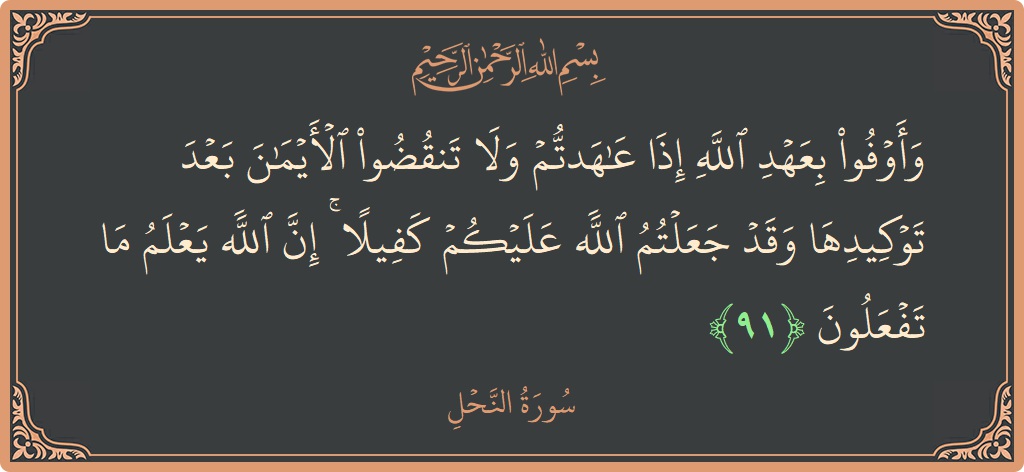
Surah An-Nahl: Verse 91 - وأوفوا بعهد الله إذا عاهدتم... - English
Tafsir of Verse 91, Surah An-Nahl
English Translation
And fulfill the covenant of Allah when you have taken it, [O believers], and do not break oaths after their confirmation while you have made Allah, over you, a witness. Indeed, Allah knows what you do.English Transliteration
Waawfoo biAAahdi Allahi itha AAahadtum wala tanqudoo alaymana baAAda tawkeediha waqad jaAAaltumu Allaha AAalaykum kafeelan inna Allaha yaAAlamu ma tafAAaloonaTafsir of Verse 91
Commentary
Breaking Pledges is Forbidden
The word: عَھد ('ahd) is inclusive of all transactions, pacts and pledges the responsibility of which has been assumed verbally, whether one does or does not swear by it, and whether it relates to doing something or not doing it.
In fact, these verses are the explanation and conclusion of previous verses. The previous verses carried the command to do justice and to be good. The sense of justice there includes the fulfillment of pledges as well. [ Qurtubi ]
After having given a pledge or made a contract with someone, breaking it is a major sin. But, in the event it is broken, there is no Kaffarah (expiation) fixed for this purpose. Instead, it brings the punishment of the Hereafter on the offender. According to Hadith, the Holy Prophet ﷺ said that a flag shall be planted on the back of the pledge-breaker on the Day of Resurrection which will become the cause of his or her disgrace there.
Similarly, acting contrary to what one has sworn by is also a major sin. In the Hereafter, it is full of unimaginably evil consequences while in the present world too there are its particular situations in which Kaffarah (expiation) becomes necessary. [ Qurtubi ]
The Command to fulfill the Covenant
This is one of the commands of Allah, to fulfill covenants, keep promises and to fulfill oaths after confirming them. Thus Allah says:
(and do not break the oaths after you have confirmed them) There is no conflict between this and the Ayat:
(And do not use Allah as an excuse in your oaths) 2:224
(That is the expiation for oaths when you have sworn. And protect your oaths.) 5:89 meaning, do not forgo your oaths without offering the penance. There is also no conflict between this Ayah (16:91) and the Hadith reported in the Two Sahihs according to which the Prophet said:
(By Allah, if Allah wills, I will not swear an oath and then realize that something else is better, but I do that which is better and find a way to free myself from the oath. According to another report he said: "and I offer penance for my oath. ") There is no contradiction at all between all of these texts and the Ayah under discussion here, which is:
(and do not break the oaths after you have confirmed them) because these are the kinds of oaths that have to do with covenants and promises, not the kind that have to do with urging oneself to do something or preventing him from doing something. Therefore Mujahid said concerning this Ayah:
(and do not break the oaths after you have confirmed them) "The oath here refers to oaths made during Jahiliyyah." This supports the Hadith recorded by Imam Ahmad from Jubayr bin Mut`im, who said that the Messenger of Allah said:
(There is no oath in Islam, and any oath made during the Jahiliyyah is only reinforced by Islam.) This was also reported by Muslim. The meaning is that Islam does not need oaths as they were used by the people of the Jahiliyyah; adherence to Islam is sufficient to do away with any need for what they used to customarily give oaths for. In the Two Sahihs it was reported that Anas said: "The Messenger of Allah () swore the treaty of allegiance between the Muhajirin (emigrants) and the Ansar (helpers) in our house. " This means that he established brotherhood between them, and they used to inherit from one another, until Allah abrogated that. And Allah knows best.
(Verily, Allah knows what you do.) This is a warning and a threat to those who break their oaths after confirming them.
(And do not be like the one who undoes the thread which she has spun, after it has become strong,) `Abdullah bin Kathir and As-Suddi said: "This was a foolish woman in Makkah. Everytime she spun thread and made it strong, she would undo it again." Mujahid, Qatadah and Ibn Zayd said: "This is like the one who breaks a covenant after confirming it." This view is more correct and more apparent, whether or not there was a woman in Makkah who undid her thread after spinning it. The word Ankathan could be referring back to the word translated as "undoes", reinforcing the meaning, or it could be the predicate of the verb "to be", meaning, do not be Ankathan, the plural of Nakth (breach, violation), from the word Nakith (perfidious). Hence after this, Allah says:
(by taking your oaths as a means of deception among yourselves) meaning for the purposes of cheating and tricking one another.
(when one group is more numerous than another group. ) meaning, you swear an oath with some people if they are more in number than you, so that they can trust you, but when you are able to betray them you do so. Allah forbids that, by showing a case where treachery might be expected or excused, but He forbids it. If treachery is forbidden in such a case, then in cases where one is in a position of strength it is forbidden more emphatically. Mujahid said: "They used to enter into alliances and covenants, then find other parties who were more powerful and more numerous, so they would cancel the alliance with the first group and make an alliance with the second who were more powerful and more numerous. This is what they were forbidden to do." Ad-Dahhak, Qatadah and Ibn Zayd said something similar.
(Allah only tests you by this) Sa`id bin Jubayr said: "This means (you are tested) by the large numbers." This was reported by Ibn Abi Hatim. Ibn Jarir said: "It means (you are being tested) by His command to you to adhere to your covenants."
(And on the Day of Resurrection, He will certainly clarify that which you differed over.) Everyone will be rewarded or punished in accordance with his deeds, good or evil.