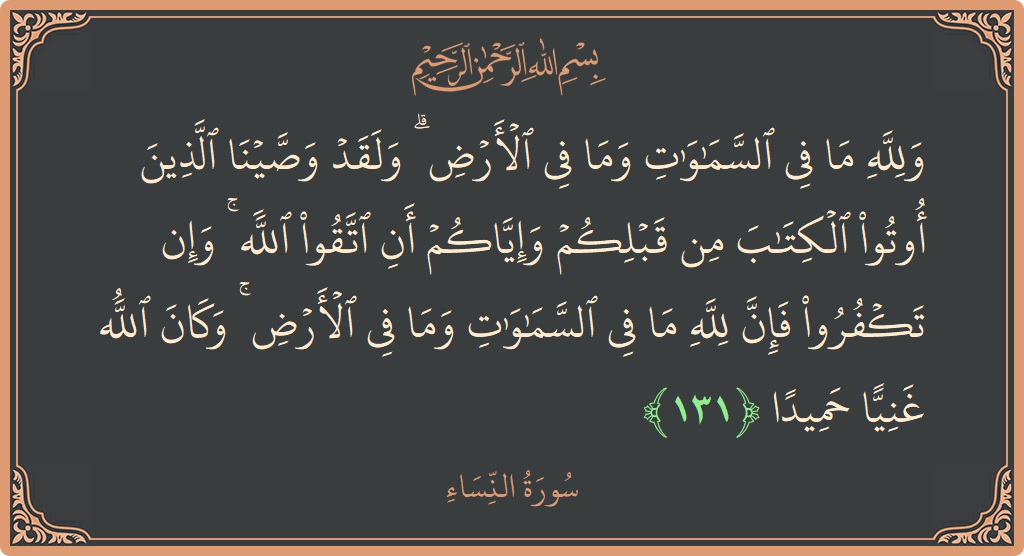
Surah An-Nisaa: Verse 131 - ولله ما في السماوات وما... - English
Tafsir of Verse 131, Surah An-Nisaa
English Translation
And to Allah belongs whatever is in the heavens and whatever is on the earth. And We have instructed those who were given the Scripture before you and yourselves to fear Allah. But if you disbelieve - then to Allah belongs whatever is in the heavens and whatever is on the earth. And ever is Allah Free of need and Praiseworthy.English Transliteration
Walillahi ma fee alssamawati wama fee alardi walaqad wassayna allatheena ootoo alkitaba min qablikum waiyyakum ani ittaqoo Allaha wain takfuroo fainna lillahi ma fee alssamawati wama fee alardi wakana Allahu ghaniyyan hameedanTafsir of Verse 131
Sequence
After having stated the rules of behaviour as related to women and orphans, the text now reminds the promise of rewards for those abiding by these rules, and the warning for those contravening them, which is the usual style of the Holy Qur'an.
Significant Inferences
Readily noticeable here is the repetition of لِّلَّـهِ مَا فِي السَّمَاوَاتِ وَمَا فِي الْأَرْضِ which means that everything created in the heavens and the earth belongs to Allah. Repeated thrice, these words signify three shades of meaning. In the first place, the aim is to point out to the limitless scope of Allah's power of creation which lacks nothing. In the second instance, the objective is to focus on Allah's attribute of self sufficiency, self-adequacy and His being need-free. It means: Should one disbelieve, deny or reject the good counsel given, He is in no need of anyone's obedience for He stands ever-praised in His pristine glory.
The Necessity of Taqwa of Allah
Allah states that He is the Owner of the heavens and earth and that He is the Supreme Authority over them. Hence Allah's statement,
(And verily, We have recommended to the People of the Scripture before you, and to you) meaning, We have recommended to you what We recommended to the People of Scriptures; Taqwa of Allah, by worshipping Him Alone without partners. Allah then said,
(But if you disbelieve, then unto Allah belongs all that is in the heavens and all that is in the earth). In another Ayah, Allah said that Musa said to his people,
("If you disbelieve, you and all on the earth together, then verily, Allah is Rich (free of any need), Owner of all praise."). Allah said,
(So they disbelieved and turned away. But Allah was not in need (of them). And Allah is Rich (free of any need), Worthy of all praise) meaning, He is far too Rich than to need His servants, and worthy of all praise in all His decisions and commandments. The meaning of Allah's statement,
(And to Allah belongs all that is in the heavens and all that is in the earth. And Allah is Ever All-Sufficient as a Disposer of affairs.) He has perfect watch over every soul, knowing what it deserves, He is the Watcher, and Witness of all things. Allah's statement,
(If He wills, He can take you away, O people, and bring others. And Allah is Ever All-Potent over that.) means, He is able to take you away and replace you with other people if you disobey Him. In a similar Ayah, Allah said,
(And if you turn away, He will exchange you for some other people and they will not be your likes) Allah's statement,
(Whoever desires the rewards of this life, then with Allah is the reward of this worldly life and of the Hereafter.) means, O those whose ultimate desire is this life, know that Allah owns the rewards of this life and the Hereafter. Therefore, if you ask Allah for both, He will enrich you, award you and suffice for you. As Allah said,
(But of mankind there are some who say: "Our Lord! Give us in this world!" and for such there will be no portion in the Hereafter. And of them there are some who say: "Our Lord! Give us in this world that which is good and in the Hereafter that which is good, and save us from the torment of the Fire!" For them there will be alloted a share for what they have earned),
(Whosoever desires (by his deeds) the reward of the Hereafter, We give him increase in his reward), and
(Whoever desires the quick-passing (transitory enjoyment of this world), We readily grant him what We will for whom We like) until,
(See how We prefer one above another (in this world)). So Allah said here,
(And Allah is Ever All-Hearer, All-Seer.)