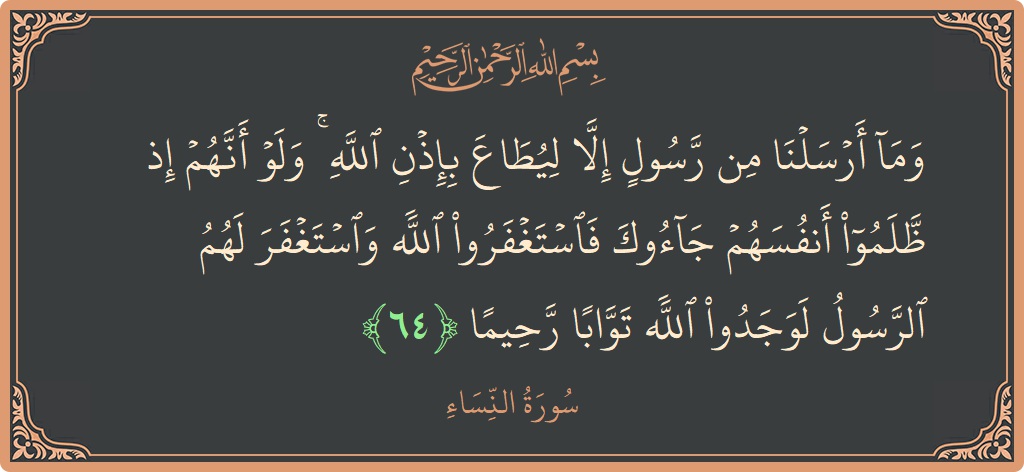
Surah An-Nisaa: Verse 64 - وما أرسلنا من رسول إلا... - English
Tafsir of Verse 64, Surah An-Nisaa
English Translation
And We did not send any messenger except to be obeyed by permission of Allah. And if, when they wronged themselves, they had come to you, [O Muhammad], and asked forgiveness of Allah and the Messenger had asked forgiveness for them, they would have found Allah Accepting of repentance and Merciful.English Transliteration
Wama arsalna min rasoolin illa liyutaAAa biithni Allahi walaw annahum ith thalamoo anfusahum jaooka faistaghfaroo Allaha waistaghfara lahumu alrrasoolu lawajadoo Allaha tawwaban raheemanTafsir of Verse 64
The fifth verse (64) begins by stating a universal Divine principle: And We did not send any Messenger but to be obeyed by the leave of Allah.' It means that any Messenger who was sent by Allah was sent so that everyone obeys the rules set by him in accordance with the will and command of Allah Almighty. In that case, the inevitable consequence will be that anyone who opposes the rules set by the Messenger will be dealt with in the manner disbelievers are dealt with. Therefore, whatever Sayyidna ` Umar ؓ did turned out to be correct. Following this appears an advice in the best interest of the hypocrites indicating that they would have done better if, rather than indulge in false oaths and interpretations, they would have confessed their error and presented themselves before him seeking forgiveness from Allah, and the Messenger too prayed for their forgiveness, then, Allah Almighty would have certainly accepted their repentance.
At this place, for the repentance to be acceptable, two things have been made binding: That they present themselves before the Holy Prophet ~..L ..1L ! t and that he then prays for their forgiveness. Perhaps, the first reason is that they violated the great station of prophethood bestowed by Allah Almighty on His noble Messenger ﷺ and caused him undue pain by disregarding the decision given by him. So, in order that their repentance: over their crime becomes acceptable, the condition that they present themselves before the Holy Prophet ﷺ and that he prays for their forgiveness was imposed on them.
Although, this verse (64) was revealed in the background of a particular incident relating to the hypocrites, yet its words yield a general ruling which stipulates that anyone who presents himself before the Holy Prophet ﷺ and he prays for his forgiveness he will definitely be forgiven. And 'the presence before the Holy Prophet ﷺ as it would have been during his blessed life in this mortal world, holds the same effect even today as the visit to the sacred precincts of the Mosque of the Prophet and the act of 'presenting' oneself before the blessed resident of the sanctified mausoleum falls within the jurisdiction of this rule.
Sayyidna Ali ؓ said: "Three days after we all had finished with the burial of the Messenger of Allah ﷺ a villager came and fell down close to the blessed grave. Weeping bitterly, he referred to this particular verse of the Qur'an and addressing himself to the blessed grave, he said: 'Allah Almighty has promised in this verse that a sinner, if he presented himself before the Rasul of Allah, and the Rasul elects to pray for his forgiveness, then he will be forgiven. Therefore, here I am, presenting myself before you so that I may be blessed with your prayer for my forgiveness.' People personally present there at that time say that, in response to the pleading of the villager, a voice coming out from the sanctified mausoleum rang around with the words: قَد غُفِرَ لَکَ meaning: You have been forgiven. (al-Bahr al-Muhit)
The Necessity of Obeying the Messenger
Allah said,
(We sent no Messenger, but to be obeyed) meaning, obeying the Prophet was ordained for those to whom Allah sends the Prophet. Allah's statement,
(by Allah's leave) means, "None shall obey, except by My leave," according to Mujahid. This Ayah indicates that the Prophets are only obeyed by whomever Allah directs to obedience. In another Ayah, Allah said,
(And Allah did indeed fulfill His promise to you when you were killing them (your enemy) with His permission) meaning, by His command, decree, will and because He granted you superiority over them. Allah's statement,
(If they (hypocrites), when they had been unjust to themselves,) directs the sinners and evildoers, when they commit errors and mistakes, to come to the Messenger , so that they ask Allah for forgiveness in his presence and ask him to supplicate to Allah to forgive them. If they do this, Allah will forgive them and award them His mercy and pardon. This is why Allah said,
(they would have found Allah All-Forgiving (One Who forgives and accepts repentance), Most Merciful).
One Does not Become a Believer Unless He Refers to the Messengerfor Judgment and Submits to his Decisions
Allah said,
(But no, by your Lord, they can have no faith, until they make you judge in all disputes between them,) Allah swears by His Glorious, Most Honorable Self, that no one shall attain faith until he refers to the Messenger for judgment in all matters. Thereafter, whatever the Messenger commands, is the plain truth that must be submitted to inwardly and outwardly. Allah said,
(and find in themselves no resistance against your decisions, and accept (them) with full submission.) meaning: they adhere to your judgment, and thus do not feel any hesitation over your decision, and they submit to it inwardly and outwardly. They submit to the Prophet's decision with total submission without any rejection, denial or dispute. Al-Bukhari recorded that `Urwah said, "Az-Zubayr quarreled with a man about a stream which both of them used for irrigation. Allah's Messenger said to Az-Zubayr,
(O Zubayr! Irrigate (your garden) first, and then let the water flow to your neighbor.) The Ansari became angry and said, `O Allah's Messenger! Is it because he is your cousin' On that, the face of Allah's Messenger changed color (because of anger) and said,
(Irrigate (your garden), O Zubayr, and then withhold the water until it reaches the walls (surrounding the palms). Then, release the water to your neighbor.) So, Allah's Messenger gave Az-Zubayr his full right when the Ansari made him angry. Before that, Allah's Messenger had given a generous judgment, beneficial for Az-Zubayr and the Ansari. Az-Zubayr said, `I think the following verse was revealed concerning that case,
(But no, by your Lord, they can have no faith, until they make you (O Muhammad ) judge in all disputes between them.)"' Another Reason In his Tafsir, Al-Hafiz Abu Ishaq Ibrahim bin `Abdur-Rahman bin Ibrahim bin Duhaym recorded that Damrah narrated that two men took their dispute to the Prophet , and he gave a judgment to the benefit of whoever among them had the right. The person who lost the dispute said, "I do not agree." The other person asked him, "What do you want then" He said, "Let us go to Abu Bakr As-Siddiq." They went to Abu Bakr and the person who won the dispute said, "We went to the Prophet with our dispute and he issued a decision in my favor." Abu Bakr said, "Then the decision is that which the Messenger of Allah issued." The person who lost the dispute still rejected the decision and said, "Let us go to `Umar bin Al-Khattab." When they went to `Umar, the person who won the dispute said, "We took our dispute to the Prophet and he decided in my favor, but this man refused to submit to the decision." `Umar bin Al-Khattab asked the second man and he concurred. `Umar went to his house and emerged from it holding aloft his sword. He struck the head of the man who rejected the Prophet's decision with the sword and killed him. Consequently, Allah revealed,
(But no, by your Lord, they can have no faith).