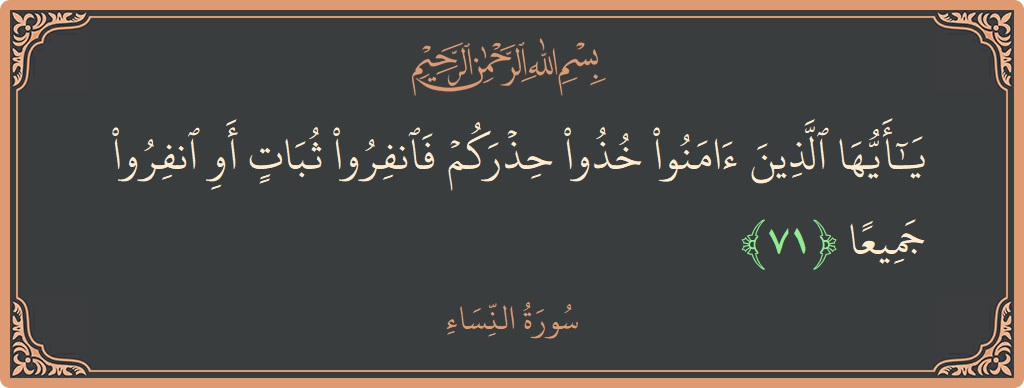
Surah An-Nisaa: Verse 71 - يا أيها الذين آمنوا خذوا... - English
Tafsir of Verse 71, Surah An-Nisaa
English Translation
O you who have believed, take your precaution and [either] go forth in companies or go forth all together.English Transliteration
Ya ayyuha allatheena amanoo khuthoo hithrakum fainfiroo thubatin awi infiroo jameeAAanTafsir of Verse 71
Before this, there was the command to obey Allah and His Messenger. Now, in the present verses, Jihad has been prescribed for the obedient and faithful so that they can vitalize their Faith and raise the word of Allah high and supreme. (Qurtubi)
Commentary
Important Notes
In the first part of the verse: يَا أَيُّهَا الَّذِينَ آمَنُوا خُذُوا حِذْرَكُمْ اَلخ (0 those who believe, take your precautions ...), appears the command to ensure the supply of weapons, while the later part refers to the launching of Jihad action. This tells us two things right away. Firstly, as already clarified at several places, the act of getting together functional means to achieve a good purpose is not contrary to tawakkul or trust in God. Secondly, we see that the text limits. itself to the command to ensure the supply of weapons, but it does not promise that, because of this support, Muslims will have any guaranteed security against their enemies. By doing so, it has been indicated that the choice of using means is for nothing but a certain peace of mind, otherwise, the use of means as such does not carry any operational gain or loss. The Qur'an has said: قُل لَّن يُصِيبَنَا إِلَّا مَا كَتَبَ اللَّـهُ لَنَا (0 Prophet) say: "Nothing will befall us except what Allah has prescribed for us." (9:51)
2. Let us look at the first verse again. It opens up with the command to get ready for Jihad followed by a- description of the marching plan; the later has been expressed in two sentences, that is, فَانفِرُوا ثُبَاتٍ أَوِ انفِرُوا جَمِيعًا (...and march in groups, or march off all together.) Here, the word, 'thubatin' is the plural form of 'thubatun' which means a small group and is used to denote a military company and was called a Sariyyah in the military campaigns of the Holy Prophet ﷺ . In that sense, it is being said here that Muslims, when they go out for Jihad, should not start off all alone. They should, rather, set out in the formation of small groups. The other alternative is to march as a large army: jami’ an' because, in fighting, going 'alone is very likely to hurt --- the enemy is not going to let this opportunity slip out of their hands.
No doubt, this instruction has been given to Muslims for the particular occasion of Jihad, but, even in normal circumstances, this is what the Shari’ ah teaches - do not travel alone. In a hadith, therefore, a lone traveler is called one satan and two of them two satans and three of them become a group or party. Similarly, there is another hadith which says:
خَیر الصحابہ اربعۃ، و خیرالسرایا أبعہ مایٔہ، وخیر اجیوش اربعۃ آلاف .
The best companions are four and the best military company is that of four hundred and the best army is that of four thousand.' (From Mishkat as reported by Al-Tabarani)
The Necessity of Taking Necessary Precautions Against the Enemy
Allah commands His faithful servants to take precautions against their enemies, by being prepared with the necessary weapons and supplies, and increasing the number of troops fighting in His cause.
(in parties) means, group after group, party after party, and expedition after expedition. `Ali bin Talhah reported that Ibn `Abbas said that,
(and either go forth in parties) means, "In groups, expedition after expedition,
(or go forth all together), means, all of you." Similar was reported from Mujahid, `Ikrimah, As-Suddi, Qatadah, Ad-Dahhak, `Ata' Al-Khurrasani, Muqatil bin Hayyan and Khusayf Al-Jazari.
Refraining from Joining Jihad is a Sign of Hypocrites
Allah said,
(There is certainly among you he who would linger behind.) Mujahid and others said that this Ayah was revealed about the hypocrites. Muqatil bin Hayyan said that,
(linger behind) means, stays behind and does not join Jihad. It is also possible that this person himself lingers behind, while luring others away from joining Jihad. For instance, `Abdullah bin Ubayy bin Salul, may Allah curse him, used to linger behind and lure other people to do the same and refrain from joining Jihad, as Ibn Jurayj and Ibn Jarir stated. This is why Allah said about the hypocrite, that when he lingers behind from Jihad, then:
(If a misfortune befalls you) death, martyrdom, or - by Allah's wisdom - being defeated by the enemy,
(he says, "Indeed Allah has favored me that I was not present among them.") meaning, since I did not join them in battle. Because he considers this one of Allah's favors on him, unaware of the reward that he might have gained from enduring war or martyrdom, if he was killed.
(But if a bounty comes to you from Allah) such as victory, triumph and booty,
(he would surely say - as if there had never been ties of affection between you and him,) meaning, as if he was not a follower of your religion,
("Oh! I wish I had been with them; then I would have achieved a great success.") by being assigned a share of the booty and taking possession of that share. This is his ultimate aim and objective.
The Encouragement to Participation in Jihad
Allah then said,
(So fight) the believer with an aversion (to fighting),
(those who trade the life of this world with the Hereafter) referring to those sell their religion for the meager goods of the world, and they only do this because of their disbelief and lack of faith. Allah then said;
(And whoever fights in the cause of Allah, and is killed or gets victory, We shall bestow on him a great reward.) meaning, whoever fights in the cause of Allah, whether he was killed or triumphant, he will earn an immense compensation and a great reward with Allah. The Two Sahihs recorded,
(Allah has guaranteed the Mujahid in His cause that He will either bring death to him, admitting into Paradise; or, He will help him return safely to his home with whatever reward and booty he gained.)