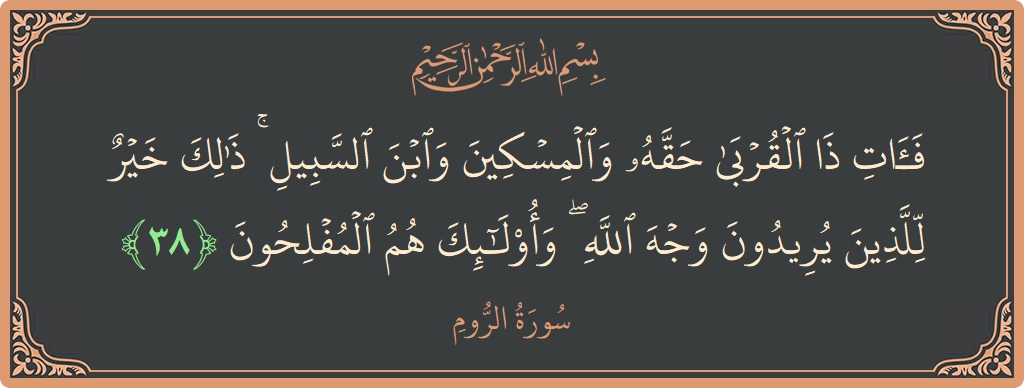
Surah Ar-Room: Verse 38 - فآت ذا القربى حقه والمسكين... - English
Tafsir of Verse 38, Surah Ar-Room
English Translation
So give the relative his right, as well as the needy and the traveler. That is best for those who desire the countenance of Allah, and it is they who will be the successful.English Transliteration
Faati tha alqurba haqqahu waalmiskeena waibna alssabeeli thalika khayrun lillatheena yureedoona wajha Allahi waolaika humu almuflihoonaTafsir of Verse 38
فَآتِ ذَا الْقُرْبَىٰ حَقَّهُ وَالْمِسْكِينَ وَابْنَ السَّبِيلِ (So give to the kinsman his right, and to the needy and the wayfarer - 30:38). In the preceding verse, it was stated that provision of sustenance is the sole prerogative of Allah Ta` a1a. He makes it abundant for whom He likes and curtails the sustenance whenever and whomever He so wills. It clearly gives the message that whoever spends it in the way of Allah, He does not make his sustenance dwindle. But if someone acts miserly and tries to accumulate what he has, then his possession does not expand.
In the background of this divine rule, the Holy Prophet ﷺ ، and according to Hasan Al-Basri (رح) ، every person privileged with abundance, is advised not to be close-fisted in spending the wealth Allah has graced him with. Rather it should be spent on needy cheerfully. This spending will not result in shrinking of the wealth. Some avenues of spending have also been enumerated along with this advice. First, kinsman; second, masakin (the needy); third travelers; that is, these categories should be given from the wealth that Allah has granted you. At the same time, it has been clarified that this is the right of these people which has been obligated on your wealth. Therefore, while giving it to them, no favour should be shown to them, because passing on someone's share to him is an act of fairness and justice and not a favour.
'Kinsman' in this verse apparently means common relatives, whether mahrams or otherwise, as explained by the majority of the commentators. The words, 'his right' also refers to the rights of the kinsmen in general terms, and encompasses obligatory rights, such as those of parents, children and other close relations. It also includes voluntary acts of beneficence and charity, which carry greater rewards when done for close relations compared to when performed in favour of any other non-relative common person; so much so that the Imam of Tafsir Mujahid (رح) has said that the charity of that person is not acceptable in the sight of Allah who neglects his own close relatives and gives it to someone else. It should also be understood that the right of close relatives is not restricted to financial support, but it includes looking after them, and providing any physical service to them as well. If nothing else is within means, they may at least be treated sympathetically and be consoled in their distress. Sayyidna Hasan ؓ has said that the one who enjoys abundance in wealth should help his close relatives with money, and the one who does not have it, should provide physical service and consolation verbally. (Qurtubi).
After 'kinsman', the rights of indigent and then of the travelers follow. For meeting these rights also the same principle applies, that is if one has financial means, he should extend monetary help to them, otherwise physical service and consolation may discharge the right.
The Command to uphold the Ties of Kinship and the Prohibition of Riba Allah commands giving:
(to the kindred his due) his due of respect and upholding the ties of kinship.
(and to Al-Miskin) the one who has nothing to spend on his needs, or he has something but it is not enough.
(and to the wayfarer.) the traveler who is in need of money and other things during his journey.
(That is best for those who seek Allah's Face;) meaning; to look upon Him on the Day of Resurrection, which is the ultimate aim.
(and it is they who will be successful.) means, in this world and the Hereafter. Then Allah says:
(And that which you give in Riba, in order that it may increase from other people's property, has no increase with Allah;) This means, that which is given as a gift to others in the hope that they will give back more than they were given. There is no reward for this with Allah. This is how this Ayah was interpreted by Ibn `Abbas, Mujahid, Ad-Dahhak, Qatadah, `Ikrimah, Muhammad bin Ka`b and Ash-Sha`bi. Allah says:
(but that which you give in Zakah seeking Allah's Face, then those they shall have manifold increase.) Those are the ones for whom Allah will multiply the reward. It was reported in the Sahih:
(No person gives in charity the equivalent of a date which was earned in a lawful manner, but the Most Merciful takes it in His Right Hand and takes care of it for its owner, just as any one of you takes care of his foal or young camel, until the date becomes the size of Mount Uhud.)
Creation, Provision, Life and Death are all in the Hand of Allah Allah says:
(Allah is He Who created you, then provided food for you,) means, He is the Creator and Provider. He brings man forth from his mother's womb naked and knowing nothing, not able to see or hear, and having no strength. Then He provides him with all these things, giving him household effects, clothing, wealth, possessions and earnings.
(then will cause you to die,) means, after this life.
(then (again) He will give you life.) means, on the Day of Resurrection.
(Is there any of your partners) means, those whom you worship instead of Allah,
(that do anything of that) meaning, none of them are able to do any of that. But Allah is the One Who is Independent in His powers of creation, provision, and giving life and death. Then He will resurrect His creation on the Day of Resurrection. This is why, after all this He says:
(Glory be to Him! And Exalted be He above all that they associate. ) meaning, exalted and sanctified and glorified be He far above having any partner, peer, equal, son or father, for He is the One, the Unique, the Self-Sufficient Master, Who begets not nor was He begotten, and there is none comparable unto Him.