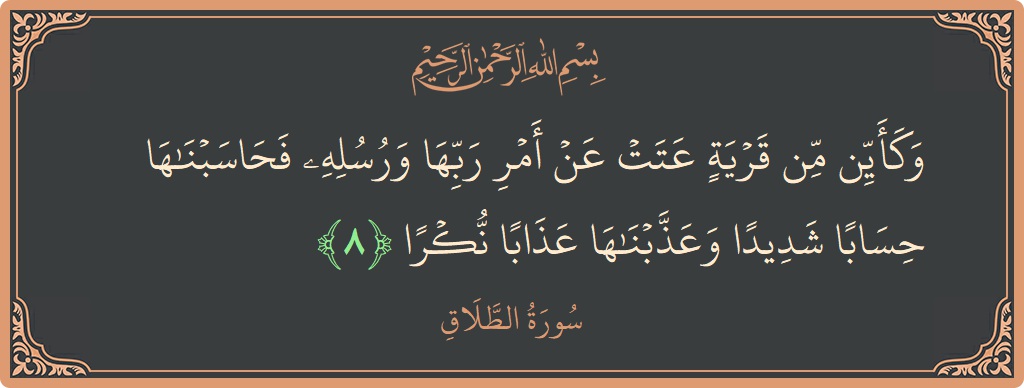
Surah At-Talaaq: Verse 8 - وكأين من قرية عتت عن... - English
Tafsir of Verse 8, Surah At-Talaaq
English Translation
And how many a city was insolent toward the command of its Lord and His messengers, so We took it to severe account and punished it with a terrible punishment.English Transliteration
Wakaayyin min qaryatin AAatat AAan amri rabbiha warusulihi fahasabnaha hisaban shadeedan waAAaththabnaha AAathaban nukranTafsir of Verse 8
Commentary
فَحَاسَبْنَاهَا حِسَابًا شَدِيدًا وَعَذَّبْنَاهَا عَذَابًا نُّكْرًا (so We called them to a severe account, and punished them with an evil punishment...65:8). The severe account and evil punishment of nations mentioned in this verse refers to what will happen in the Hereafter. However, the past tense has been employed presumably to indicate the occurrence of these events is as certain as if it has already been materialised. [ Ruh ]. The other possibility is that the hisab or 'account' in this context does not refer to interrogation, but to the determination of punishment, (in which case it may refer to the punishment faced by the infidels right here in this world.) Another possibility is that the 'severe account' will though take place in the Hereafter, it has already been recorded and is being recorded on daily basis in the ledger of deeds and is therefore described as 'called them to a severe account'. In this interpretation, the 'punishment' refers to the past nations who were destroyed by Divine punishment in this world because they defied Allah's and His Messengers' commandments. In this case, only the next statement أَعَدَّ اللَّـهُ لَهُمْ عَذَابًا شَدِيدًا (Allah has prepared for them a severe punishment...10) would refer to the terrible punishment of the Hereafter.
Punishment for defying Allah's Commandments
Allah the Exalted threatens those who defy His commands, deny His Messengers and contradict His legislation, by informing them of the end that earlier nations met who did the same,
(And many a town revolted against the command of its Lord and His Messengers;) meaning, they rebelled, rejected and arrogantly refused to obey Allah and they would not follow His Messengers,
(and We called it to a severe account, and We shall punish it with a horrible torment.) meaning, horrendous and terrifying,
(So it tasted the evil result of its affair,) meaning, they tasted the evil consequences of defiance and they regretted their actions when regret does not avail,
(and the consequence of its affair was loss. And Allah has prepared for them a severe torment.) means, in the Hereafter, added to the torment that was sent down on them in this life. Allah the Exalted said, after mentioning what happened to the disbelieving nations,
(So have Taqwa of Allah, O men of understanding,) meaning, `O you who have sound understanding, do not be like them because if you do, you will suffer what they suffered, O people of comprehension,'
(who believe) meaning, in Allah and His Messengers,
(Allah has indeed sent down to you a Reminder.) meaning, this Qur'an. Allah also said,
(Verily, We, it is We Who have sent down the Dhikr and surely, We will preserve it.) (15:9)
The Qualities of the Messenger
Allah's statement,
(A Messenger, who recites to you the Ayat of Allah containing clear explanations,) Some said that the Messenger is the subject of what is being sent as a reminder because the Messenger is the one that conveys the Dhikr. Ibn Jarir said that what is correct is that the Messenger explains the Dhikr. This is why Allah the Exalted said here,
(A Messenger, who recites to you the Ayat of Allah containing clear explanations,) meaning, plain and apparent. The statement of Allah;
(that He may take out those who believe and do righteous good deeds, from the darkness to the light.) Allah's is like saying;
(A Book which We have revealed unto you in order that you might lead mankind out of darkness) (14:1), and,
(Allah is the Guardian of those who believe. He brings them out from darkness into light.) (2:257) meaning, out of the darkness of disbelief and ignorance into the light of faith and knowledge. Allah the Exalted called the revelation that He has sent down, light, on account of the guidance that it brings. Allah also called it Ruh, in that, it brings life to the hearts,
(And thus We have sent to you Ruh of our command. You knew not what is the book, nor what is faith But We have made it a light wherewith we guide whosoever of Our servants We will. And verily, you are indeed guiding to the straight path.) (42:52) Allah's statement,
(And whosoever believes in Allah and performs righteous good deeds, He will admit him into Gardens under which rivers flow, to dwell therein forever. Allah has indeed granted for him an excellent provision.) was explained several times before, and therefore, we do not need to repeat its explanation here. All the thanks and praises are due to Allah.