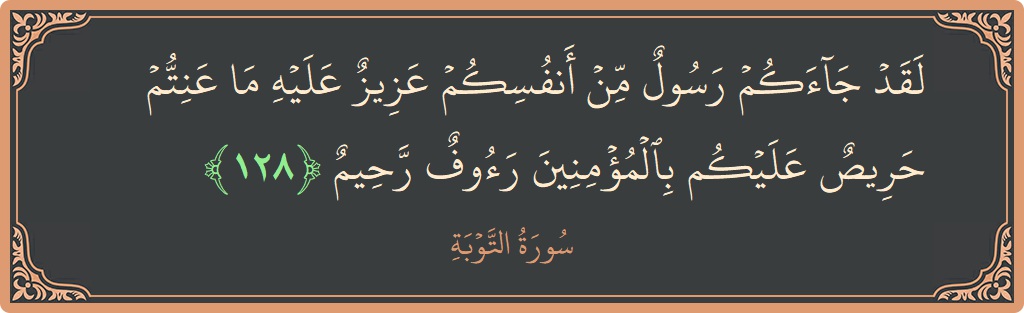
Surah At-Tawba: Verse 128 - لقد جاءكم رسول من أنفسكم... - English
Tafsir of Verse 128, Surah At-Tawba
English Translation
There has certainly come to you a Messenger from among yourselves. Grievous to him is what you suffer; [he is] concerned over you and to the believers is kind and merciful.English Transliteration
Laqad jaakum rasoolun min anfusikum AAazeezun AAalayhi ma AAanittum hareesun AAalaykum bialmumineena raoofun raheemunTafsir of Verse 128
Commentary
These are the last verses of Surah At-Taubah where it has been declared that the Holy Prophet ﷺ is very kind and merciful for the entire creation of Allah, particularly so for Muslims. Then, in the last verse, he has been told that he should observe patience and trust Allah even if there are people who do not come to believe despite all his efforts.
That this theme appears at the end of Surah At-Taubah happens to be very appropriate. It will be recalled that this Surah has been full of references to the declaration of withdrawal from the disbelievers, the ultimate severance of relationship with them and then fighting in Jihad against them. This is, however, the last resort of the Call to Allah subject to the condition that the initial steps of Da'wah (call) and Tabligh (communication of the Message) leave no hope of correction and betterment. But, the basic function of the prophets is to invite people to the way of Allah with love, affection, sympathy and an earnest de-sire for their well-being; if they have to face aversion from the people or have to suffer some hardships, they are supposed to leave it to Allah and place their trust in Him, for He is the Lord of the Great Throne. By saying the Rabb رَبّ or Lord of the Great ` Arsh, the purpose is to lay stress on the fact that He encompasses the entire creation.
(I was sent with the easy Hanifiyah monotheism way.) An authenic Hadith mentions,
(Verily, this religion is easy) and its Law is all easy, lenient and perfect. It is easy for those whom Allah the Exalted makes it easy.)
(He is eager for you), that you gain guidance and acquire benefits in this life and the Hereafter. Imam Ahmad recorded that `Abdullah bin Mas`ud said that the Messenger of Allah said,
(Verily, every matter that Allah has prohibited, He knows that some among you will breach it; but I am indeed holding you by the waist so that you do not fall in the Fire, just like butterflies and flies.) Allah's statement next,
(for the believers (he is) full of pity, kind, and merciful.) 9:128, is similar to His other statement,
(And be kind and humble to the believers who follow you. Then if they disobey you, say: "I am innocent of what you do." And put your trust in the All-Mighty, the Most Merciful) 26:215-217. Allah the Exalted commanded His Messenger in this honorable Ayah,
(But if they turn away), from the glorious, pure, perfect and encompassing Law that you -- O Muhammad -- brought them,
(then say: "Allah is sufficient for me. There is no God but He,) Allah is sufficient for me, there is no deity worthy of worship except Him, and in Him I put my trust. Similarly, Allah said,
((He alone is) the Lord of the east and the west; there is no God but He. So take Him alone as a guardian.) 73:9. Allah said next,
(Verily, there has come unto you a Messenger from among yourselves ...) 9:128" until the end of the Surah It is recorded in the Sahih that Zayd bin Thabit said, "I found the last Ayah in Surah Bara'ah with Khuzaymah bin Thabit." This is the end of Surah Bara'ah, all praise is due to Allah.
(and He is the Lord of the Mighty Throne) 9:129. He is the King and Creator of all things, and He is the Lord of the Mighty Throne (`Arsh), which is above all creation; all that is in and between the heavens and earths is under the Throne (`Arsh) and subservient to Allah's power. His knowledge encompasses all things, and His decision will certainly come to pass over all matters. He is the guardian of all things. Imam Ahmad recorded that Ibn `Abbas said that Ubayy bin Ka`b said, "The last Ayah revealed from the Qur'an was this Ayah,
(Verily, there has come unto you a Messenger f rom among yourselves . . . )until the endof the Surah It is recorded in the Sahih that Zayd bin Thabit said, "I found the last Ayah in SurahBara'ah with Khuzaymah bin Thabit . " This is the end of Surah Bara'ah, all praise is due to Allah.