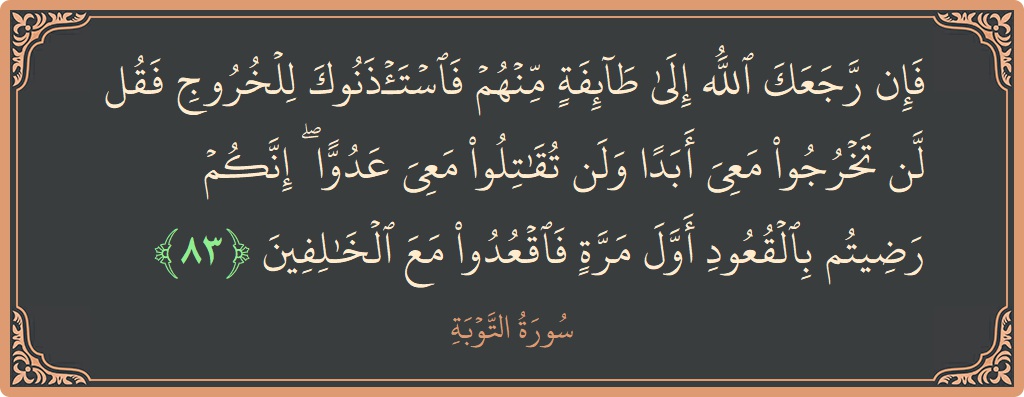
Surah At-Tawba: Verse 83 - فإن رجعك الله إلى طائفة... - English
Tafsir of Verse 83, Surah At-Tawba
English Translation
If Allah should return you to a faction of them [after the expedition] and then they ask your permission to go out [to battle], say, "You will not go out with me, ever, and you will never fight with me an enemy. Indeed, you were satisfied with sitting [at home] the first time, so sit [now] with those who stay behind."English Transliteration
Fain rajaAAaka Allahu ila taifatin minhum faistathanooka lilkhurooji faqul lan takhrujoo maAAiya abadan walan tuqatiloo maAAiya AAaduwwan innakum radeetum bialquAAoodi awwala marratin faoqAAudoo maAAa alkhalifeenaTafsir of Verse 83
The statement: لَّن تَخْرُجُوا (Ian takhruju ... you shall never march) in the second verse (83) has been explained by Maulana Ashraf ` Ali Thanavi (رح) in the summary of his Tafsir Bay-an a1-Qur'an. According to him, ` even if these people intend to participate in a future Jihad, they would get out of it when they want to, under one or the other pretext; and since they do not have faith in their heart, their intention too will not be backed by sincerity. Therefore, the Holy Prophet ﷺ was commanded that, even if they want to take part in a Jihad, he should tell them the truth that he does not trust their word and deed. So, they would neither go for Jihad nor fight an enemy of Islam in his company.'
Most of the commentators have said that this injunction has been enforced as their punishment in the present world, that is, even if they themselves were to make a request that they be allowed to take part in Jihad, even then, they should not be allowed to do that.
Hypocrites are barred from participating in Jihad
Allah commands His Messenger, peace be upon him,
(If Allah brings you back), from this battle,
(to a party of them) in reference to the twelve (hypocrite) men, according to Qatadah,
(and they ask your permission to go out), with you to another battle,
(say: "Never shall you go out with me nor fight an enemy with me...") as an admonishment and punishment for them. Allah mentioned the reason for this decision,
("You were pleased to sit (inactive) on the first occasion...") Allah said in a similar Ayah,
(And We shall turn their hearts and their eyes away (from guidance), as they refused to believe therein for the first time. ) 6:110 The recompense of an evil deed includes being directed to follow it with another evil deed, while the reward of a good deed includes being directed to another good deed after it. For instance, Allah said concerning the `Umrah of Hudaybiyyah,
(Those who lagged behind will say, when you set forth to take the spoils.)48:15 Allah said next,
("...then you sit (now) with those who lag behind.") in reference to the men who lagged behind from Tabuk battle, according to Ibn `Abbas.