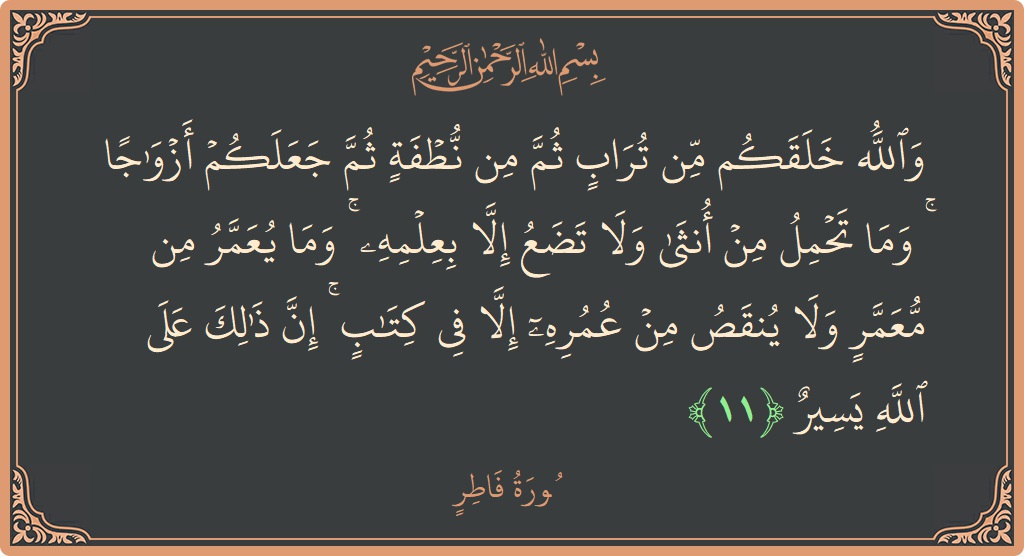
Surah Faatir: Verse 11 - والله خلقكم من تراب ثم... - English
Tafsir of Verse 11, Surah Faatir
English Translation
And Allah created you from dust, then from a sperm-drop; then He made you mates. And no female conceives nor does she give birth except with His knowledge. And no aged person is granted [additional] life nor is his lifespan lessened but that it is in a register. Indeed, that for Allah is easy.English Transliteration
WaAllahu khalaqakum min turabin thumma min nutfatin thumma jaAAalakum azwajan wama tahmilu min ontha wala tadaAAu illa biAAilmihi wama yuAAammaru min muAAammarin wala yunqasu min AAumurihi illa fee kitabin inna thalika AAala Allahi yaseerunTafsir of Verse 11
The sense of the verse: وَمَا يُعَمَّرُ مِن مُّعَمَّرٍ وَلَا يُنقَصُ مِنْ عُمُرِهِ إِلَّا فِي كِتَابٍ (And no aged person is made to advance in age, nor a part is curtailed from his age, but all this is (recorded) in a book - 35:11), according to the majority of the commentators is that if Allah Ta’ ala blesses a person with a long age, it is a fact already on record in the Preserved Tablet (al-lawh al-mahfuz). Similarly, when the age of a certain person is kept at a lower mark in terms of the number of years, that too already stands recorded in al-lawh al-mahfuz. The outcome of it all is that the text, at this place, is not referring to one individual person's age being long or short, instead, the statement relates to humankind as a whole, in the sense that some individuals from it are given long ages and others, a comparatively shorter ones. The explanation has been reported by Ibn Kathir from Sayyidna ` Abdullah Ibn ` Abbas ؓ . Abu Bakr al-Jassas (رح) reports the same saying from Hasan al-Basri and Dahhak رحمۃ اللہ علیہما . Therefore, in general books of Tafsir, such as, Ibn Jarir, Ibn Kathir, Rah ul-Ma’ ani and others, this very explanation has been declared as the view of the majority of commentators. However, some early commentators have said: Should the length of age concerns one single person, then, decrease in age would mean that the age of every person as already written by Allah Ta’ ala is certain, and every day that passes decreases one day from this pre-fixed age. If two days pass, two days decrease. In the same way, every day, in fact, every single breath keeps decreasing one's age. This Tafsir or explanation has been reported from Sha'bi, Ibn Jubayr, Abu Malik, Ibn ` Atiyyah and Suddiyy. (Ruh ul Ma’ ani)
This subject has been succinctly expressed in an Arabic couplet as:
حِیَاتُک اَنفَاسُ تُعَدُّ فَکُلَّمَا مَضٰی نَفَسُ مِّنھَا انتقَصَتُ بِہٖ جُزء،
Your life is (the name of) counted breaths. So, whenever passes away a breath from it, a part of it decreases.
In his explanation of this verse, Imam an-Nasa` i (رح) has reported from Sayyidna Anas Ibn Malik ؓ that he heard the Holy Prophet ﷺ saying,” مَن سَرَّہ، اَن یُبسَطَ لَہ، فِی رِزقِہٖ وَ یُنسَأ فِی اَثَرہٖ فَلیَصِلَ رَحمَۃ،”. This Hadith has also been reported by al-Bukhari, Muslim and Abu Dawud on the authority of a narration from Yunus Ibn Yazid Ayli. The Hadith means: 'He who wishes that his sustenance and age is increased should treat his close relatives well (Silatu-r-rahim).' This obviously suggests that these deeds increase one's age. But, another Hadith given below has itself clarified its sense:
Ibn Abi Hatim (رح) reports from Sayyidna Abu-d-Darda' ؓ . He says, 'when we mentioned this (subject) before the Holy Prophet ﷺ ، he said, " (Age as such is already fixed and determined by Allah), when the fixed term is over, no one is given the least respite. In fact, increase in age means (in the Hadith cited above) that Allah Ta` a1a blesses one with good children who keep praying for him. This person is not there anymore, but he keeps receiving their prayers in his grave (that is, he keeps on receiving the benefits one would have received if one were alive. Thus, in a way, his age has increased" ). (Both narrations appearing above have been reported by Ibn Kathir). In short, Ahadith that say that some deeds cause age to increase mean increase in the barakah or bliss of age.