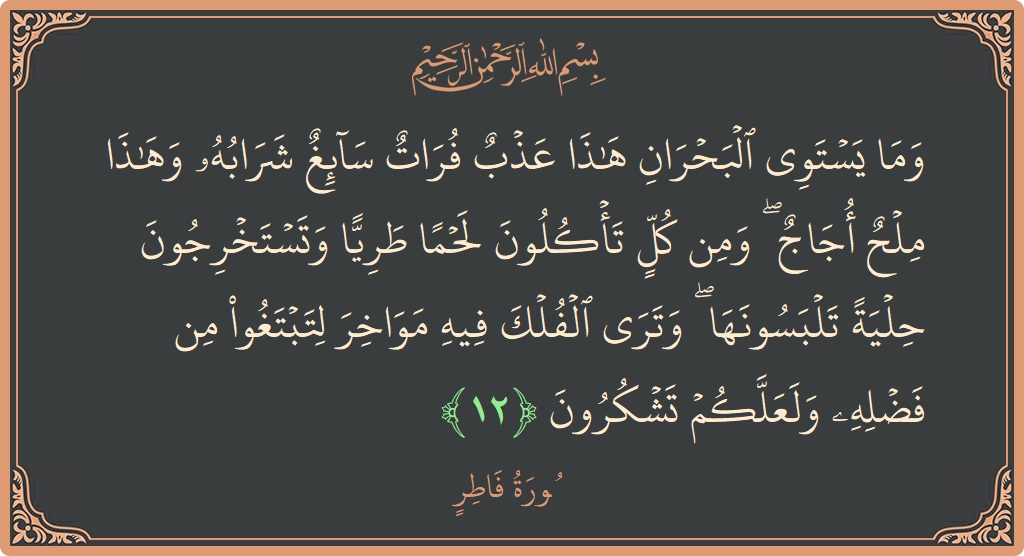
Surah Faatir: Verse 12 - وما يستوي البحران هذا عذب... - English
Tafsir of Verse 12, Surah Faatir
English Translation
And not alike are the two bodies of water. One is fresh and sweet, palatable for drinking, and one is salty and bitter. And from each you eat tender meat and extract ornaments which you wear, and you see the ships plowing through [them] that you might seek of His bounty; and perhaps you will be grateful.English Transliteration
Wama yastawee albahrani hatha AAathbun furatun saighun sharabuhu wahatha milhun ojajun wamin kullin takuloona lahman tariyyan watastakhrijoona hilyatan talbasoonaha watara alfulka feehi mawakhira litabtaghoo min fadlihi walaAAallakum tashkuroonaTafsir of Verse 12
In the next verse: وَمِن كُلٍّ تَأْكُلُونَ لَحْمًا طَرِيًّا وَتَسْتَخْرِجُونَ حِلْيَةً تَلْبَسُونَهَا (And from each, you eat fresh meat, and derive ornaments that you wear - 35:12), it is being said that one gets fresh meat, that is, fish to eat from both waters, sweet or brackish. In this verse, by alluding to fish as meat, the hint released is that fish is meat, already halal by itself. One does not have to slaughter it. This is contrary to the case of the animals found on land. Unless one slaughters them with the name of Allah, they do not become halal. Fish does not have this condition. It is meat, ready to eat. And the word: حِلْيَةً (hilyah) means ornament and refers to pearls. The verse tells us that the way pearls are found in brackish waters, they are also found in sweet waters, something contrary to the general belief, since it is well known that pearls are harvested from the brackish water of the seas. However, the reality is what is evident from the words of the Qur'an that they form in both - yes, much less in sweet waters and far more in the brackish waters of the sea. That they are found in seas excessively contributed to the popular belief that pearls come only from brackish waters.
By using the masculine form in the last word: تَلْبَسُونَهَا (talbasunaha: that you wear), a hint is being released that the use of pearls is permissible for men as well - contrary to gold and silver, the use of which as an ornament is not permissible for men. (Ruh-ul-Ma’ ani)
The Blessings and Signs of Allah
Allah says, pointing out His mighty power in creating different things, how He has created the two seas (kinds of water). The fresh, palatable sea (kind of water) refers to the rivers which flow among people, rivers great and small according to people's needs in all regions and areas and lands. This water is sweet and palatable for whoever wants to drink it.
and that is salty and bitter. means, unpalatable. This is the ocean in which the big ships sail, and is salty and undrinkable. Allah says:
(and that is salty and bittery.) Then Allah says:
(And from them both you eat fresh tender meat,) meaning, fish.
(and derive the ornaments that you wear.) This is like the Ayah:
(Out of them both come out pearl and coral. Then which of the blessings of your Lord will you both (Jinn and men) deny) (55:22-23).
And you see the ships cleaving, means, they travel through it, plowing through the water with their beak-shaped bows. Muja0hid said, The wind drives the ships, and the wind cannot drive any ships except the big ones.
that you may seek of His bounty, means, through your journeys to engage in trade from one land to another.
and that you may give thanks. means, that you may give thanks to your Lord for subjugating this mighty creation -- the sea -- to you, so that you can travel through it as you wish and go wherever you want, and nothing stops you؛ His power has subjugated for you whatever is in the heavens and on earth, and all of this is by His grace and mercy.