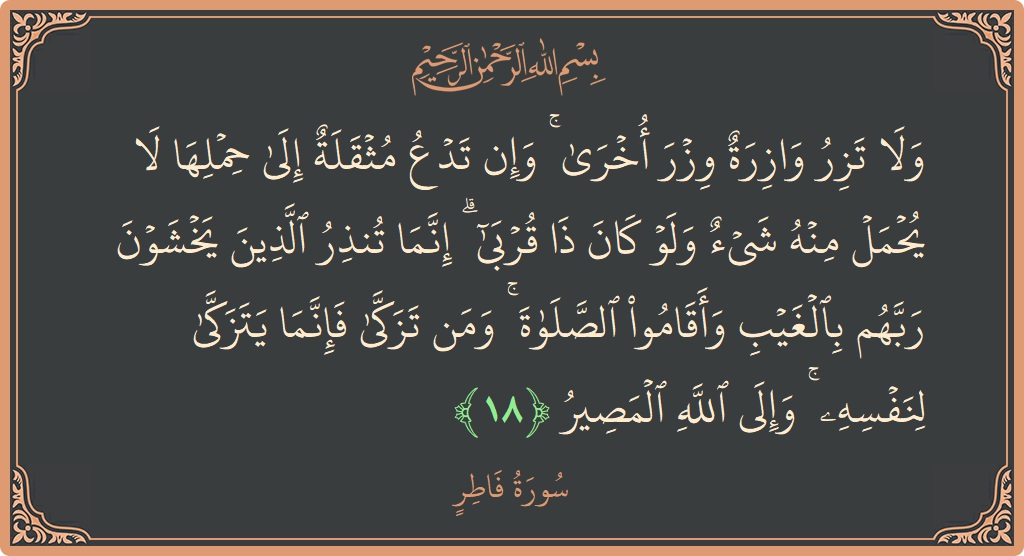
Surah Faatir: Verse 18 - ولا تزر وازرة وزر أخرى... - English
Tafsir of Verse 18, Surah Faatir
English Translation
And no bearer of burdens will bear the burden of another. And if a heavily laden soul calls [another] to [carry some of] its load, nothing of it will be carried, even if he should be a close relative. You can only warn those who fear their Lord unseen and have established prayer. And whoever purifies himself only purifies himself for [the benefit of] his soul. And to Allah is the [final] destination.English Transliteration
Wala taziru waziratun wizra okhra wain tadAAu muthqalatun ila himliha la yuhmal minhu shayon walaw kana tha qurba innama tunthiru allatheena yakhshawna rabbahum bialghaybi waaqamoo alssalata waman tazakka fainnama yatazakka linafsihi waila Allahi almaseeruTafsir of Verse 18
Commentary
Verse 18: وَلَا تَزِرُ وَازِرَةٌ وِزْرَ أُخْرَىٰ (And no bearer will bear the burden of any other person) means that, on the Day of Judgment, no one will be able to bear the burden of another person's sins. Everyone will have to bear his or her burden. As for what appears in Surah Al-` Ankabut (29:13): وَأَثْقَالًا مَّعَ أَثْقَالِهِمْ , which means that people who make others go astray will not only bear the burden of going astray personally, but will also bear the burden of having made others go astray. it does not mean that they will somehow lighten the burden of those they had caused to go astray. Instead, their burden will weigh on them as it was in its own place and because of the crime of those who made people go astray, being twofold, their burden too will become twofold, one: that of being astray and two: that of making others go astray. Therefore, there is no contradiction in these two verses. (Ruh-ul-Ma’ ani)
Explaining this verse, Sayyidna ` Ikrimah ؓ said: On that Day, a father would say to his son, 'You know how affectionate a father I was to you?' He will say, 'yes, your favors to me are countless. You have certainly faced many a hardship for me during the life of the world.' Then, the father will say, 'son, today I need you. Give me some of your good deeds, so that I can have my salvation.' The son will say, 'father, the return you asked for is not much, but what can I do? If I were to give that to you, I shall be facing the same situation that you are facing now, therefore, I am sorry, I cannot help you.' Then, he will say the same thing to his wife, 'I sacrificed everything for you during the life of the world. Today, I need a few of your good deeds. Please give these to me.' The wife will give him the same answer as was given by the son.
Sayyidna ` Ikrimah ؓ said that this is what the verse: لَا تَزِرُ وَازِرَةٌ وِزْرَ أُخْرَىٰ (And no bearer will bear the burden of any other) means. Then he said that the noble Qur'an has taken up this subject in several of its verses. At one place, it has said: لَّا يَجْزِي وَالِدٌ عَن وَلَدِهِ وَلَا مَوْلُودٌ هُوَ جَازٍ عَن وَالِدِهِ شَيْئًا that is, on that Day, neither a father would be able to have his son be spared from the punishment, nor would a son be able to do that for his father (31:33). The essential sense is that no one will save another person by carrying the burden of his sins over one's own shoulders. However, the matter of intercession (shafa'ah) is dierent. Similarly, in another verse, it was said: يَوْمَ يَفِرُّ الْمَرْءُ مِنْ أَخِيهِ وَأُمِّهِ وَأَبِيهِ that is, on that Day, one will run from his brother and his mother and father and his wife and children (80:34, 35). The purpose of running is no other but that he would be in fear, lest these people try to pass on the burden of their sins on him or come up with a request for some of his good deeds. (Ibn Kathir)