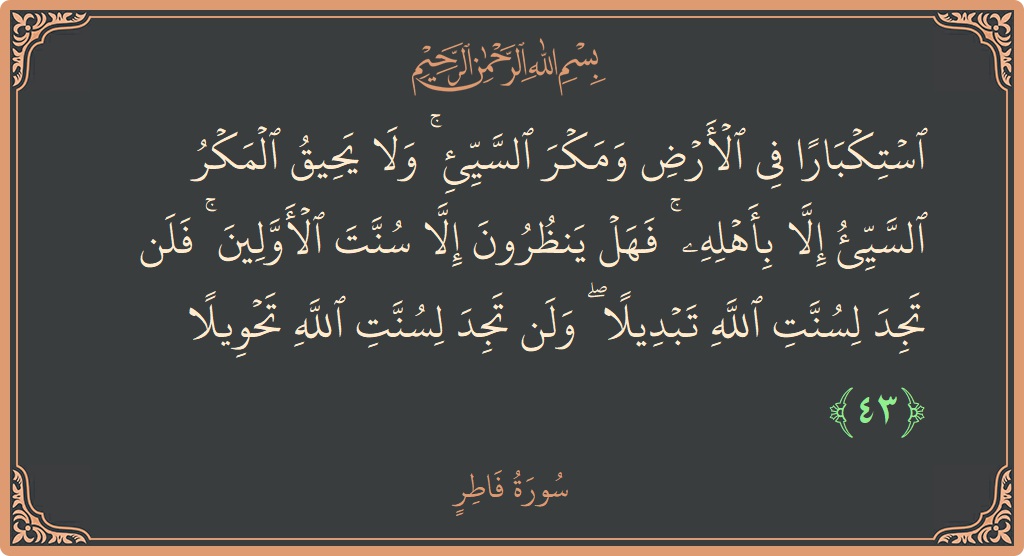
Surah Faatir: Verse 43 - استكبارا في الأرض ومكر السيئ... - English
Tafsir of Verse 43, Surah Faatir
English Translation
[Due to] arrogance in the land and plotting of evil; but the evil plot does not encompass except its own people. Then do they await except the way of the former peoples? But you will never find in the way of Allah any change, and you will never find in the way of Allah any alteration.English Transliteration
Istikbaran fee alardi wamakra alssayyii wala yaheequ almakru alssayyio illa biahlihi fahal yanthuroona illa sunnata alawwaleena falan tajida lisunnati Allahi tabdeelan walan tajida lisunnati Allahi tahweelanTafsir of Verse 43
Commentary
The word: لَا يَحِيقُ (la yahiq) in verse 43: وَلَا يَحِيقُ الْمَكْرُ السَّيِّئُ إِلَّا بِأَهْلِهِ (And the evil plot envelops none but its own people ( who make it) carries the sense of: لَا یُحِیطُ (la yuhit: does not surround) or: لَا یُصیبُ (la usib: does not afflict). Thus, it comes to mean that the curse of making an evil plan falls on none but the one who makes it. In other words, a person who wishes evil for others, he himself falls a victim to it.
A doubt may arise at this point. It is commonly seen in this worldly life that someone with an evil plan gets away with it and the loss intended for anyone stands inflicted on him. The answer to this has been given by Maulana Ashraf Ali Thanavi (رح) by saying that the pain or loss inflicted on such a person was a loss limited to this mortal world, while the loss to be the fate of the maker of such evil plan in the Hereafter was not only heavier, but was more lasting too. So, if compared, his worldly loss amounts to nothing.
There is another answer given by some elders who say that there are occasions when the curse of contriving against someone innocent or inflicting injustice on him, more than often, falls on the person causing it, right here in this world as well. Muhammad Ibn Ka` b al-Qurazi said: There are three things the doer of which does not remain safe against its curse and punishment even in this world. These are: (1) Causing harm or pain to some innocent person by engineering evil against him. (2) Inflicting any injustice. (3) Breaking of pledge. (Ibn Kathir) Particularly so, when things like that are done against a person who is helpless or does not have the power to avenge or elects to endure despite having that power. Experience bears out that no one who does things like that has ever remained unaffected by the curse of injustice thus inflicted even in this world. Hence, the outcome will be that the element of restriction (Hasr) visible here appears in terms of a majority rule and not in any absolute sense. Allah knows best.
Alhamdulillah
The Commentary on
Surah Fatir
Ends here