Surah Hud: Verse 11 - إلا الذين صبروا وعملوا الصالحات... - English
Tafsir of Verse 11, Surah Hud
English Translation
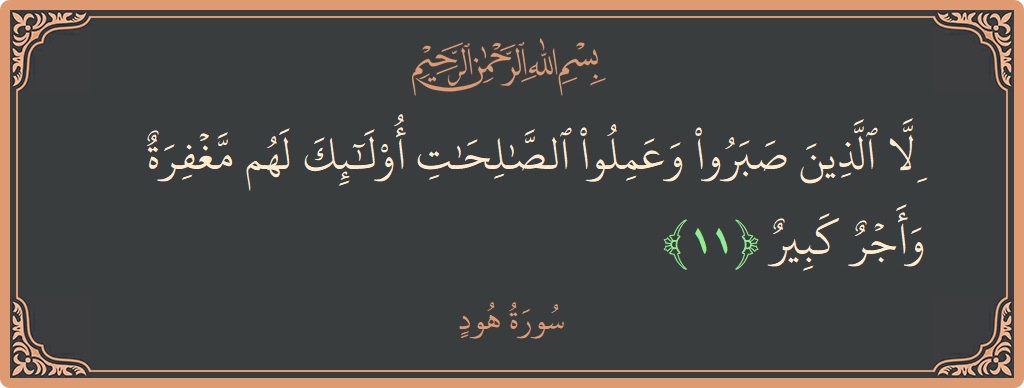
Except for those who are patient and do righteous deeds; those will have forgiveness and great reward.English Transliteration
Illa allatheena sabaroo waAAamiloo alssalihati olaika lahum maghfiratun waajrun kabeerunTafsir of Verse 11
In order to make such perfect models of humanity distinct from those having common human temperament, it was said in the third verse (11): إِلَّا الَّذِينَ صَبَرُوا وَعَمِلُوا الصَّالِحَاتِ (except those who are patient and do good deeds). It means that people exempted from this common human frailty have two qualities: صَبر Sabr (patience) and al-Amal as-Salih (good deeds).
The word: صَبر (sabr) is used to convey a much wider range of meanings in the Arabic language, much wider than conveyed by its translation as ` patience' in English. The real meaning of صَبر Sabr is to tie, check, stop or hold back. In the terminology of the Qur'an and Sunnah, to hold the desiring human self back from going for the impermissible is Sabr. Therefore, the sense of صَبر Sabr (patience) includes abstention from all sins and doings counter to the dictates of the Shari` ah and al-Amal as-Salih (good deeds) covers all that is obligatory (fard), necessary (wajib), Sunnah and recommended (mustahabb). The verse now comes to mean that there are people who will not be affected by common human weaknesses. This will happen because they would have faith in Allah and they would fear the reckoning of the Last Day of Qiyamah. They will abstain from everything disliked by Allah and His Rasul and race towards every deed that brings their pleasure.
At the end of this very verse, also identified there is the recompense of these perfect human beings: أُولَـٰئِكَ لَهُم مَّغْفِرَةٌ وَأَجْرٌ كَبِير (Those are the people for whom there is forgiveness and a great reward - 11)
At this place, it should be noted that the Holy Qur'an uses the word: اَذَقنَا (adhaqna: We give them a taste of) for blessing and suffering both. By this device, it was indicated that real blessing and suffering is that of the Hereafter. Neither is the comfort of the mortal world the whole of it, nor is its suffering the whole of it. Instead of that, it should be taken at the level of tasting and sampling so that human beings could have some idea of the blessings and sufferings of the Hereafter. Therefore, neither are the comforts of this world something to be happy about unnecessarily, nor are its sufferings something to grieve about too much. If you were to think, this whole world is, to borrow a commercial term, only a showroom of the Hereafter with sample displays of comfort and suffering.