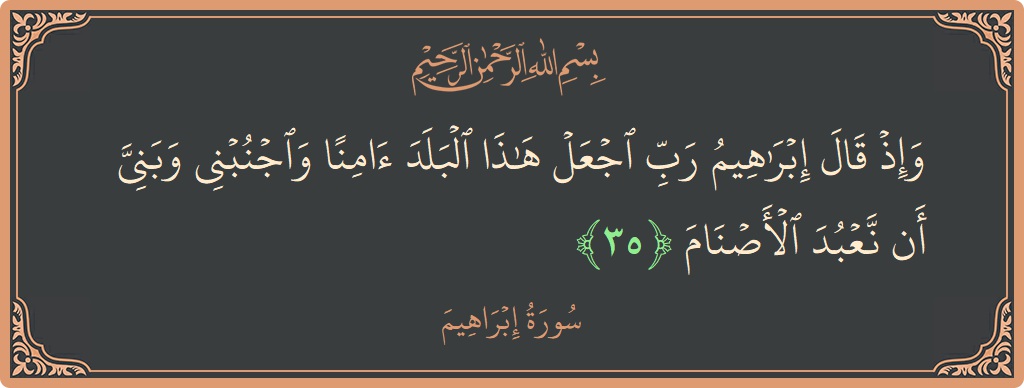
Surah Ibrahim: Verse 35 - وإذ قال إبراهيم رب اجعل... - English
Tafsir of Verse 35, Surah Ibrahim
English Translation
And [mention, O Muhammad], when Abraham said, "My Lord, make this city [Makkah] secure and keep me and my sons away from worshipping idols.English Transliteration
Waith qala ibraheemu rabbi ijAAal hatha albalada aminan waojnubnee wabaniyya an naAAbuda alasnamaTafsir of Verse 35
Commentary
Stated in the previous verses was the rational strength and cardinal position of Tauhid, the belief in the Oneness of Allah. And also mentioned there in contrast was the gross ignorance of Shirk, the ascribing of partners in the pristine divinity of Allah, and a condemnation thereof. Among the group of prophets (علیہم السلام) the most successful Jihad waged to establish pure monotheism was that of Sayyidna Ibrahim (علیہ السلام) . Therefore, the religion preached by him is known particularly as the upright religion.
In view of this, reference has been made to the story of Sayyidna Ibrahim علیہ السلام in the cited verses. However, there is another reason too. In a previous verse (28): الَّذِينَ بَدَّلُوا نِعْمَتَ اللَّـهِ كُفْرًا (those who changed the favour of Allah with disbelief), condemned were people from among the disbelievers of Makkah who had changed faith for disbelief and Tauhid (Oneness of Allah) for Shirk (ascribing of partners to Allah) because that was what their forefathers have been doing. They have been told in these verses about the belief and behaviour of their patriarch, Sayyidna Ibrahim (علیہ السلام) so that these people so eager to follow the lead of their ancestors would just look at this model and would, hopefully, abstain from their disbelief. (Al-Bahr Al-Muhit)
And as it is already clear to us that by describing the stories and conditions of blessed prophets, the Qur’ an never aims to narrate their history only. Instead of that, in them there are guiding principles for every department of human life. It is to make them become available continuously that these events about prophets are repeated in the Qur'an time and again.
At this place, there are in the first verse (35) two prayers made by Sayyidna Ibrahim (1) رَبِّ اجْعَلْ هَـٰذَا بَلَدًا آمِنًا 'My Lord, make this city (of Makkah) peaceful.' This prayer appears in Sarah Al-Baqarah (2:126) as well. But, there the word: بَلَد (balad : city) appears as: بَلَداً (baladan) without the definite article Alif Lam which means an indefinite city. The reason is that this prayer belonged to a time when the city of Makkah was not inhabited. Therefore, the words of the prayer made were general when he said: 'My Lord, make this a city of peace.'
In the prayer which he made when Makkah was already a populated city, he made a definite reference to the city of Makkah saying: 'My Lord, make this city peaceful.'
(2) The second prayer made by him was: 'and keep me and my children away from worshiping idols.'
Though, prophets on whom be peace are protected by Allah, so Shirk, idol-worship, or a sin cannot issue forth from them. But, in this prayer, Sayyidna Ibrahim (علیہ السلام) has included himself as well. The reason for this is either that prophets too live under a constant fear of being in danger, or that his main purpose was to pray for the safety of his children against the danger of disbelief and idol-worship. It was to impress his children with the gravity of the matter that he included himself too with-in the prayer.
Allah jalla thana'uh granted the prayer of His 'friend.' His children remained protected from Shirk and idol-worship. This brings up a question. The people of Makkah are generally from among the progeny of
Sayyidna Ibrahim (علیہ السلام) . Idol-worship was very much present with them. Tafsir Al-Bahr Al-Muhit answers it on the authority of Sufyan ibn ` Uyaiynah that no one from among the progeny of Sayyidna Ismail (علیہ السلام) did really take to idol-worship. In fact, when people of the tribe of Jurhum took over Makkah and expelled the children of Sayyidna Ismail (علیہ السلام) from the حَرَم Haram, they carried away with them some stones from there out of love and respect for the sacred place. These they used to keep as a momento of the sacred House of Allah before them when they worshipped or went round them making Tawaf. Initially, in doing so, they had no desire to turn back from Allah. They thought that the way making prayers turning towards Baytullah or making Tawaf round it was nothing but devoting to the worship of Allah, so when they turn to that stone from there and make their Tawaf round it, that would not be counter to the worship of Allah. After a passage of time, this very method became the cause of idol-worship.
brahim's Supplication to Allah when He brought Isma`il to Makkah
Allah mentions here, while bringing forth more evidences against Arab polytheists, that the Sacred House in Makkah was established on the worship of Allah alone, without partners. He also states that Ibrahim, who establsihed the city, has disowned those who worship others besides Allah, and that he begged Allah to make Makkah peaceful and secure,
(O my Lord! Make this city (Makkah) of peace and security,) and Allah accepted his supplication. Allah said in other Ayat,
(Have they not seen that We have made (Makkah) a secure sanctuary.) 29:67 and,
(Verily, the first House (of worship) appointed for mankind was that at Bakkah (Makkah), full of blessing, and a guidance for Al-'Alamin. In it are manifest signs, the Maqam of Ibrahim; whosoever enters it, he attains security.)3:96 Allah said here that Ibrahim supplicated,
(O my Lord! Make this city (Makkah) a of peace and security, ) saying, "this city", after he established it, and this is why he said afterwards,
(All praise is due to Allah, Who has given me in old age Isma`il and Ishaq.) 14:39 It is well-known that Isma`il was thirteen years older than Ishaq. When Ibrahim took Isma`il and his mother to Makkah, while Isma`il was still young enough to nurse, he supplicated to Allah,
(O my Lord! Make this city (Makkah) a place of peace and security.) 2:126 as we in explained in Surat Al-Baqarah. Ibrahim then said,
(and keep me and my sons away from worshipping idols.) It is proper for whoever supplicates to Allah to also ask for the benefit of his parents and offspring, as well as himself. Ibrahim next mentioned that many among mankind were led astray because of idols, and he disowned those who worship them and referred their matter to Allah; if Allah wills, He will punish them, and if He wills, He will forgive them. `Isa, peace be upon him, said similar words,
(If You punish them, they are Your servants, and if You forgive them, verily, You, only You are the Almighty, the All-Wise.)5:118 This supplication refers this and all matters to Allah, not that it is actually going to happen. `Abdullah bin `Amr narrated that the Messenger of Allah recited Ibrahim's supplication,
(O my Lord! They have indeed led astray many among mankind.), and the supplication of `Isa,
(If You punish them, they are Your servants.) 5:118 then raised his hands and said,
(O Allah, Save my Ummah! O, Allah, Save my Ummah! O, Allah, Save my Ummah!) and cried. Allah said to the angel Jibril, "O Jibril, go to Muhammad, and Your Lord has more knowledge, and ask him what makes him cry." Jibril came to the Prophet and asked him, and he repeated to him what he said (in his supplication). Allah said, "Go to Muhammad and tell him this; `We will make you pleased with your Ummah, O Muhammad, and will not treat them in a way you dislike."'