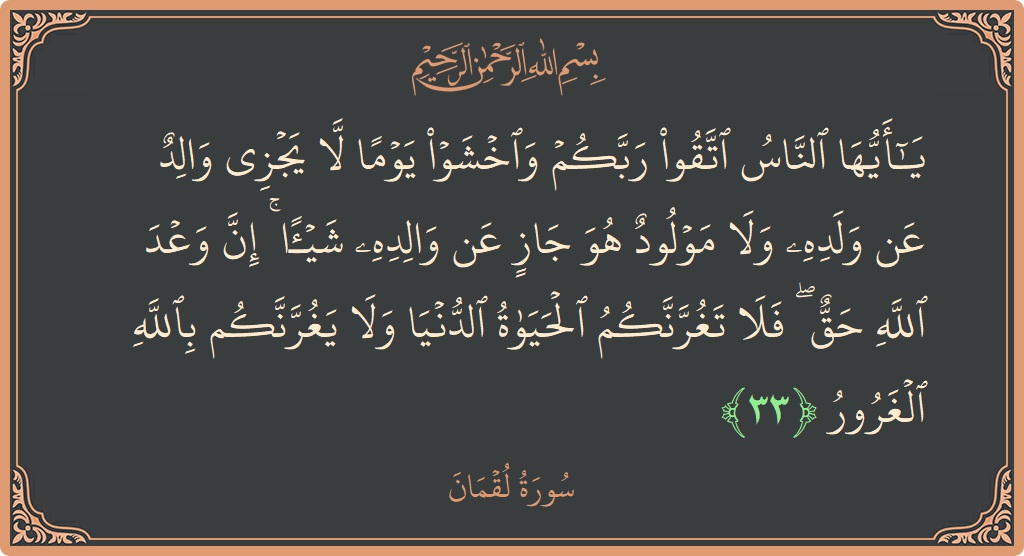
Surah Luqman: Verse 33 - يا أيها الناس اتقوا ربكم... - English
Tafsir of Verse 33, Surah Luqman
English Translation
O mankind, fear your Lord and fear a Day when no father will avail his son, nor will a son avail his father at all. Indeed, the promise of Allah is truth, so let not the worldly life delude you and be not deceived about Allah by the Deceiver.English Transliteration
Ya ayyuha alnnasu ittaqoo rabbakum waikhshaw yawman la yajzee walidun AAan waladihi wala mawloodun huwa jazin AAan walidihi shayan inna waAAda Allahi haqqun fala taghurrannakumu alhayatu alddunya wala yaghurrannakum biAllahi algharooruTafsir of Verse 33
Commentary
In the first of the two verses cited above, the address is to common people, believing and disbelieving both. They have been served with a notice that they will face Allah and be accountable before Him for their deeds on the day of Judgment and that they should be prepared for it. It was said: يَا أَيُّهَا النَّاسُ اتَّقُوا رَبَّكُمْ ( O people, fear your Lord - 33). At this place, the text has not gone by the name of Allah Ta'ala or His some other attribute. Instead of that, it has elected to mention the attribute of Rabb (master, sustainer of all, usually translated as Lord with this sense included therein). This serves as an indicator towards the nature of fearing Allah Ta’ ala. Hence, the command to fear given here is not the kind of fear one habitually has from some beast or enemy. The reason is that 'Allah Ta'ala is your Rabb. He nourishes, sustains and cherishes you. He is the compassionate master. Why would someone apprehend this kind of danger from Him?' Instead of that, the fear mentioned at this place is the particular 'fear' that is necessarily generated because of the sublimity and awe of one's elders. It is in that sense that a son 'fears' his father and a student, his teacher. They are no enemies. They are not going to hurt them. But, their affectionate sublimity and awe reside in hearts and it is from there that these two make one obey a father and a teacher. This is what is meant at this place and it is being said that 'the sublimity and awe of Allah Ta'ala should reign supreme over your hearts so that you can obey Him, perfectly and easily.'
The next sentence reads: call وَاخْشَوْا يَوْمًا لَّا يَجْزِي وَالِدٌ عَن وَلَدِهِ وَلَا مَوْلُودٌ هُوَ جَازٍ عَن وَالِدِهِ شَيْئًا (and fear a day when no father will suffice his son, nor will a son be sufficing his father in the least - 33). It means the father and son out of whom one is a believer and the other, a disbeliever. The sense is that a believing father would neither be able to remit or reduce the punishment of his disbelieving son nor would he be able to bring any benefit to him. Similarly, a believing son will be of no avail to his disbelieving father.
The reason for this particularization lies in other verses of the noble Qur'an, and the narratives of Hadith. There it has been clarified that, on the day of Judgment, parents will intercede on behalf of their children and the children on behalf of their parents. Then, this intercession will turn out to be successful as well. Says the Qur'an: وَالَّذِينَ آمَنُوا وَاتَّبَعَتْهُمْ ذُرِّيَّتُهُم بِإِيمَانٍ أَلْحَقْنَا بِهِمْ ذُرِّيَّتَهُمْ (And those who believed and their children followed them in belief, We will join their children with them - 52:21) even though their deeds may not match the ranking of the deeds of their parents, but such would be the barakah of righteous parents that they too would be made to reach where their parents are. But, this is subject to the condition that the children should be believers - even though, their deeds may have suffered from some shortcomings.
Similarly, in another verse, it was said: جَنَّاتُ عَدْنٍ يَدْخُلُونَهَا وَمَن صَلَحَ مِنْ آبَائِهِمْ وَأَزْوَاجِهِمْ وَذُرِّيَّاتِهِمْ (the eternal gardens they enter, and the righteous of their fathers, spouses, and progeny as well - 13:23). Qualification refers here to their being believers.
Both these verses prove that, should parents and children and, in the same way, a husband and wife, share the common denominator of being believers, then, they will receive benefit from each other even on the day of Judgment. Similar to this, there are several narratives of Hadith which report children interceding on behalf of their parents. Therefore, this rule set forth in the present verse (33) - that no father can bring any benefit to his son and no son to his father on the day of Judgment - can become operative only in a situation when one of them is a believer while the other, a disbeliever. (Mazhari)
Special Note:
Here, it should be noted that the statement declaring the inability of a father to bring benefit to his son (لَّا يَجْزِي وَالِدٌ عَن وَلَدِهِ - 3) has been made through a verbal sentence, but two changes were made while mentioning the other side of it. Firstly, it was described in the form of a nominal sentence. Secondly, the word: مَولُود (maulud) meaning the born one, that is, a son, was employed instead of ) وَلَد walad) which is more common for 'son.' There is a wise consideration at work here. A nominal sentence is more emphatic as compared to a verbal sentence. By this change in the sentence, a hint was released towards the difference between a father and his children. The love of a father with his children is more intense. Contrary to this, the love of children does not reach this level of intensity even in the mortal world. However, the likelihood of either of the two bringing any benefit for each other on the day of Judgment has been negated in the case of both, but the children's lack of ability to bring benefit has been described with added emphasis. Then, there is a particular wise consideration in electing the word: مَولُود (maulud) instead of وَلَد) (walad). The word, 'maulud' denotes one's own son or children only. As for the word, وَلَد 'walad,' it is general and includes the children of one's children as well. Thus, it is from another angle that the same subject has been strengthened. It is being virtually said, 'when even the son from the very loins of the father would be of no avail to the father, any expectations from the grandson and the great grandson are futile.'
In the next verse, the knowledge of five things has been declared as exclusive to Allah Ta’ ala and that no created being has that knowledge except Him and at this ends the Surah Luqman:
The Command to fear Allah and remember the Day of Resurrection
Here Allah warns people about the Day of Resurrection, and commands them to fear Him and remember the Day of Resurrection when
(no father can avail aught for his son,) which means, even if he wanted to offer himself as a sacrifice for his son, it would not be accepted from him. The same will apply in the case of a son who wants to sacrifice himself for his father -- it will not be accepted from him. Then Allah reminds them once again with the words:
(let not then this present life deceive you,) meaning, do not let your feelings of contentment with this life make you forget about the Hereafter.
(nor let the chief deceiver deceive you about Allah.) refers to the Shaytan. This was the view of Ibn `Abbas, Mujahid, Ad-Dahhak and Qatadah. The Shaytan makes promises to them and arouses in them false desires, but there is no substance to them, as Allah says:
(He makes promises to them, and arouses in them false desires; and Shaytan's promises are nothing but deceptions.) (4:120). Wahb bin Munabbih said: `Uzayr, peace be upon him, said: "When I saw the misfortune of my people, I felt very sad and distressed, and I could not sleep, so I prayed to my Lord and fasted, and I called upon Him weeping. There came to me an angel and I said to him: `Tell me, will the souls of the righteous intercede for the wrongdoers, or the fathers for their sons' He said: `On the Day of Resurrection all matters will be settled, and Allah's dominion will be made manifest and no exceptions will be made. No one will speak on that Day except with the permission of the Most Merciful. No father will answer for his son, or any son for his father, or any man for his brother, or any servant for his master. No one will care about anybody except himself, or feel grief or compassion for anyone except himself. Everyone will be worried only about himself. No one will be asked about anybody else. Each person will be concerned only about himself, weeping for himself and carrying his own burden. No one will carry the burden of another."' This was recorded by Ibn Abi Hatim.