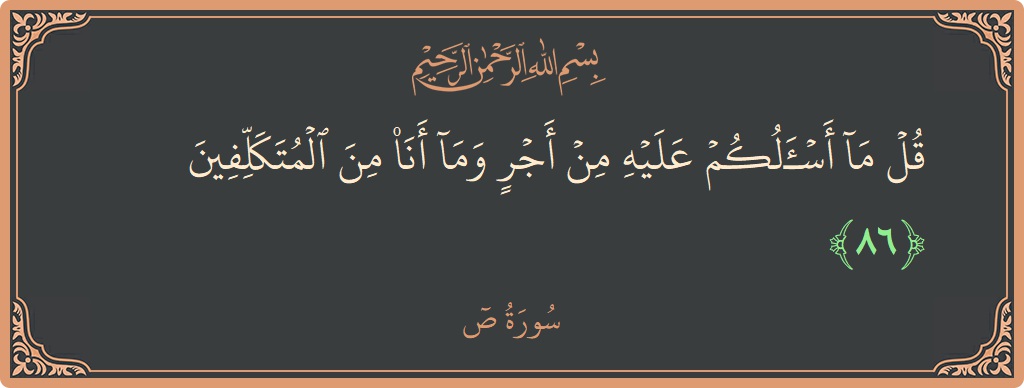
Surah Saad: Verse 86 - قل ما أسألكم عليه من... - English
Tafsir of Verse 86, Surah Saad
English Translation
Say, [O Muhammad], "I do not ask you for the Qur\'an any payment, and I am not of the pretentiousEnglish Transliteration
Qul ma asalukum AAalayhi min ajrin wama ana mina almutakallifeenaTafsir of Verse 86
In verse 86, it was said: وَمَا أَنَا مِنَ الْمُتَكَلِّفِينَ (nor am I from among those who make up things artificially.).
The blameworthiness of artificial behavior
The statement means: 'I am not declaring my prophethood artificially, nor am I falsely pretending to have knowledge and wisdom, rather, I am conveying the commandments of Allah to you as they are. From this we learn that feigned formality and pretension is blameworthy in the light of the Shari'ah. Accordingly, there are some ahadith that condemn it. In the Sahihayn (al-Bukhari and Muslim), it has been reported from Sayyidna ` Abdullah Ibn Masud ؓ :
"0 people, whoever from among you knows something, let him tell people about it. But, that which he does not know, let him simply say: وَاللہ سبحانہ و تعالیٰ اَعلَم (Allah knows best) (because) Allah Ta` a-la has said about his Rasul قُلْ مَا أَسْأَلُكُمْ عَلَيْهِ مِنْ أَجْرٍ وَمَا أَنَا مِنَ الْمُتَكَلِّفِينَ (Say,"I do not demand from you any fee for it, nor am I from among those who make up things artificially."- 38:86)." (Ruh-ul-Ma’ ani)
Alhamdulillah
The Commentary on
Surah Sad
(nor am I one of the Mutakallifin.) means, `and I do not add anything to that which Allah has told me. Whatever I am commanded to do, I do it, and I do not add anything or take anything away. By doing this I am seeking the Face of Allah and the Hereafter.' Sufyan Ath-Thawri, narrated from Al-A`mash and Mansur from Abu Ad-Duha that Masruq said, "We went to `Abdullah bin Mas`ud, may Allah be pleased with him. He said, `O people! Whoever knows a thing should say it, and whoever does not know should say, `Allah knows best."' It is part of knowledge, when one does not know, to say "Allah knows best." For Allah said to your Prophet :
(Say: "No wage do I ask of you for this, nor am I one of the Mutakallifin.") This was reported by Al-Bukhari and Muslim.
(It is only a Reminder for all the creatures.) means, the Qur'an is a reminder for all those who are held accountable, men and Jinn. This was the view of Ibn `Abbas, may Allah be pleased with him. This Ayah is like the Ayat:
(that I may therewith warn you and whomsoever it may reach) (6:19), and
(but those of the sects that reject it, the Fire will be their promised meeting place) (11:17).
(And you shall certainly know the truth of it) means, `you will see confirmation that what he says is true.'
(after a while.) means, soon. Qatadah said, "After death. `Ikrimah said, "It means, on the Day of Resurrection." There is no contradiction between the two views, because whoever dies comes under the rulings of the Day of Resurrection. This is the end of the Tafsir of Surah Sad. All praise and gratitude is due to Allah, and Allah may He be glorified and exalted, knows best.