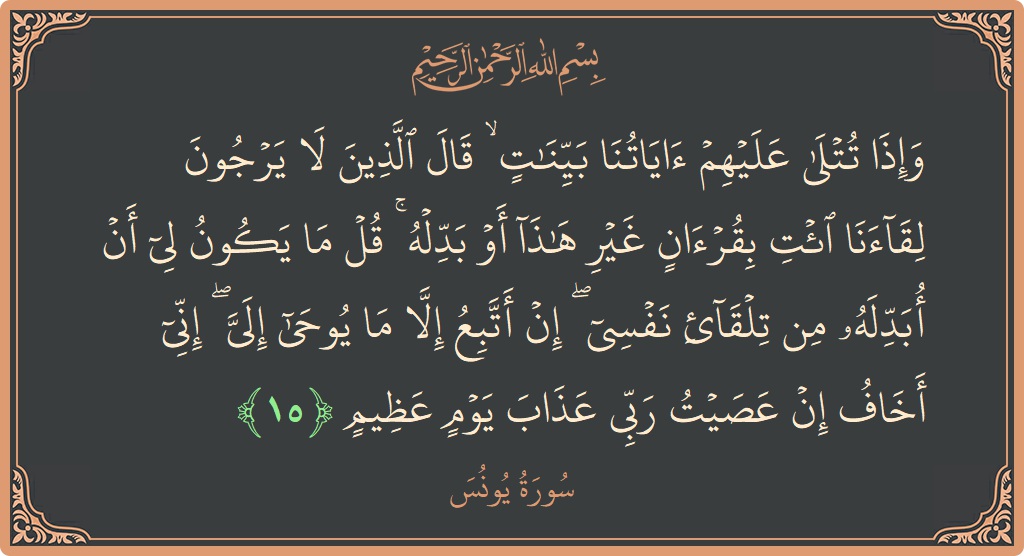
Surah Yunus: Verse 15 - وإذا تتلى عليهم آياتنا بينات... - English
Tafsir of Verse 15, Surah Yunus
English Translation
And when Our verses are recited to them as clear evidences, those who do not expect the meeting with Us say, "Bring us a Qur\'an other than this or change it." Say, [O Muhammad], "It is not for me to change it on my own accord. I only follow what is revealed to me. Indeed I fear, if I should disobey my Lord, the punishment of a tremendous Day."English Transliteration
Waitha tutla AAalayhim ayatuna bayyinatin qala allatheena la yarjoona liqaana iti biquranin ghayri hatha aw baddilhu qul ma yakoonu lee an obaddilahu min tilqai nafsee in attabiAAu illa ma yooha ilayya innee akhafu in AAasaytu rabbee AAathaba yawmin AAatheeminTafsir of Verse 15
In the last three verses (15-17), there is the refutation of a false notion entertained by the deniers of Akhirah and also the rejection of an inappropriate request made by them. They were a people who did not know much about God or Revelation or Prophets sent by Him. They took them to be like common human beings having nothing special about them. Think of the Holy Qur'an, which reached the world through the Prophet of Islam. Even this, they thought, was spoken and written by him. It was under this frame of mind that they told the Holy Prophet ﷺ ` as for this Qur'an, it is against our beliefs and ideas.' These idols our forefathers have been worshipping since ever as providers of their needs are, according to the Qur'an, totally false and ineffectual. There are things we have been using and transactions we have been making all along. The Qur'an says that they are all unlawful. And then, the Qur'an tells us that we have to live again after we are dead and that we have to account for everything we have done. All these things make no sense to us. We are not ready to accept them. Therefore, you do one of the two things we are asking you to do. Either you replace this one with another Qur'an which does not have these things, or at the least, amend this very Qur'an and expunge those (undesirable) things from there.'
Rejecting their false notion first, the Qur'an instructs the Holy Prophet a1JI to tell those people that the Qur'an was not his Word, nor could he change it on his own. He only followed what was revealed to him by Allah. If he were to make the least change in it on his own and by his choice, he would be committing a grave sin, and that he feared the punishment that falls upon those who disobey Allah, therefore, he could not do that.
Then he was asked to tell them that he did everything under Divine orders. Had it been the will of Allah Ta` ala that this Word should not be recited to them, neither would he have recited that to them, nor would He have let them know about that. Now that it was the very will of Allah Ta` ala that they should be made to listen to precisely that Word, who can dare make any addition or deletion therein?
Obstinance of the Chiefs of the Quraysh
Allah tells us about the obstinance of the disbelievers of the Quraysh, who were opposed to the message and denied Allah. When the Messenger read to them from the Book of Allah and His clear evidence they said to him: "Bring a Qur'an other than this." They wanted the Prophet to take back this Book and bring them another book of a different style or change it to a different form. So Allah said to His Prophet :
(Say: "It is not for me to change it on my own accord;) This means that it is not up to me to do such a thing. I am but a servant who receives commands. I am a Messenger conveying from Allah.
(I only follow that which is revealed unto me. Verily, I fear the torment of the Great Day (the Day of Resurrection) if I were to disobey my Lord.)
The Evidence of the Truthfulness of the Qur'an Muhammad then argued with supporting evidence to the truthfulness of what he had brought them:
(Say: "If Allah had so willed, I should not have recited it to you nor would He have made it known to you...") This indicates that he brought this only with the permission and will of Allah for him to do so. The proof of this was that he had not fabricated it himself and that they were incapable of refuting it, and that they should be fully aware of his truthfulness and honesty since he grew up among them, until Allah sent the Message to him. The Prophet was never criticized for anything or held in contempt. So he said,
(Verily, I have stayed among you a lifetime before this. Have you then no sense) Which meant "don't you have brains with which you may distinguish the truth from falsehood" When Heraclius, the Roman king, asked Abu Sufyan and those who were in his company about the Prophet , he said: "Have you ever accused him of telling lies before his claim" Abu Sufyan replied: "No." Abu Sufyan was then the head of the disbelievers and the leader of the idolators, but he still admitted the truth. This is a clear and irrefutable testimony since it came from the enemy. Heraclius then said: "I wondered how a person who does not tell a lie about others could ever tell a lie about Allah." Ja`far bin Abu Talib said to An-Najashi, the king of Ethiopia: "Allah has sent to us a Messenger that we know his truthfulness, ancestral lineage, and honesty. He stayed among us before the prophethood for forty years."