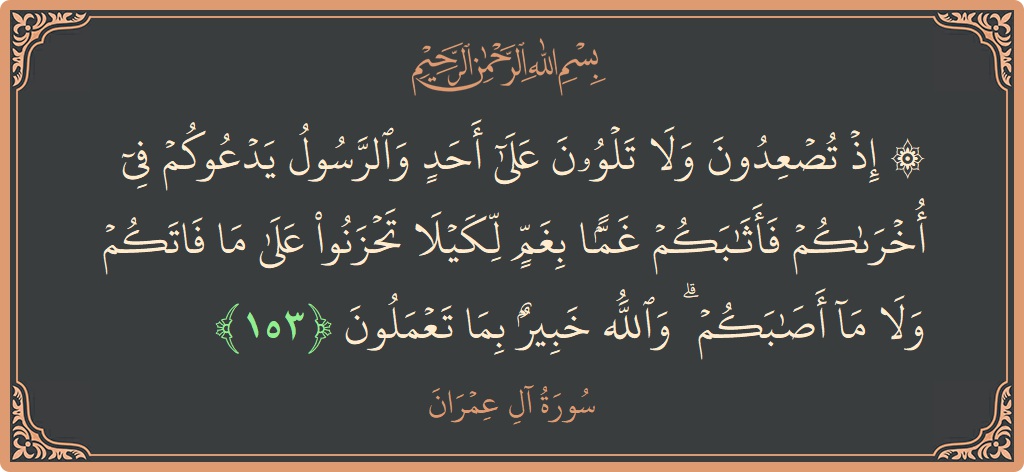
Surah Aal-i-Imraan: Verse 153 - ۞ إذ تصعدون ولا تلوون... - English
Tafsir of Verse 153, Surah Aal-i-Imraan
English Translation
[Remember] when you [fled and] climbed [the mountain] without looking aside at anyone while the Messenger was calling you from behind. So Allah repaid you with distress upon distress so you would not grieve for that which had escaped you [of victory and spoils of war] or [for] that which had befallen you [of injury and death]. And Allah is [fully] Acquainted with what you do.English Transliteration
Ith tusAAidoona wala talwoona AAala ahadin waalrrasoolu yadAAookum fee okhrakum faathabakum ghamman bighammin likayla tahzanoo AAala ma fatakum wala ma asabakum waAllahu khabeerun bima taAAmaloonaTafsir of Verse 153
These verses form part of the several previous verses relating to the battle of Uhud. The first verse here mentions the sorrows of the sahabah, the noble Companions ؓ of the Holy Prophet ﷺ . The long succeeding verse describes the antidote. The third verse reiterates that the form of defeat they faced was no punishment. It was a test to separate the true and sincere Muslims from the hypocrites. Finally comes the repeated proclamation that the mistake made by the noble Companions has been forgiven.
Commentary :
In the first verse here, the Holy Qur'an describes the exit of the Companions from the battlefield, their inability to come back even when called by the Holy Prophet in person, the consequent grief that afflicted him because of their conduct and, later on, the incidence of the Companions feeling sorry for the sorrow they brought on their master. According to hadith narrations, when Sayyidna Ka'b ibn Malik ؓ called out to them, Muslims heard his call and reassembled.
The author of Ruh al-Ma'ani resolves this by saying that the first call came from the Messenger of Allah himself which could not be heard by the Companions and they kept going the way they were going. That was the time when Sayyidna Ka'b ibn Malik ؓ called. Every-body heard him and reassembled.
In Bay-an al-Qur'an, Maulana Ashraf Thanavi (رح) has said that the real reason for this confusion was the news that the Holy Prophet ﷺ has fallen a martyr on the battlefield. When he called, there was obviously no refutation of the news with the call. Even if his voice can be taken to have reached the retreating Companions, the possibility remains that it was not recognized. Finally, when Sayyidna Ka'b ibn Malik ؓ called out, his call included a refutation of this news mentioning the fact that the Messenger of Allah ﷺ was alive. On hearing this, everybody took a sigh of relief and reassembled. As far as the displeasure of Allah and the sorrow of His Messenger ﷺ are concerned, these can be explained by saying - if they had stayed unagitated and firm, they could have recognized the calling voice.