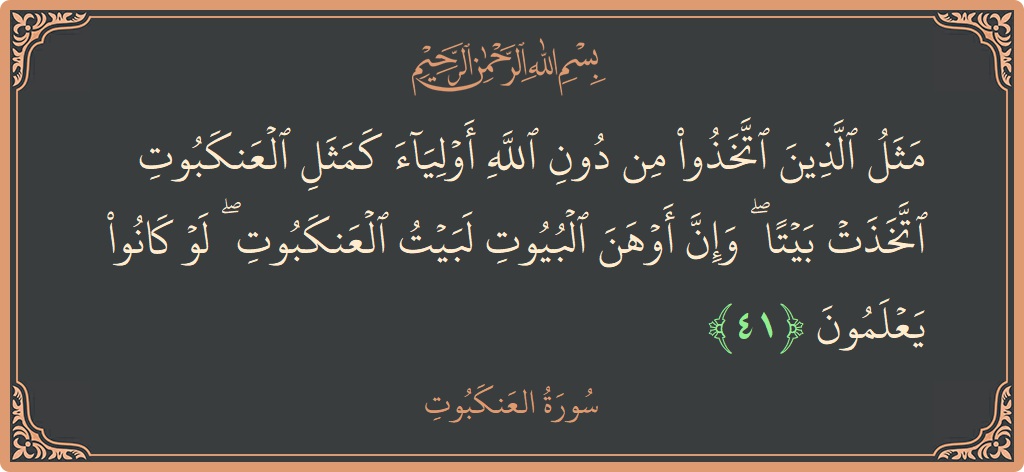
Surah Al-Ankaboot: Verse 41 - مثل الذين اتخذوا من دون... - English
Tafsir of Verse 41, Surah Al-Ankaboot
English Translation
The example of those who take allies other than Allah is like that of the spider who takes a home. And indeed, the weakest of homes is the home of the spider, if they only knew.English Transliteration
Mathalu allatheena ittakhathoo min dooni Allahi awliyaa kamathali alAAankabooti ittakhathat baytan wainna awhana albuyooti labaytu alAAankabooti law kanoo yaAAlamoonaTafsir of Verse 41
وَإِنَّ أَوْهَنَ الْبُيُوتِ لَبَيْتُ الْعَنكَبُوتِ (And surely the weakest of houses is the house of the spider - 29:41). ` Ankabut (عَنكَبُوتِ ) is the Arabic language equivalent for spider. There are different species of spiders. Some of them live underground. Apparently those are not meant here. Instead the specie of spider meant here is the one which weaves web for itself, and stays suspended in it. It attracts and kills flies in the cobweb. Among all the known types of nests, dens and other abodes of animals, the spider's web is the weakest. Even a mild breeze can break its threads. This verse has described those who worship and place their trust in any one other than Allah, are like the web of spider, which is extremely weak. The trust of those who depend on idols or any human is as weak and fragile as the trust of a spider on its web.
Ruling
Scholars have different viewpoints in the matter of killing of spiders and removing of cobwebs from the houses. Some do not like it, because at the time of hijrah the spider weaved its web at the mouth of the cave Thaur, and thus made a place of respect for itself. Khatib has reported that Sayyidna ` Ali ؓ had prohibited its killing. But Tha` labi and Ibn ` Atiyyah have quoted a narration, again from Sayyidna ` Ali رضی اللہ تعالیٰ عنہ that says طَھِّرُوا بُیُوتَکُم مِّن نَسجِ العَنکَبُوتِ فَاِنَّ ترکَہ، یُورثُ الفَقَر (Clean your homes from the web of the spider, because its retaining causes poverty.) The chain of the narrators of both these reports is not reliable, but the second narration draws credence from other narrations in which keeping of homes clean is stressed. (Ruh u1-Mani)
Likening the gods of the Idolators to the House of a Spider
This is how Allah described the idolators in their reverence of gods besides Him, hoping that they would help them and provide for them, and turning to them in times of difficulties. In this regard, they were like the house of a spider, which is so weak and frail, because by clinging to these gods they were like a person who holds on to a spider's web, who does not gain any benefit from that. If they knew this, they would not take any protectors besides Allah. This is unlike the Muslim believer, whose heart is devoted to Allah, yet he still does righteous deeds and follows the Laws of Allah, for he has grasped the most trustworthy handle that will never break because it is so strong and firm. Then Allah warns those who worship others besides Him and associate others with Him that He knows what they do and the rivals they associate with Him. He will punish them for their attribution, for He is All-Wise and All-Knowing. Then He says:
(And these are the examples We give for mankind; but none will understand them except those who have knowledge.) meaning, no one understands them or ponders them except those who are possessed of deep knowledge. Ibn Abi Hatim recorded that `Amr bin Murrah said, "I never came across an Ayah of the Book of Allah that I did not know, but it grieved me, because I heard that Allah says:
(And these are the examples We give for mankind; but none will understand them except those who have knowledge. )"