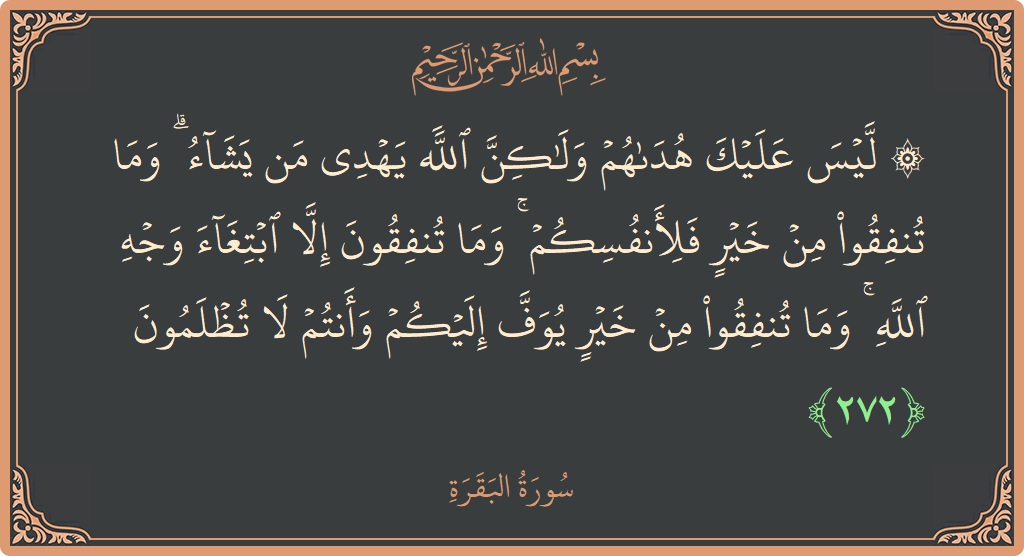
Surah Al-Baqara: Verse 272 - ۞ ليس عليك هداهم ولكن... - English
Tafsir of Verse 272, Surah Al-Baqara
English Translation
Not upon you, [O Muhammad], is [responsibility for] their guidance, but Allah guides whom He wills. And whatever good you [believers] spend is for yourselves, and you do not spend except seeking the countenance of Allah. And whatever you spend of good - it will be fully repaid to you, and you will not be wronged.English Transliteration
Laysa AAalayka hudahum walakinna Allaha yahdee man yashao wama tunfiqoo min khayrin falianfusikum wama tunfiqoona illa ibtighaa wajhi Allahi wama tunfiqoo min khayrin yuwaffa ilaykum waantum la tuthlamoonaTafsir of Verse 272
(6) Verse 272: لَّيْسَ عَلَيْكَ هُدَاهُمْ (الی قولہ) وَأَنتُمْ لَا تُظْلَمُونَ : "It is not for you to put them on the right path ... and you shall not be wronged."
It has been clarified in this verse that a صدقہ sadaqah given to a non-Muslim also carries a reward in the life to come. As the basic purpose of a Muslim in making a sadaqah صدقہ is to get that reward, he should not confine himself to giving it to the Muslims only and to avoid giving it to the poor non-Muslims in the hope that this attitude will persuade them towards Islam, because a Muslim is not charged with bringing non-Muslims to the right path. He should seek his own benefit (the reward in the Hereafter) which can also be achieved through giving sadaqah صدقہ to a non-Muslim.
Let us be clear at this point that sadaqah صدقہ referred to here is nafl نفل supererogatory or voluntary charity) which can be given to a dhimmi (a non-Muslim citizen of a Muslim state) as well. The obligatory زکاۃ Zakah is not meant here since it is not permissible to give that to anyone except a Muslim (Mazhari). It is not permissible to give any kind of sadaqah صدقہ to a harbi (a non-Muslim citizen of a non-Muslim state) and, however, it is permissible to give the dhimmis ذمیوں all other types of sadaqat, obligatory or supererogatory. زکاۃ Zakah is not included in the verse.
Giving Charity to Polytheists
Abu `Abdur-Rahman An-Nasa'i recorded that Ibn `Abbas said that they, "Disliked giving charity to their polytheist relatives, but were later on allowed to give it to them when they inquired about this matter, and this Ayah was revealed,
(Not upon you (Muhammad ) is their guidance, but Allah guides whom He wills. And whatever you spend in good, it is for yourselves, when you spend not except seeking Allah's Face. And whatever you spend in good, it will be repaid to you in full, and you shall not be wronged.)
Allah's statement,
(And whatever you spend in good, it is for yourselves) is similar to His other statement,
(Whosoever does righteous good deed, it is for (the benefit of) his ownself.)
There are many other similar Ayat in the Qur'an.
Allah said next,
(When you spend not except seeking Allah's Face. )
Al-Hasan Al-Basri commented, "Whenever the believer spends, including what he spends on himself, he seeks Allah's Face with it." `Ata' Al-Khurasani said that the Ayah means, "You give away charity for the sake of Allah. Therefore, you will not be asked about the deeds or wickedness of those who receive it." This is a sound meaning indicating that when one spends in charity for Allah's sake, then his reward will be with Allah. He will not be asked if the charity unintentionally reached righteous, evil, deserving or undeserving persons, for he will be rewarded for his good intention. The proof to this statement is the Ayah,
(And whatever you spend in good, it will be repaid to you in full, and you shall not be wronged.)
The Two Sahihs recorded a Hadith by Abu Hurayrah that the Messenger of Allah said,
(A man said, "Tonight, I shall give charity." He went out with his charity and (unknowingly) gave it to an adulteress. The next morning the people said that alms were given to an adulteress. The man said, "O Allah! All the praises are for You. (I gave my alms) to an adulteress. Tonight, I shall give alms again." He went out with his charity and (unknowingly) gave it to a rich person. The next morning (the people) said, "Last night, a wealthy person was given alms." He said, "O Allah! All the praises are for You. (I gave alms) to a wealthy man. Tonight, I shall again give charity." So he went out with his charity and (unknowingly) gave it to a thief. The next morning (the people) said, "Last night, a thief was given alms." He said, "O Allah! All the praises are for You. (I have given alms) to an adulteress, a wealthy man and a thief." Then, someone came to him and said, "The alms that you gave away were accepted. As for the adulteress, the alms might make her abstain from adultery. As for the wealthy man, it might make him take a lesson and spend his wealth that Allah has given him. As for the thief, it might make him abstain from stealing.")
Who Deserves Charity
Allah said,
((Charity is) for the poor, who in Allah's cause are restricted (from travel)) meaning, the migrants who migrated to Allah and His Messenger, resided in Al-Madinah and did not have resources that sufficiently provided them with their needs,
(And cannot Darban (move about) in the land) meaning, "They cannot travel in the land to seek means of livelihood." Allah said in other instances using a variation of the word Darban
(And when you (Muslims) travel in the land, there is no sin on you if you shorten the Salah (the prayer)) 4:101, and,
(He knows that there will be some among you sick, others traveling through the land, seeking of Allah's bounty, yet others fighting in Allah's cause) 73:20.
Allah then said,
(The one who knows them not, thinks that they are rich because of their modesty) meaning, those who do not know their situation think that they are well-off, because they are modest in their clothes and speech. There is a Hadith with this meaning that the Two Sahihs recorded from Abu Hurayrah that the Messenger of Allah said,
(The Miskin (needy) is not he who wanders about and whose need is sufficed by a date or two, a bite or two or a meal or two. Rather, the Miskin is he who neither has enough resources to sustain him, all the while people are unaware of his need so they do not give to him, nor does he ask people for anything.)
Imam Ahmad also recorded this Hadith from Ibn Mas`ud.
Allah's statement,
(You may know them by their mark) means, "Those who have good minds discover their situation," just as Allah said in other instances,
(The mark of them (i.e. of their faith) is on their faces) 48:29, and,
(But surely, you will know them by the tone of their speech!) 47:30. Allah's statement,
(they do not beg of people at all) means, they do not beg and, thus, do not require people to provide them with more than what they actually need. Indeed, those who ask people for help, while having what suffices for their needs, have begged.
Imam Ahmad recorded that Abu Sa`id said, "My mother sent me to the Messenger of Allah to ask him for help, but when I came by him I sat down. The Prophet faced me and said to me,
(Whoever felt satisfied, then Allah will enrich him. Whoever is modest, Allah will make him decent. Whoever is content, then Allah will suffice for him. Whoever asks people, while having a small amout, he will have begged the people.)
Abu Sa`id said, "I said to myself, `I have a camel, Al-Yaqutah, and indeed, it is worth more than a small amount.' And I went back without asking the Prophet for anything." This is the same wording for this Hadith collected by Abu Dawud and An-Nasa'i.
Allah's statement,
(And whatever you spend in good, surely Allah knows it well) indicates that no charity escapes Him, and He will reward it fully and perfectly on the Day of Resurrection, when it is most desperately needed.
Praise for those who Spend in Charity
Allah said,
(Those who spend their wealth (in Allah's cause) by night and day, in secret and in public, they shall have their reward with their Lord. On them shall be no fear, nor shall they grieve.)
This Ayah praises those who spend in charity for Allah's sake, seeking His pleasure, day and night, publicly and in secret, including what one spends on his family. The Two Sahihs recorded that the Messenger of Allah said to Sa`d bin Abi Waqqas:
(You will not spend charity with which you seek Allah's Face, but you will ascend a higher degree and status because of it, including what you put in your wife's mouth.)
Imam Ahmad recorded that Abu Mas`ud said that the Prophet said,
(When the Muslim spends on his family while awaiting the reward for it from Allah, it will be written as charity for him.)
Al-Bukhari and Muslim also recorded this Hadith.
Allah said,
(shall have their reward with their Lord), on the Day of Resurrection, as reward for what they spent in acts of obedience. We previously explained the Ayah,
(there shall be no fear on them nor shall they grieve.)